1870 G50C BG-921 (Regular Strike)
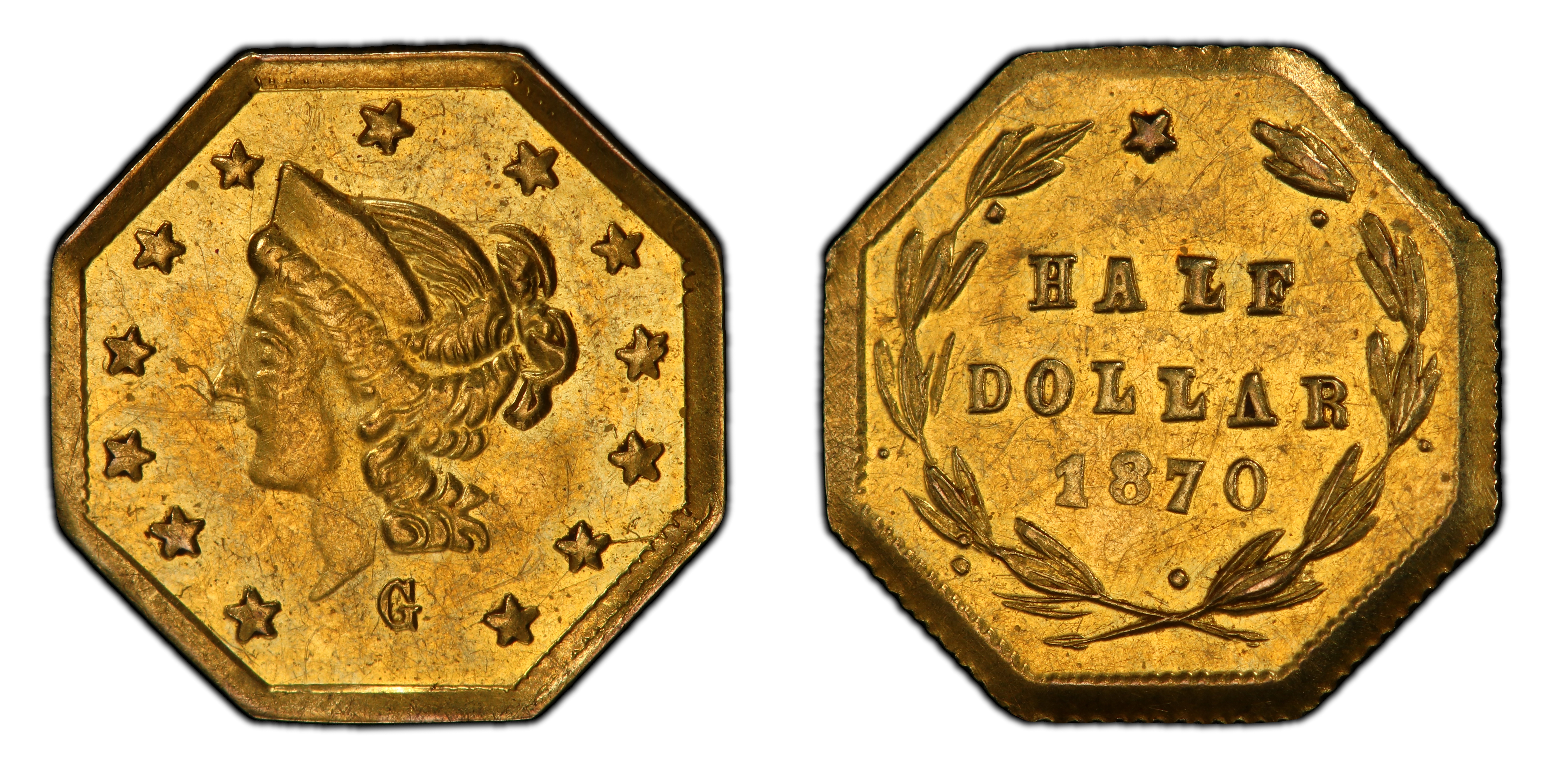
Obverse & Reverse
The 1870 G50C, cataloged as Breen-Gillio 921, is a quintessential example of a 'Period Two' California Fractional Gold piece. By 1870, the initial, desperate need for small circulating coinage that characterized the Gold Rush's peak in the early 1850s had largely subsided. The San Francisco Mint was in full operation, producing ample federal coinage for commerce. The continued production of these tiny, privately-issued gold pieces shifted from a primarily monetary function to that of a commercial novelty. They were created and sold by jewelers as souvenirs, keepsakes, and curiosities for tourists and locals enchanted by the romance of the Gold Rush. This period, from 1858 to 1882, is often termed the 'Jeweler's Issue' era. Unlike the earlier 'Period One' issues, which were struck with a pretense of conforming to federal weight standards, these later pieces were notoriously underweight for their stated value, containing far less than fifty cents worth of gold. The minter, Robert B. Gray & Co. of San Francisco, was a prolific producer during this time, having acquired the business and dies of another prominent jeweler, Antoine Nouizillet, around 1859. The BG-921 is a distinct product of Gray's own dies, though it notably lacks the 'G' mintmark often seen on his other issues. These pieces were typically manufactured using the 'hammer method,' where a planchet was placed on a bottom die and struck with a sledgehammer-wielded top die, resulting in frequent inconsistencies in strike quality. The passage of the Private Coinage Act of 1864 made such private issues illegal, but enforcement by the Secret Service was lax until the early 1880s, allowing firms like Robert B. Gray & Co. to continue their profitable enterprise. Today, the BG-921 is not just a relic of the Gold Rush, but a tangible link to the post-Rush period of romanticism and commercialization of the West.
Associated EventCalifornia Gold Rush (Later 'Jeweler's Issue' Period)
Reason For MintingPrimarily created to be sold as souvenirs and keepsakes rather than to fill a circulating coinage shortage.
Minter HistoryRobert B. Gray & Co. was a prominent San Francisco jewelry firm active in the production of California Fractional Gold from approximately 1859 to 1871. Gray entered the business by purchasing the operations of Antoine Louis Nouizillet, another key minter from the earlier period. Gray utilized both Nouizillet's old dies and created his own, some of which bear his initial 'G'. The firm's issues are characteristic of the 'Period Two' pieces, which were lighter in weight and intended more as novelties than as circulating currency. The business was eventually sold to the California Jewelry Co. in 1871.
Historical SignificanceThis coin represents the evolution of fractional gold from a necessity of commerce to a souvenir item. Its existence highlights the lasting cultural and economic impact of the Gold Rush, demonstrating how private enterprise adapted to monetize the legend of the West long after the initial fever had passed.
BG-921
Denomination50 Cents
Minting Period1870
Assayer/MinterRobert B. Gray & Co.
Geographic OriginSan Francisco, California
Obverse DescriptionA classic Liberty Head motif facing left, surrounded by 13 six-pointed stars. The portrait is in the style of the federal gold coinage of the era, though often rendered with less refinement. The date, 1870, is positioned below the bust.
Obverse Inscription1870
Reverse DescriptionThe central inscription 'HALF DOLLAR' is enclosed within a wreath composed of two branches tied with a bow at the bottom. This variety is notable for the absence of 'CAL.' (for California) on the reverse, a departure from many other fractional gold designs.
Reverse InscriptionHALF DOLLAR
CompositionGold
Stated Fineness Actual FinenessVariable, typically lower than federal standards for the period.
EdgePlain
Unknown
Survival EstimateFewer than 75; likely in the 35-50 range based on combined NGC and PCGS population reports plus an estimate for raw examples.
Rarity ScaleR-5 (Low R-6 in some catalogs)
The BG-921 is sought after for its specific Breen-Gillio variety, its octagonal shape, and its connection to the well-documented minter Robert B. Gray & Co. As a 'Period Two' issue, it is more accessible than its 'Period One' counterparts, making it a popular entry point for collectors specializing in the extensive fractional gold series.
Key VarietiesThe primary variety is the regular business strike of BG-921 itself. There are no major sub-varieties, patterns, or official restrikes known for this specific die marriage. The collector should focus on die states; early strikes may show sharper details and more prooflike surfaces from polished dies, while later strikes can exhibit die fatigue and softness.
Authentication TipsAuthentic BG-921 examples often exhibit a characteristically weak or uneven strike, particularly on the highest points of Liberty's hair and the leaves in the wreath. Counterfeits are often sharply struck and have a 'modern' feel. Look for the proper denomination 'HALF DOLLAR' without 'CAL' on the reverse. The surfaces of genuine pieces, even high-grade ones, may show fine die polishing lines or microscopic planchet striations. Replicas are often made of brass or gilt base metal and will have an incorrect weight and specific gravity. Third-party grading is highly recommended for this series due to the prevalence of counterfeits and replicas.
Shopping ConsiderationsA premium quality example of BG-921 will exhibit a bold strike for the issue, with clear definition in Liberty's hair and the individual leaves of the wreath. Many survivors are found in About Uncirculated (AU) or low Mint State (MS) grades. Look for lustrous, original surfaces that have not been cleaned or polished; a soft, satiny glow is ideal. Deeply prooflike (DPL) or prooflike (PL) examples command significant premiums and are prized for their eye appeal. Avoid pieces that are bent, holed, or have been mounted in jewelry, as was common. Pay close attention to the sharpness of the date, as the '18' is a known area of weakness.
A coin's grade is its condition, rated on a 1-70 scale. For rare coins, this is the most critical factor in determining value, as a tiny difference in preservation can mean a huge difference in price.
Relevant Grade TypesOriginal period issues of BG-921 were business strikes, although many were sold as souvenirs and never circulated. They are found in Circulated grades (AG-3 to AU-58) and, more commonly for this issue, Mint State (MS-60 to MS-70) grades. No official Proofs were struck during the original minting period. However, due to the use of polished dies, some business strikes exhibit Prooflike (PL) or Deep Prooflike (DPL) characteristics, which are surface designations noted by grading services and are highly desirable.
Mint State CharacteristicsAn uncirculated BG-921 is defined by its luster. Typical examples have a soft, satiny luster, but exceptional pieces can be highly reflective. Strike quality is a major factor; most are weakly struck, especially on the date (the '18' is often faint) and Liberty's neck. A coin with a bold strike throughout is a rarity and commands a premium. Due to being stored with other small trinkets, even high-grade specimens may have tiny, scattered contact marks that do not break the luster.
Circulated Wear PatternsOn circulated examples, wear first appears on the highest points: Liberty's hair above the eye and ear, and the cheekbone. On the reverse, the high points of the wreath's leaves and the bow will show flattening. In lower grades (VF and below), the stars will begin to lose their points and merge with the fields, and the finer details of the wreath will become indistinct.
Key Factors For ValueThe primary drivers of value for a BG-921 are grade and surface quality. An example with original, uncleaned surfaces and strong luster will always be worth more than a cleaned or dull counterpart of the same grade. Strike sharpness is the next key factor; a well-struck coin is far more desirable than a typically soft one. Eye appeal, including attractive original gold toning and prooflike surfaces, adds a significant premium. A CAC sticker for this issue confirms premium quality for the grade and often results in a higher market value.
PCGS Price Guide
| Grade | Price | Population |
|---|---|---|
| 50 | $200.00 | 1 |
| 50+ | $205.00 | N/A |
| 53 | $210.00 | 3 |
| 53+ | $215.00 | N/A |
| 55 | $220.00 | 8 |
| 55+ | $225.00 | N/A |
| 58 | $240.00 | 8 |
| 58+ | $265.00 | N/A |
| 60 | $300.00 | 2 |
| 61 | $375.00 | 5 |
| 62 | $575.00 | 19 |
| 62+ | $700.00 | N/A |
| 63 | $1,000.00 | 5 |
| 63+ | $1,150.00 | N/A |
| 64 | $1,500.00 | N/A |
| 66 | N/A | N/A |