1871 G50C BG-924, PL (Regular Strike)
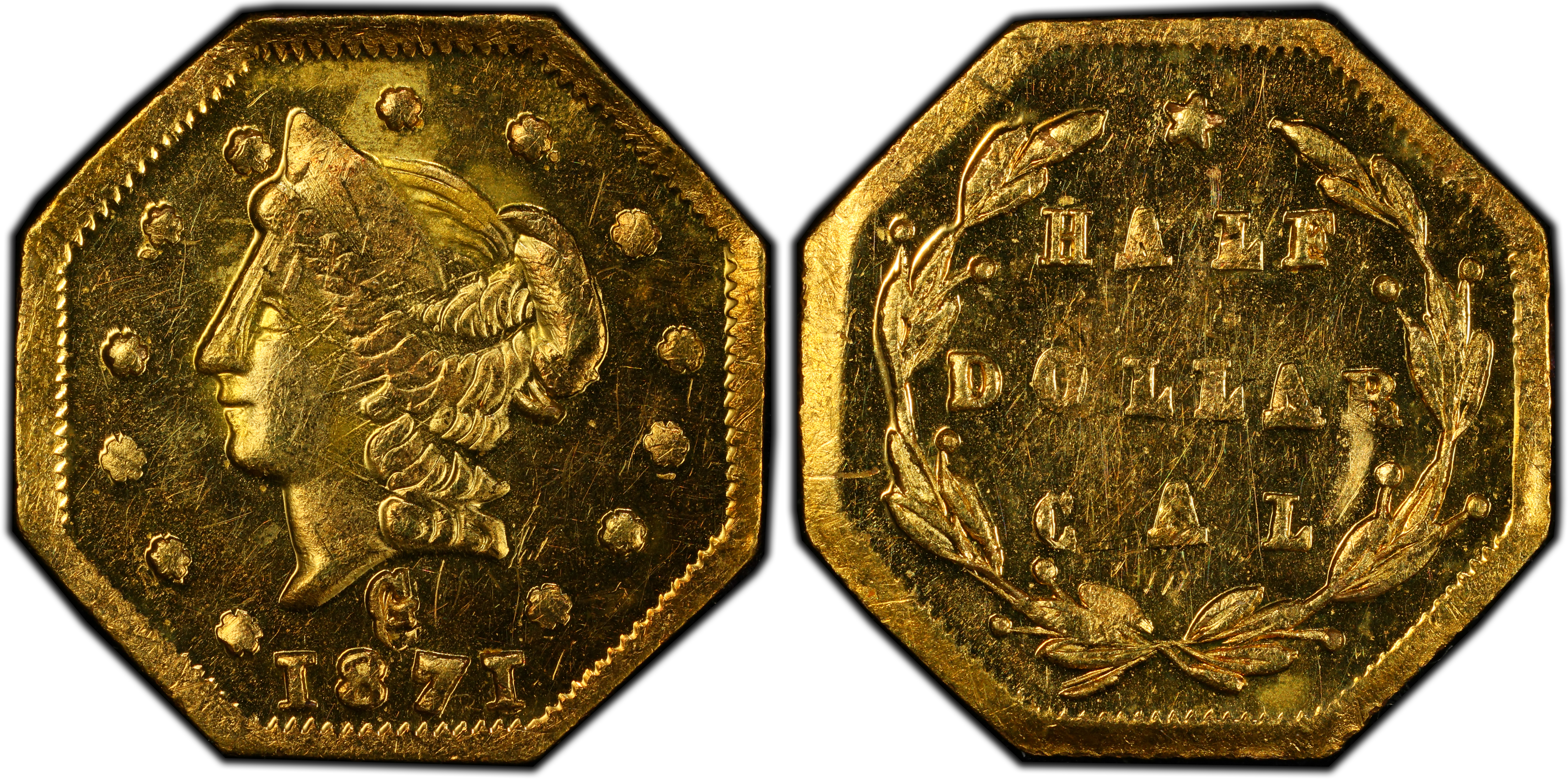
Obverse & Reverse
The 1871 BG-924 50 Cents piece emerges from the second great era of California Fractional Gold production, a period distinct from the initial utilitarian issues of the early Gold Rush. By the 1870s, the acute shortage of small change that had plagued California in the early 1850s had been largely resolved by the output of the San Francisco Mint. The raison d'être for fractional gold had shifted. These small, privately struck gold pieces were no longer essential for commerce but had transformed into popular souvenirs, keepsakes, and jeweler's items. They catered to a public fascinated by the romance of the Gold Rush and the allure of gold itself. San Francisco, now a bustling metropolis, was a center for skilled jewelers and private minters who recognized this new market. One such firm was Robert B. Gray & Co. They, like other 'Period Two' minters, produced these octagonal and round tokens with intricate, miniature designs that mimicked federal coinage but were often lighter and of a slightly lower fineness than their stated value would imply. The Coinage Act of 1864 had technically made such private issues illegal, but enforcement by the Secret Service was lax in California until the early 1880s. This legal gray area allowed for a flourishing trade in these denominated 'jeweler's issues.' The BG-924, with its crisp Liberty Head design and octagonal shape, is a quintessential example of this period. It was not intended for gruelling daily circulation but rather to be purchased as a memento of a visit to the Golden State, a small piece of bullion to be tucked away. The quality of strike and finish, including prooflike examples, suggests a production process aimed at creating objects of beauty rather than mere utility. Their survival in high grades today is a testament to their original purpose as treasured objects rather than workhorse coins.
Associated EventPost-Gold Rush California Economic Expansion
Reason For MintingPrimarily created to serve the growing market for souvenirs and curiosities related to the California Gold Rush.
Minter HistoryRobert B. Gray & Co. was a San Francisco-based firm of jewelers and engravers active in the post-Gold Rush era. Like many of their contemporaries, they leveraged their skills in metalworking to produce a variety of items, including the popular small-denomination gold tokens. The 'G' mintmark seen below the bust on the obverse of BG-924 is the identifier for this maker. These 'Period Two' producers focused on creating attractive, well-made pieces for the souvenir market, often with designs derivative of official U.S. Mint coinage.
Historical SignificanceThis piece is significant not as a coin that facilitated commerce, but as a tangible artifact of how the California Gold Rush was memorialized and commercialized. It represents the transition of fractional gold from a necessity of a remote, specie-starved economy to a nostalgic keepsake, reflecting a maturing California that was beginning to market its own history.
N/A
Denomination50 Cents
Minting Period1871
Assayer/MinterRobert B. Gray & Co.
Geographic OriginSan Francisco, California
Obverse DescriptionA head of Liberty facing left, her hair tied in a bun, wearing a coronet inscribed with 'LIBERTY'. She is surrounded by thirteen stars representing the original colonies. Below the truncation of the neck is the maker's mark 'G'.
Obverse InscriptionLIBERTY
Reverse DescriptionThe denomination '1/2' is centered within a wreath composed of two branches tied with a ribbon at the bottom. The legend 'CALIFORNIA GOLD' encircles the wreath, separated by a star at the top center. The date '1871' is positioned below the ribbon.
Reverse InscriptionCALIFORNIA GOLD / 1/2 / 1871
CompositionGold
Stated Fineness Actual FinenessVariable, generally lower than .900
Weight0.25 grams
Diameter10.00 mm
EdgePlain
Unknown
Survival Estimate200-300
Rarity ScaleR-3
The BG-924 is popular with collectors due to its classic Liberty Head design, attractive octagonal shape, and its status as a representative 'Period Two' issue. Its relative affordability compared to rarer Period One types makes it an accessible entry point into the series. Examples with prooflike surfaces command a significant premium and are highly sought after for their aesthetic appeal.
Key VarietiesNo major varieties are noted for the BG-924 business strike from the original minting period. As these were produced as jeweler's issues, some examples were struck with special care on polished planchets, resulting in Prooflike (PL) or Deep Mirror Prooflike (DMPL) surfaces. These are not true Proofs in the U.S. Mint sense but are distinct manufacturing variants that carry a premium. No later-date restrikes are known.
Authentication TipsGenuine pieces exhibit a sharp, well-defined strike, especially on the stars and letters. The 'G' mintmark should be clear and match known exemplars. Counterfeits are common and may be cast, showing a porous or soft texture. They may also be underweight or made of brass with gold plating. Pay close attention to the style of the numerals in the date and the wreath details, as these are often poorly replicated on fakes. A key diagnostic for Die State I shows a faint, thin initial 'G' visible inside and to the right of the primary 'G' on the obverse.
Shopping ConsiderationsA premium quality example of BG-924 will possess a sharp strike with full details on Liberty's hair and the leaves of the wreath. Seek out pieces with clean, original surfaces that have not been harshly cleaned or polished, which would strip away the delicate original skin and luster. Prooflike examples are particularly desirable; look for deep, clear reflectivity in the fields. Common problems include rim bumps, scratches from improper handling (due to their small size), and loss of detail from circulation, although most survivors are in higher grades.
A coin's grade is its condition, rated on a 1-70 scale. For rare coins, this is the most critical factor in determining value, as a tiny difference in preservation can mean a huge difference in price.
Relevant Grade TypesOriginal issues of BG-924 were business strikes, although produced with greater care than earlier commercial issues. They are found in both Circulated (1-58) and Mint State (MS, 60-70) grades. Due to their status as souvenirs, a large proportion of the surviving population is Uncirculated. No true Proof (PR/PF) examples were struck in the manner of the U.S. Mint. However, specimens struck on highly polished planchets are designated as Prooflike (PL) or Deep Mirror Prooflike (DMPL) by grading services and are considered a distinct and more valuable category than standard business strikes.
Mint State CharacteristicsAn uncirculated BG-924 is defined by the presence of original mint luster, which can range from satiny to deeply reflective (prooflike). The strike is typically sharp, though minor weakness on the highest points of Liberty's hair or the wreath is not uncommon. Because they were made by jewelers and not handled roughly in circulation, contact marks can be minimal, but their small size made them susceptible to scratches or nicks from being kept with other items. High-grade examples are expected to be largely free of distracting marks.
Circulated Wear PatternsOn circulated examples, wear first appears on the high points of the design. For the obverse, this includes Liberty's cheek, the hair above the ear, and the coronet. On the reverse, the highest points of the wreath's leaves and the bow of the ribbon will show the first signs of friction and flattening. In lower grades, the stars and lettering will begin to merge with the fields.
Key Factors For ValueThe primary driver of value is the grade and surface quality. An example with original, lustrous surfaces will always be worth more than a cleaned or polished one of the same grade. Strike sharpness is critical; a fully struck piece with all details present is highly desirable. Eye appeal, including any attractive toning and the depth of reflectivity on PL examples, adds a significant premium. A CAC sticker, indicating premium quality for the grade, is highly valued by discerning collectors for this series.
PCGS Price Guide
| Grade | Price | Population |
|---|---|---|
| 62 | $475.00 | 1 |
| 62+ | $525.00 | N/A |
| 63 | $600.00 | N/A |
| 63+ | $675.00 | N/A |
| 64 | $850.00 | 1 |
| 64+ | $950.00 | N/A |
| 65 | $1,350.00 | N/A |
| 65+ | $1,750.00 | N/A |
| 66 | $2,750.00 | N/A |