1870 G25C BG-835 (Regular Strike)
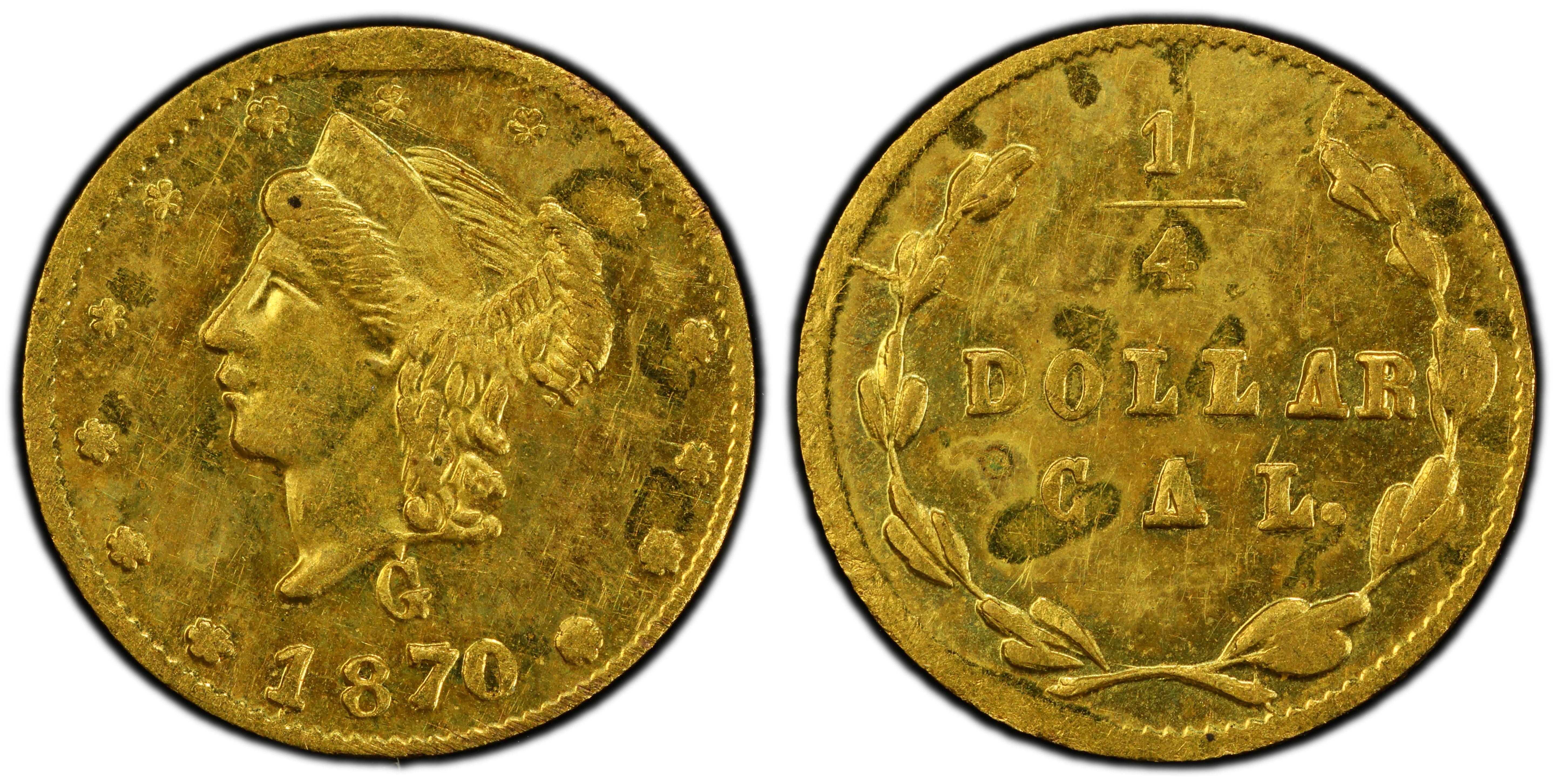
Obverse & Reverse
The 1870 G25C BG-835 is a product of the fascinating and complex period of California Fractional Gold. Following the initial Gold Rush boom, the smallest denomination coin in regular federal circulation was the silver three-cent piece, with the silver half dime and dime being too valuable for small, everyday transactions. The constant presence of gold dust as a medium of exchange created a persistent need for a more convenient, standardized small-denomination currency. Private jewelers and minters in San Francisco and across Northern California stepped in to fill this void, producing miniature gold coins in 25 cent, 50 cent, and dollar denominations from 1852 until federal legislation in 1882 curtailed the practice. These 'coins' were technically tokens, often containing gold value slightly less than their face value, but their utility made them indispensable in local commerce for decades. The period from 1858 to 1882 is often called the 'Jeweler's Period,' characterized by more refined and artistic designs compared to the crude early issues. The BG-835, with its detailed Indian Head obverse, is a prime example of this later period's craftsmanship. These pieces were not official U.S. Mint products and their production was a gray area legally. An 1864 law prohibited private coinage, but it was not strictly enforced against these small-denomination tokens until a final act in 1882 effectively ended their production. The 1870 G25C BG-835 circulated widely in its time, used for everything from buying a newspaper to paying for a drink. Today, they are cherished by numismatists as tangible links to the post-Gold Rush economy of California, representing a unique solution to a regional currency problem.
Associated EventCalifornia Gold Rush Aftermath / 'Jeweler's Period' of Private Coinage
Reason For MintingA severe shortage of small-denomination coinage for everyday transactions in California prompted private minting of fractional gold tokens.
Minter HistoryThe specific minter for BG-835 is not definitively known, a common trait for many California Fractional Gold pieces. However, numismatic scholarship, particularly the work of Robert D. Leonard, Jr., and research into die states and punches, often links this and similar varieties to the workshop of Robert B. Gray & Co. of San Francisco. Gray was a prolific producer of these tokens during the 'Jeweler's Period.' These minters were typically skilled jewelers and engravers who saw a commercial opportunity. They operated outside the federal system, creating their own dies and striking planchets, often from gold sourced directly from the California mines.
Historical SignificanceThis coin is significant as an artifact of a unique period in American monetary history where private enterprise filled a circulation void left by the federal government. It demonstrates the persistent economic effects of the Gold Rush and the ingenuity of local businesses in a developing economy. The entire series of California Fractional Gold represents the longest-running and most successful private currency system in U.S. history.
N/A
DenominationG25C (Gold 25 Cents)
Minting Period1870
Assayer/MinterUnknown, possibly Robert B. Gray & Co.
Geographic OriginSan Francisco, California
Obverse DescriptionA well-defined depiction of a Liberty head facing left, adorned with a feathered headdress. The portrait is often referred to as an 'Indian Head.' Thirteen stars encircle the portrait within a beaded border.
Obverse Inscription[None, only stars and portrait]
Reverse DescriptionThe denomination '1/4' is centered within a wreath of leaves and berries. The date '1870' is positioned below the wreath, just inside the beaded border. The 'G' for 'Gold' is located below the fraction bar.
Reverse Inscription1/4 / G / 1870
CompositionGold
Stated Fineness Actual FinenessVaries, typically between .500 and .600 fine (12-14 karat gold).
Weight0.25 grams
Diameter9.80 mm
EdgePlain
Unknown
Survival Estimate500-750
Rarity ScaleR-4 (Scarce)
The BG-835 is highly popular due to its classic 'Indian Head' design, its status as a dated type coin, and its relative affordability compared to rarer varieties. It serves as an excellent entry point into the complex and fascinating world of California Fractional Gold, offering a genuine piece of Gold Rush-era history.
Key VarietiesThe primary variety is the regular business strike (BG-835). Proof strikings are known to exist but are exceedingly rare (categorized as BG-835P). These Proofs are distinguished by their sharp strikes, mirrored fields, and squared-off rims. They were not intended for circulation but were made for collectors or as presentation pieces. No other major die varieties from the original minting period are widely recognized for BG-835.
Authentication TipsGenuine examples have a sharp, well-defined strike, particularly on the feathers and facial features. The 'G' on the reverse should be clear and properly formed. Counterfeits, often made of brass or gilded base metal, will feel lighter and have a soapy, indistinct appearance. The stars on the obverse should be individually distinct. Many fakes have mushy details and may have incorrect weight or dimensions. Compare any potential purchase against high-resolution images from reputable auction archives.
Shopping ConsiderationsA premium quality example for its grade will possess a bold strike with full details on the headdress feathers and Liberty's hair. Look for clean surfaces with minimal distracting contact marks. Original, undisturbed luster is paramount; coins that have been cleaned or polished will appear unnaturally bright and should be avoided. Attractive, original reddish-gold or orange-peel toning adds significantly to eye appeal. Check for evidence of past mounting in jewelry, such as rim damage or solder marks, which drastically reduces value.
A coin's grade is its condition, rated on a 1-70 scale. For rare coins, this is the most critical factor in determining value, as a tiny difference in preservation can mean a huge difference in price.
Relevant Grade TypesOriginal period issues were business strikes intended for circulation, and are found in Circulated (1-58) and Mint State (MS, 60-70) grades. While extremely rare Proof (PR/PF) examples were struck for this variety during the period, they are numismatically distinct and collected as separate items. No later-date restrikes are known to exist for this specific variety.
Mint State CharacteristicsUncirculated examples of BG-835 typically exhibit a soft, satiny luster rather than a hard, frosty one. The strike is often sharp on the central devices but can show some weakness on the peripheral stars and beads. Due to the small size and minting process, even Mint State examples may have minor planchet flaws or adjustment marks. Light, scattered contact marks are common and must be evaluated to determine the specific MS grade (e.g., MS-62 vs. MS-64).
Circulated Wear PatternsWear first appears on the highest points of the design: the cheekbone of the Indian Head, the eyebrow, and the details in the feathers. On the reverse, the highest points of the wreath and the numbers in the fraction '1/4' will show initial friction. In lower grades (VG and below), the stars will begin to merge with the fields, and the date and denomination become faint.
Key Factors For ValueFor the BG-835, the primary value drivers are grade and surface quality. An example with original, uncleaned surfaces and strong luster will command a significant premium over a cleaned or polished piece of the same technical grade. The sharpness of the strike is crucial; well-struck examples with full feather and hair detail are highly sought after. Eye appeal, driven by attractive original toning and a lack of distracting marks, plays a major role. A sticker from CAC (Certified Acceptance Corporation) indicates a premium quality coin for the grade and will often result in a higher market price.
PCGS Price Guide
| Grade | Price | Population |
|---|---|---|
| 45 | $185.00 | 4 |
| 45+ | $190.00 | N/A |
| 50 | $200.00 | 12 |
| 50+ | $210.00 | N/A |
| 53 | $220.00 | 12 |
| 53+ | $230.00 | N/A |
| 55 | $240.00 | 26 |
| 55+ | $255.00 | N/A |
| 58 | $265.00 | 50 |
| 58+ | $280.00 | N/A |
| 60 | $300.00 | 11 |
| 61 | $325.00 | 30 |
| 62 | $350.00 | 75 |
| 62+ | $400.00 | N/A |
| 63 | $450.00 | 20 |
| 63+ | $525.00 | N/A |
| 64 | $700.00 | 11 |
| 64+ | $850.00 | N/A |
| 65 | $1,000.00 | N/A |
| 65+ | N/A | N/A |