1874/3 G50C BG-943 (Regular Strike)
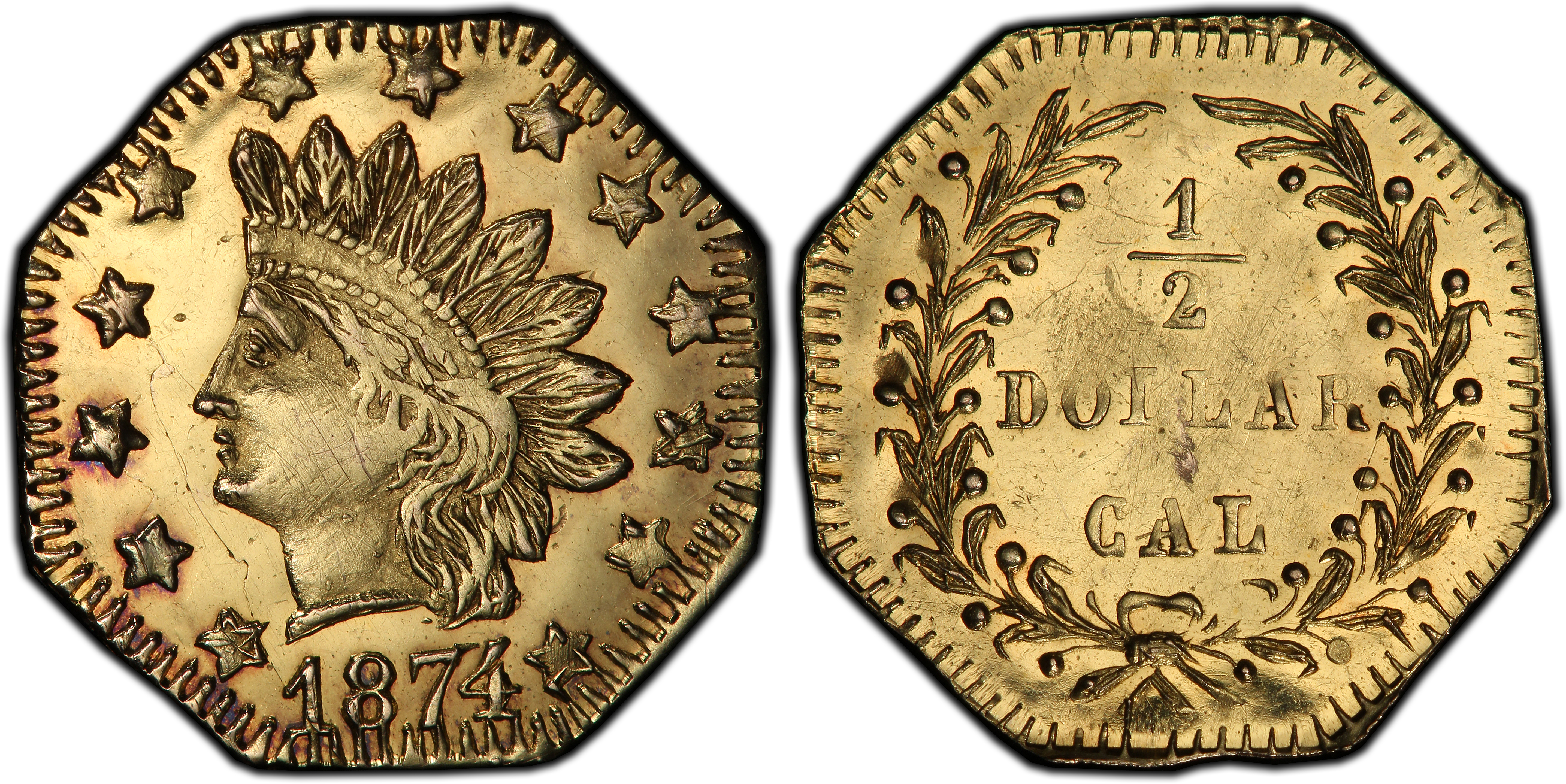
Obverse & Reverse
The 1874/3 BG-943 50 Cents is a quintessential example of a 'Period Two' California Fractional Gold piece. The story of these fascinating miniature coins begins with the profound societal and economic upheaval of the California Gold Rush. The initial influx of gold dust and nuggets after 1848 created immense wealth but also a severe shortage of circulating small-denomination coinage for daily commerce. Simple transactions became cumbersome, often settled with a 'pinch' of gold dust, an inaccurate and contentious method. To fill this void, private minters, many of whom were jewelers with metallurgical skills, began striking coins from native California gold starting in 1852. These 'Period One' (1852-1857) issues were generally well-regarded and circulated actively. However, the Coinage Act of April 22, 1864, officially made private coinage illegal. This legislation, coupled with the establishment of the San Francisco Mint, should have ended the practice. Yet, the law was not aggressively enforced until 1883. This legal gray area gave rise to the 'Period Two' issues (1859-1882), to which the BG-943 belongs. These later pieces were not primarily intended to alleviate a coinage shortage but were instead produced as souvenirs and curios for tourists and collectors. Struck by anonymous jewelers in San Francisco, they were often intentionally backdated to years before the 1864 Act to feign legality. They contained less gold than their stated face value, functioning more as high-quality tokens than true coinage. The 1874/3 BG-943 is a product of this era, a memento of the Gold Rush's romantic legacy, crafted for a public fascinated with the 'Wild West.' The use of an overdate, punching a 4 over a 3 in the die, was likely a measure of economy by the jeweler, who reused an older, obsolete die. These tiny octagonal pieces represent the final chapter of private gold coinage in California, a transition from utilitarian necessity to commercial nostalgia.
Associated EventCalifornia Gold Rush Aftermath
Reason For MintingPrimarily created as a souvenir or collectible token for the tourist trade in post-Gold Rush San Francisco, not to fill a circulating coinage need.
Minter HistoryThe specific minter of the BG-943 variety is unknown, a common trait for Period Two 'jeweler's issues.' After the 1864 Coinage Act, producers of fractional gold often operated anonymously to avoid legal scrutiny. They were typically skilled craftsmen, likely based in San Francisco, who had the equipment to create dies and strike small gold pieces. Unlike Period One assayers who often hallmarked their work, these jewelers produced a wide variety of designs, often mimicking federal coinage styles like the Indian Princess Head, to appeal to a commercial market for keepsakes of the now-legendary Gold Rush.
Historical SignificanceThe BG-943, like other Period Two issues, marks the evolution of private coinage from a vital economic necessity to a nostalgic commodity. It demonstrates the enduring legacy of the Gold Rush and the entrepreneurial spirit of California's jewelers who adapted their craft to a changing legal and economic landscape. It serves as a physical artifact of America's burgeoning tourism industry and the public's fascination with the nation's westward expansion.
N/A
Denomination50 Cents
Minting Period1874
Assayer/MinterUnknown Jeweler
Geographic OriginSan Francisco, California
Obverse DescriptionThe obverse features a rendition of the Indian Princess head, facing left. The portrait is stylized, with somewhat crude features characteristic of jeweler's issues. Thirteen stars encircle the portrait, representing the original thirteen colonies. The date, '1874', is positioned below the bust. A clear '4' is punched over a '3', making this an overdate variety.
Obverse Inscription1874
Reverse DescriptionThe reverse displays the denomination '1/2' and the word 'DOLLAR' within a continuous wreath of leaves and berries. A small bow is present at the bottom of the wreath where the stems meet. The coin has a distinctive octagonal shape.
Reverse Inscription1/2 DOLLAR
CompositionGold
Stated Fineness Actual FinenessVariable, typically 14 to 21 karats for Period Two issues.
Weight0.25 grams
Diameter10.00 mm
EdgePlain
Unknown
Survival Estimate75-125
Rarity ScaleR-4 (Scarce)
This coin is highly sought after due to its status as a clear overdate (1874/3), a feature that appeals to variety collectors. Its octagonal shape and Indian Princess design are classic elements of the popular California Fractional Gold series. As a Period Two issue, it represents the fascinating 'souvenir' era of this unique coinage.
Key VarietiesThe primary variety is the 1874/3 overdate itself. There are no known major variations or special collector restrikes for the BG-943 die pair from the original minting period. All known examples are considered business strikes, though their original purpose was for sale to collectors and tourists rather than for general circulation.
Authentication TipsThe key diagnostic is the clear repunching of the 4 over the 3 in the date; the top of the 3 is visible within the upper loop of the 4. Genuine examples exhibit a specific die state, with characteristic crudeness in the engraving of the portrait and lettering that sophisticated modern fakes often lack. The gold should have a natural, slightly alloyed color, not the brassy look of gold-plated counterfeits. Many modern replicas exist and are often undenominated or bear fantasy designs; referencing the Breen-Gillio guide is essential for authentication.
Shopping ConsiderationsA premium quality example for its grade will show a bold overdate and a sharp strike, especially on the high points of Liberty's hair and the details of the reverse wreath. The tiny size makes these coins susceptible to damage and loss of detail, so well-struck, problem-free specimens command significant premiums. Look for original, undisturbed surfaces with some remaining luster. Avoid examples that have been harshly cleaned, which will appear unnaturally bright and show hairline scratches. Also be wary of coins that have been mounted in jewelry, checking the rims carefully for evidence of soldering or removal.
A coin's grade is its condition, rated on a 1-70 scale. For rare coins, this is the most critical factor in determining value, as a tiny difference in preservation can mean a huge difference in price.
Relevant Grade TypesOriginal examples of BG-943 were business strikes, produced for commercial sale as souvenirs. They are found in Circulated grades (AU-58 and below) and, more commonly, in Mint State (MS, 60-70) grades, as many were saved as keepsakes. No proofs were struck during the original period of issue, and there are no known later-date collector restrikes for this specific variety.
Mint State CharacteristicsIn uncirculated condition, the BG-943 typically exhibits a soft, satiny luster rather than a deeply prooflike or frosty one. The strike can be uneven due to the crude hammer-striking process used by jewelers; it is common to see some weakness on the stars opposite the portrait's highest points. The key overdate feature should be sharp. Because the gold is relatively soft, even high-grade Mint State examples will often show tiny planchet flaws or contact marks from handling and storage over the decades.
Circulated Wear PatternsWear first appears on the highest points of the design: the cheek and the details in the hair above the eye on the obverse. On the reverse, the leaves in the wreath and the fractional numbers '1/2' will show the first signs of friction. On lower-grade circulated examples, the date and stars will begin to lose their sharpness, and the rims will appear rounded.
Key Factors For ValueThe primary value driver for an 1874/3 BG-943 is its grade and surface quality. A sharply struck coin with minimal contact marks and pleasing, original luster will always be worth more than a comparable grade with inferior eye appeal. The clarity and boldness of the 4-over-3 overdate is a critical factor; a clear and dramatic overdate adds a significant premium. Coins with original, untouched 'skin' are highly prized over those that have been cleaned or polished. A CAC sticker for this issue indicates superior quality for the grade and will result in a substantial price premium.
PCGS Price Guide
| Grade | Price | Population |
|---|---|---|
| 55 | $310.00 | 3 |
| 55+ | $320.00 | N/A |
| 58 | $330.00 | 3 |
| 58+ | $350.00 | N/A |
| 60 | $375.00 | N/A |
| 61 | $425.00 | 7 |
| 62 | $500.00 | 11 |
| 62+ | $550.00 | N/A |
| 63 | $600.00 | 12 |
| 63+ | $650.00 | N/A |
| 64 | $725.00 | 13 |
| 64+ | $850.00 | N/A |
| 65 | $1,150.00 | 3 |
| 65+ | $1,500.00 | N/A |
| 66 | $2,250.00 | N/A |