1856 G50C BG-307, PL (Regular Strike)
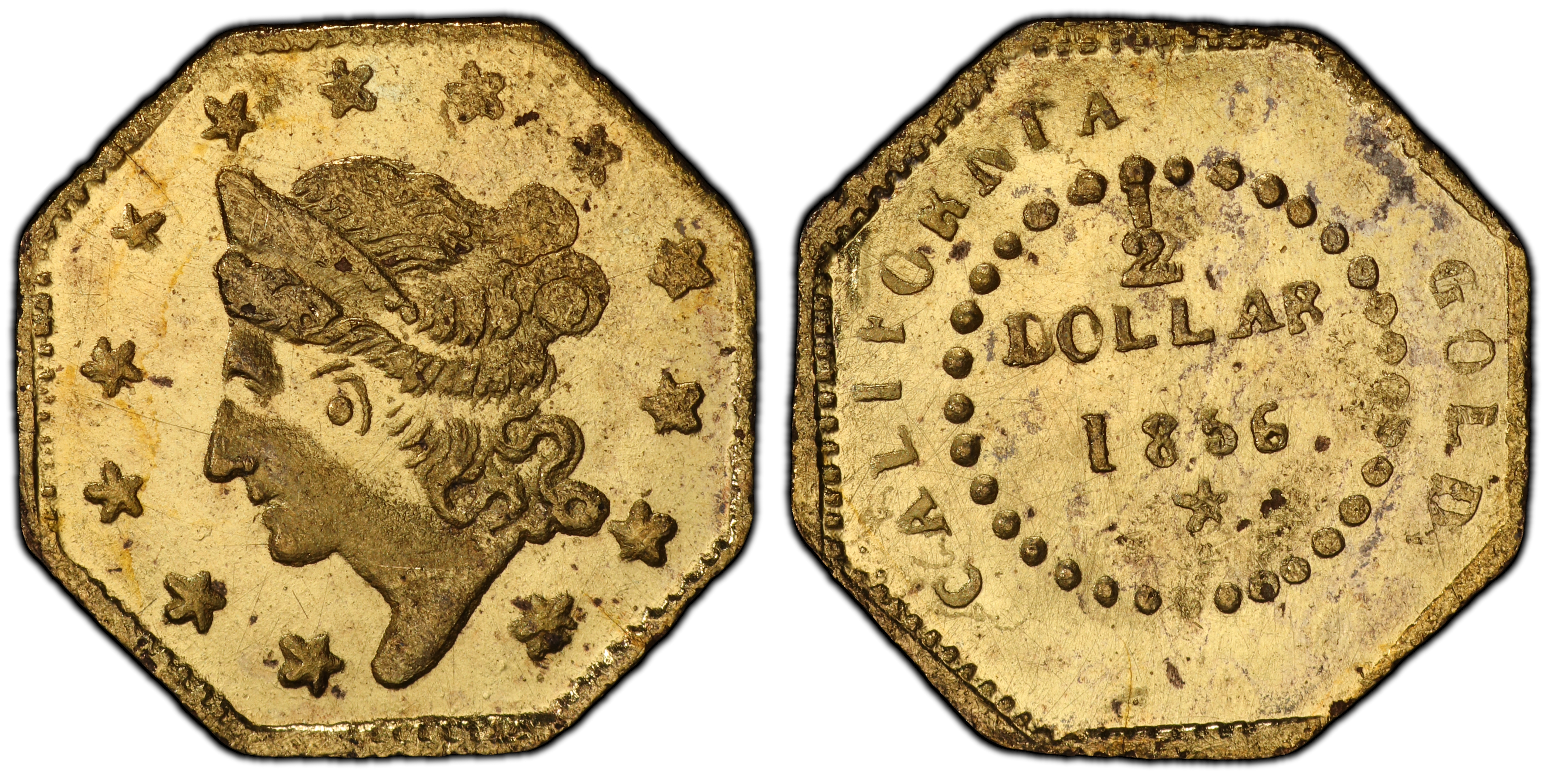
Obverse & Reverse
The 1856 octagonal 50-cent piece, cataloged as Breen-Gillio 307, is a quintessential artifact from the first phase of private coinage in Gold Rush California. Following the discovery of gold in 1848, a massive influx of prospectors and merchants created a vibrant but chaotic economy. Gold dust and large-denomination private coins handled major transactions, but a severe, chronic shortage of small change plagued daily commerce. Common foreign silver coins circulated at inconsistent values, and bartering with gold dust was imprecise and fraught with peril. Into this monetary vacuum stepped jewelers and metalworkers, many of French origin, who began minting small, denominated gold coins in 25-cent, 50-cent, and one-dollar values starting in 1852. These 'Period One' issues, including the BG-307, were struck with the genuine intent of serving as a circulating medium. Their production by firms like Frontier, Deviercy & Co. represented a bold entrepreneurial solution to a failure of federal government infrastructure, as the San Francisco Mint, which opened in 1854, initially focused on larger coins and could not meet the regional demand for fractional currency. These tiny gold pieces were crudely manufactured, typically by the hammer method, where dies were struck by hand. This resulted in significant variations in strike quality. While intended for circulation, their minuscule size made them easy to lose, and their intrinsic value was often less than their face value, leading to their eventual rejection for widespread commercial use. By late 1856 and 1857, with increased federal coinage available, the initial need for these fractional pieces waned. They quickly transitioned from being instruments of commerce to popular souvenirs of the California adventure, easily sent back East in letters. The BG-307 stands as a testament to this brief, dynamic period of private enterprise and monetary necessity on the American frontier.
Associated EventCalifornia Gold Rush
Reason For MintingTo alleviate a severe shortage of small-denomination circulating coinage for daily commerce in Gold Rush-era San Francisco.
Minter HistoryPierre Frontier and Eugene Deviercy were San Francisco-based French jewelers active in the private minting business from approximately 1852 to 1856. Their firm, Frontier, Deviercy & Co., was one of the more prominent producers of 'Period One' California fractional gold. Their issues are often identified by the initials 'F.D.' on some varieties, though not all. Like other private minters of the era, they operated in a legal gray area, creating a necessary product that the federal government was not yet supplying to the isolated California economy. Their workmanship was typical for the time, utilizing hand-cut dies and manual hammer striking, which resulted in coins with a charming, if somewhat crude, appearance. Their operations ceased around the time the initial commercial need for fractional gold subsided.
Historical SignificanceThe BG-307 is a tangible link to the chaotic, commerce-driven reality of the California Gold Rush. It represents a period of private, localized solutions to economic problems before the full integration of federal authority. As a 'Period One' issue, it is considered a genuine circulating coin rather than a later souvenir token, making it highly significant to collectors of territorial and private gold coinage.
BG-307
Denomination50 Cents (G50C)
Minting Period1856
Assayer/MinterFrontier, Deviercy & Co.
Geographic OriginSan Francisco, California
Obverse DescriptionA fairly crude depiction of the head of Liberty, facing left, with a coronet or tiara in her hair. She is surrounded by thirteen six-pointed stars, typically unevenly spaced. The date '1856' appears below the bust.
Obverse Inscription1856
Reverse DescriptionThe central design element is the key diagnostic for the variety: a circle of beads surrounds the denomination '50 CENTS'. This is distinct from the more common wreath motif seen on other varieties. A star is present below the denomination within the beaded circle. Outside the circle is the inscription 'CALIFORNIA GOLD'. The denomination 'CENTS' is reportedly from a double-punched die.
Reverse InscriptionCALIFORNIA GOLD / 50 CENTS
CompositionGold
Stated Fineness Actual FinenessVaries, typically between .800 and .900, often containing a natural silver alloy from native California gold.
Weight0.85 grams
Diameter11.00 mm
EdgePlain
Unknown; very low
Survival EstimateFewer than 75 known
Rarity ScaleHigh R-5 (31-75 known)
This variety is highly sought after due to its 'Period One' status, its extreme rarity, and its unique reverse design featuring a beaded circle instead of the common wreath. It appeals to specialists in California gold and collectors of U.S. territorial coinage who value historical significance and rarity.
Key VarietiesThe primary issue is the business strike of BG-307. There are no known major varieties from the original minting period, nor are there any known special collector issues, patterns, or official later-date restrikes associated with this specific Breen-Gillio number. Variations in strike weakness and die state are common due to the crude manufacturing process but are not considered distinct varieties.
Authentication TipsAuthenticity is paramount. Key diagnostics for a genuine BG-307 include the unique reverse with a beaded circle, not a wreath. Look for evidence of a double-punched 'CENTS'. The style of the Liberty head and stars should match known genuine examples; they are often crudely engraved. Many counterfeits and modern replicas exist. These often have a soapy, cast-like appearance, incorrect weight, or design details (like the font or star shapes) that are too sharp and modern. Genuine pieces often have planchet imperfections and strike irregularities consistent with mid-19th century hammer striking. Verification by a major grading service (PCGS or NGC) is strongly recommended.
Shopping ConsiderationsFor a 'premium quality' BG-307, seek an example with a bold strike, especially on the central Liberty head and the reverse denomination. Due to the manufacturing process, many are weakly struck, particularly at the peripheries where the 'CALIFORNIA GOLD' legend can be faint. A coin with minimal contact marks and some remaining original luster (often described as 'prooflike' or 'PL' if exceptionally reflective) commands a significant premium. Avoid examples that have been harshly cleaned, which strips the original surface, or those that show evidence of being used as jewelry (solder marks, tooling, heavy rim damage). Given the rarity, even problem-free circulated examples in grades like VF or XF are highly desirable. Eye appeal is critical; an even, attractive color adds to the value.
A coin's grade is its condition, rated on a 1-70 scale. For rare coins, this is the most critical factor in determining value, as a tiny difference in preservation can mean a huge difference in price.
Relevant Grade TypesAll original BG-307 coins are business strikes intended for circulation and are found in Circulated (1-58) and Mint State (MS, 60-70) grades. No proofs were struck during the original period of issue. While some fractional gold pieces exhibit reflective, prooflike (PL) surfaces from being struck with polished dies, these are a characteristic of the strike, not a separate proof issue. No later-date proof restrikes of this specific variety are known to exist.
Mint State CharacteristicsAn uncirculated BG-307 is exceptionally rare. Quality is defined by the strength of the strike; a fully struck central device (Liberty's hair and facial features) and clear peripheral legends are highly unusual and prized. Luster is typically satiny to semi-prooflike. Due to the softness of the gold and the crude production, even Mint State examples will often exhibit some minor planchet flaws, laminations, or light adjustment marks made before striking. Contact marks, even small ones, can have a significant impact on the grade.
Circulated Wear PatternsWear first appears on the highest points of the design. On the obverse, this includes Liberty's cheek, the hair above her ear, and the coronet. On the reverse, the high points of the beaded circle and the letters in 'CENTS' will show the first signs of friction. In lower grades (Fine and below), the stars on the obverse will begin to merge with the fields, and the date can become weak or illegible.
Key Factors For ValueRarity is the primary driver of value. For a given grade, value is determined by surface quality and eye appeal. A specimen with original, uncleaned surfaces and a pleasing, reddish-gold or apricot-gold patina is far more desirable than a cleaned or discolored piece. The sharpness of the strike is crucial; coins with bold central details and clear legends command strong premiums. The absence of distracting marks or planchet flaws is also key. For this series, a CAC sticker indicating premium quality for the grade will add a significant premium, as it confirms both authenticity and superior eye appeal.
PCGS Price Guide
| Grade | Price | Population |
|---|---|---|
| 62 | N/A | N/A |
| 63 | $2,150.00 | 4 |
| 63+ | $2,750.00 | N/A |
| 64 | $6,000.00 | N/A |
| 64+ | $6,750.00 | 1 |
| 65 | $12,000.00 | 1 |
| 65+ | $13,500.00 | 1 |
| 66 | $17,500.00 | 1 |