1863 G25C BG-820 (Regular Strike)
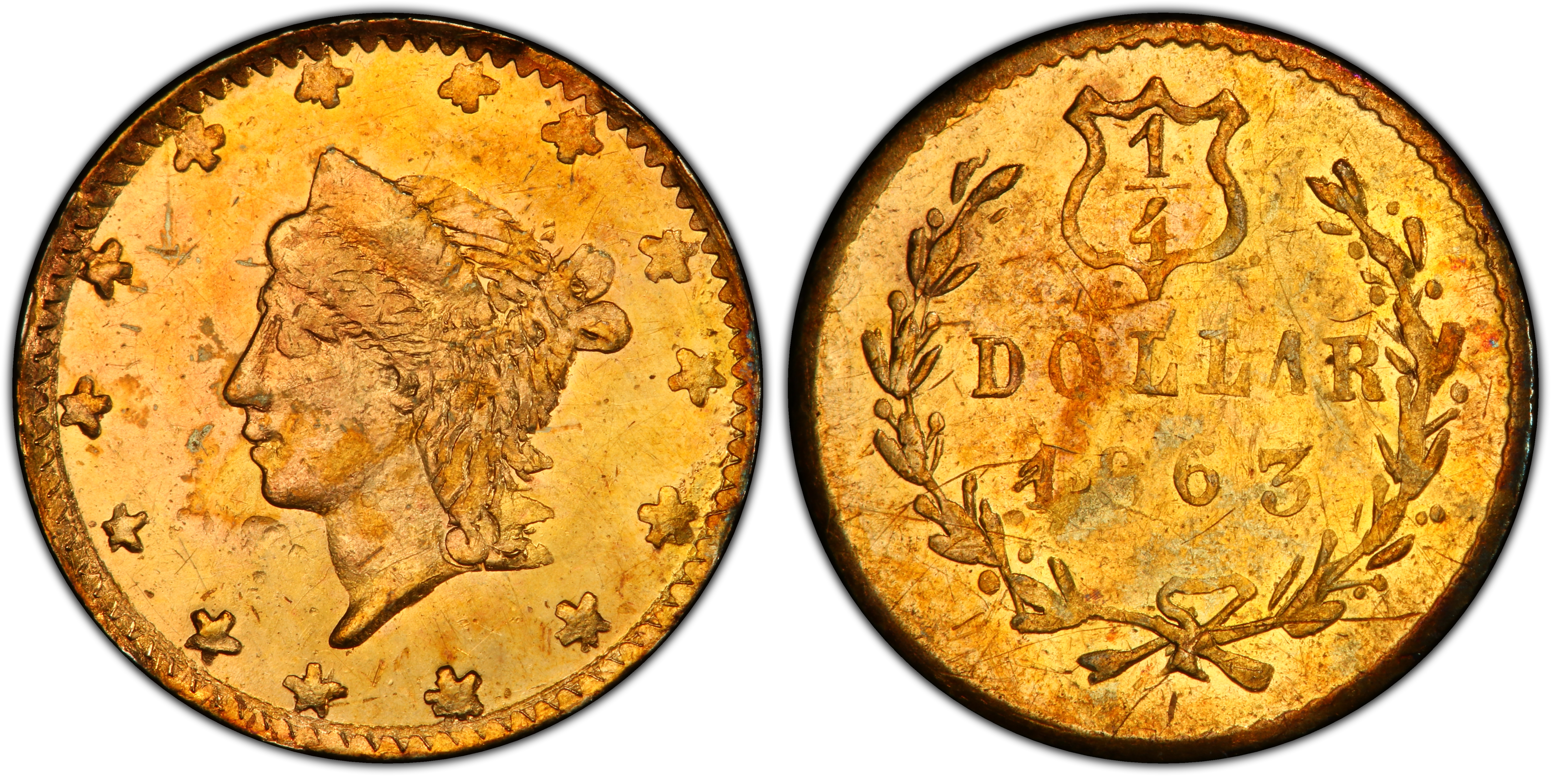
Obverse & Reverse
The 1863 BG-820 25-cent piece emerges from the second phase of California's fascinating fractional gold series. The initial impetus for these tiny coins, beginning in 1852, was a direct response to the severe shortage of small-denomination coinage that plagued the California economy during the Gold Rush. With federally-issued silver coins being hoarded or exported, conducting daily business was difficult, and private jewelers and metalworkers stepped in to fill the void. These first issues, now known as 'Period One' (1852-1857), were functional and intended for commerce. However, by 1863, the context had shifted. The San Francisco Mint was in full operation, and the most acute need for small change had subsided. The 'Period Two' issues (1858-1882), to which the BG-820 belongs, were struck primarily as souvenirs and novelty items for tourists, merchants, and those wishing to send a small, glittering piece of the Golden State back East. Robert B. Gray & Co., a prominent San Francisco jeweler who had acquired the business of an earlier minter, Antoine Nouzillet, was a key producer during this era. His pieces are noted by numismatists for their relatively high quality and weight compared to other contemporary jeweler's issues. The BG-820 was produced by the 'hammer method,' where a gold planchet was struck between two dies using a sledgehammer. This manual process resulted in significant variability in strike quality, centering, and overall appearance from one coin to the next. While no longer essential for circulation, these pieces still held a nominal value and reflected the lingering spirit of the Gold Rush. The year 1863 places this coin's creation during the height of the American Civil War, a time when gold held particular importance. The very next year, the Coinage Act of 1864 would officially prohibit all private coinage, though the law was not strictly enforced against these small souvenir pieces until 1883, allowing their production to continue for nearly two more decades. The BG-820 is therefore a tangible link to a transitional period in California's numismatic history, evolving from a coin of necessity to a cherished memento of a transformative era.
Associated EventCalifornia Gold Rush aftermath and American Civil War
Reason For MintingPrimarily struck as a souvenir or keepsake of the California Gold Rush era, rather than to alleviate a coinage shortage which defined the earlier 'Period One' issues.
Minter HistoryRobert B. Gray & Co. was a San Francisco-based manufacturing jeweler active during the 'Period Two' era of fractional gold production. In late 1858 or 1859, Gray purchased the business of Antoine Louis Nouzillet, another fractional gold producer, acquiring his dies and equipment. Gray continued to use some of Nouzillet's old dies before creating new ones, often bearing his own hallmark, a letter 'G'. His firm produced a wide variety of 25-cent, 50-cent, and dollar-denominated pieces. According to research by Breen and Gillio, Gray's issues are generally considered to be of higher weight and intrinsic value than many other jeweler's issues of the period. The firm ceased its fractional gold operations around 1871.
Historical SignificanceThe BG-820 is a classic example of a 'Period Two' California Fractional Gold piece, significant for representing the evolution of these coins from utilitarian currency to commercial souvenirs. It showcases the continued private production of gold coinage even as federal issues became more available and reflects the enduring romanticism of the Gold Rush.
N/A
Denomination25 Cents
Minting Period1863
Assayer/MinterRobert B. Gray & Co.
Geographic OriginSan Francisco, California
Obverse DescriptionA small Liberty Head facing left, modeled after the contemporary federal gold coinage. The portrait is surrounded by thirteen six-pointed stars, with the date '1863' positioned below the truncation of the neck.
Obverse Inscription1863
Reverse DescriptionA simple shield, bisected by a horizontal line, is centered. The denomination '25 CENTS' is inscribed within the shield, with '25' above the line and 'CENTS' below. There is no surrounding wreath or legend.
Reverse Inscription25 CENTS
CompositionGold
Stated Fineness Actual FinenessVariable, though Robert B. Gray's issues are generally considered to be of higher gold content than many other 'Period Two' pieces, often in the 14-22 karat range.
Weight0.25 grams
Diameter9.80 mm
EdgePlain
Unknown
Survival Estimate31-75 coins known.
Rarity ScaleR-5
This variety appeals to collectors due to its direct connection to the famous California Gold Rush era, its status as a privately-issued gold coin, and its relative scarcity. The BG-820, as a product of the known jeweler Robert B. Gray, offers a specific historical touchpoint within the vast and popular series of California Fractional Gold.
Key VarietiesThe primary variety is the regular strike. However, an extremely rare and desirable variety exists where a BG-820 die was used to overstrike a previously struck 1860/50 BG-819 quarter. This overstrike error is a significant rarity within the series. No original proof strikings are known, as these were utilitarian or souvenir items. Any piece described as a 'restrike' would be a modern creation with no numismatic value.
Authentication TipsAuthentication requires die characteristic matching to known genuine examples cataloged by Breen-Gillio (BG). The BG-820 has specific die markers in the placement of the stars, date, and reverse shield. Many modern replicas and fantasy pieces exist; genuine pieces will have the correct denomination style ('25 CENTS' on a shield) and will not have inscriptions like 'CALIFORNIA GOLD' or a bear on the reverse, which are common on modern tokens. The weight and diameter should be close to the established norms. Genuine pieces often have a soft, slightly crude appearance consistent with being hammer-struck, unlike the sharp, uniform look of modern machine-made copies.
Shopping ConsiderationsA premium quality example for its grade will exhibit a bold, well-centered strike, which is uncommon given the hammer-striking process. Look for sharpness in Liberty's hair details and the numerals of the date. Surfaces should be free of distracting marks, cleaning, or tooling. Original, uncleaned surfaces with a hint of reddish-gold or mellow orange toning are highly desirable and command significant premiums. Some examples are found with prooflike or semi-prooflike fields, which adds to their eye appeal. Be wary of pieces with evidence of being previously mounted in jewelry, such as rim damage or solder marks, which are common problems for this series.
A coin's grade is its condition, rated on a 1-70 scale. For rare coins, this is the most critical factor in determining value, as a tiny difference in preservation can mean a huge difference in price.
Relevant Grade TypesOriginal period issues were business strikes. Though intended as souvenirs rather than for heavy circulation, they are found in both Circulated (1-58) and Mint State (MS, 60-70) grades. No true Proofs were struck during the original minting period. The term 'Prooflike' (PL) may be applied to business strikes that have exceptionally reflective, mirror-like surfaces from polished dies, but these are not a separate striking method.
Mint State CharacteristicsAn uncirculated BG-820 is defined by the absence of wear and the presence of original mint luster. The quality of this luster can range from satiny to semi-prooflike. The strike is a key determinant of quality; many are weakly struck on the high points of Liberty's hair and the stars due to the nature of hammer striking. A well-struck MS example with full details is rare and highly valued. Small planchet flaws or adjustment marks are not uncommon and should be evaluated for their impact on eye appeal.
Circulated Wear PatternsWear first appears on the highest points of the design. On the obverse, look for flattening on the hair above Liberty's eye and on the cheek. The stars will also show early signs of wear on their points. On the reverse, the edges of the shield and the numerals will be the first elements to show abrasion and lose their sharpness. In lower grades (VG and below), the date and legends will become weak and may be partially illegible.
Key Factors For ValueFor the BG-820, value is driven by a combination of grade and eye appeal. A sharply struck coin will always be prized over a weakly struck example of the same grade. Surface quality is paramount; an example with clean, original surfaces and attractive toning is worth significantly more than a cleaned, scratched, or otherwise damaged coin. The presence of prooflike fields increases desirability. Finally, certification by a top-tier grading service (PCGS or NGC) is essential for market acceptance, and a CAC sticker indicating premium quality for the grade will add a substantial premium.
PCGS Price Guide
| Grade | Price | Population |
|---|---|---|
| 30 | $190.00 | 1 |
| 35 | $200.00 | 1 |
| 40 | $215.00 | N/A |
| 45 | $235.00 | 1 |
| 45+ | $250.00 | N/A |
| 50 | $265.00 | 4 |
| 50+ | $270.00 | N/A |
| 53 | $275.00 | 2 |
| 53+ | $280.00 | N/A |
| 55 | $290.00 | 6 |
| 55+ | $295.00 | N/A |
| 58 | $310.00 | 6 |
| 58+ | $325.00 | N/A |
| 60 | $350.00 | 2 |
| 61 | $375.00 | 1 |
| 62 | $475.00 | 10 |
| 62+ | $575.00 | N/A |
| 63 | $650.00 | 5 |