1876 G25C BG-850 (Regular Strike)
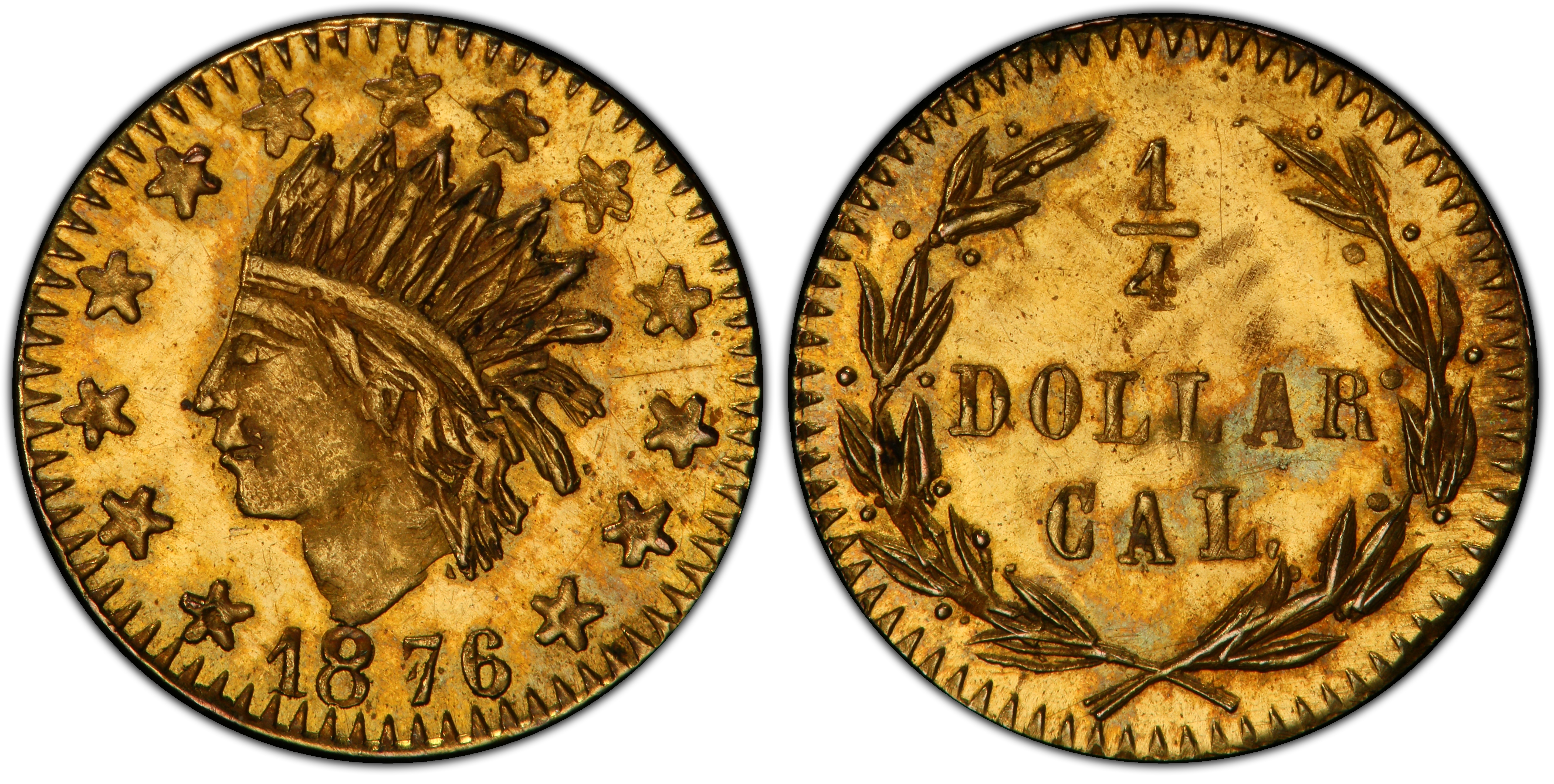
Obverse & Reverse
The 1876 BG-850 25 Cent piece belongs to the second major phase of California Fractional Gold production, known to numismatists as 'Period Two' (1858-1882). Unlike the earlier 'Period One' issues, which were struck out of a genuine commercial need to alleviate a severe shortage of small change during the initial Gold Rush, these later pieces were created primarily as souvenirs and for use in jewelry. By the 1870s, the United States Mint in San Francisco was in full operation, and the acute need for private coinage had long since passed. The socio-economic landscape of California had matured from the chaotic, frontier environment of the 1850s into a more stable and developed state. However, the allure of the Gold Rush remained a powerful cultural force, creating a thriving market for mementos of the golden era. Enterprising jewelers, many of them French immigrants operating in San Francisco, recognized this demand and began producing these miniature gold tokens. Legally, their status was ambiguous; the Coinage Act of 1864 prohibited private coinage, but the law was not strictly enforced against these small tokens until the early 1880s. To circumvent the law, minters often used designs that were distinct from federal coinage and, as time went on, sometimes omitted a specific denomination. The BG-850, however, clearly bears its denomination. These pieces were typically struck by hand, using a hammer and die method, resulting in variable strike quality. Their gold content was also unregulated and often significantly less than their face value would imply, reflecting their true nature as novelties rather than circulating currency. The Centennial Exposition of 1876 in Philadelphia sparked a nationwide interest in American history and collectibles, likely boosting the demand for such historical curiosities as California Fractional Gold. The BG-850, dated for the Centennial year, would have been a particularly popular keepsake for tourists and residents alike, a tiny, tangible link to the romanticized Gold Rush past. Today, these 'jeweler's issues' are a fascinating and complex area of study, representing the commercial evolution of a numismatic phenomenon long after its original purpose had ceased.
Associated EventCalifornia Gold Rush Aftermath & U.S. Centennial
Reason For MintingPrimarily struck as a souvenir or jewelry piece capitalizing on the legacy of the Gold Rush, rather than for circulation.
Minter HistoryThe specific minter of BG-850 is unknown, which is characteristic of 'Period Two' issues. Production was largely the domain of various San Francisco jewelers, such as Frontier, Deviercy & Co. and Antoine Louis Nouzillet. These craftsmen operated with a degree of anonymity to avoid scrutiny from federal authorities regarding the private issuance of coinage. They produced a wide variety of designs, often using shared or slightly modified dies, creating the complex web of Breen-Gillio varieties that challenge collectors today.
Historical SignificanceThe BG-850 is significant not as a coin that facilitated commerce, but as a cultural artifact. It demonstrates the enduring romanticism of the Gold Rush and the transition of private gold pieces from essential currency to popular souvenirs. Its issuance during the American Centennial year of 1876 further places it as a memento of a nation celebrating its past, with the California Gold Rush being a key chapter in that story.
N/A
Denomination25 Cents
Minting Period1876
Assayer/MinterUnknown Private Minter (Jeweler)
Geographic OriginSan Francisco, California
Obverse DescriptionFeatures a portrait of a Native American chief facing left, wearing a feathered headdress. The portrait is surrounded by 13 stars, representing the original colonies. The date '1876' appears below the bust.
Obverse Inscription1876
Reverse DescriptionA wreath of two branches tied with a ribbon at the bottom encircles the denomination. The wreath is characteristic of 'Period Two' issues, often appearing fuller with more leaves and berries than 'Period One' examples.
Reverse Inscription1/4 DOLLAR CAL.
CompositionGold
Stated Fineness Actual FinenessVaries, but typically of a lower fineness than federal coinage of the era (often 14-22 karat).
EdgePlain
Unknown
Survival Estimate13-20 coins
Rarity ScaleLow R-6
The BG-850 is highly prized for its extreme rarity (Low R-6), its connection to the historic California Gold Rush era, and its specific issuance during the 1876 U.S. Centennial year. Its miniature size and intricate design make it a classic example of the popular Indian Head 'jeweler's issues'.
Key VarietiesThe primary variety is the BG-850 itself, defined by its unique die pairing. No major varieties, patterns, or official restrikes are known to exist for BG-850. The broader series of 1876 25-cent pieces contains numerous other Breen-Gillio varieties with different portraits (Liberty vs. Indian) and die characteristics (e.g., BG-849, BG-852, etc.), which are collected alongside this issue.
Authentication TipsAuthentic Period Two pieces like BG-850 must have a denomination. Beware of pieces without 'DOLLAR' or 'CENTS' (or an abbreviation), as they are likely later tokens. The design should be compared to known genuine examples in auction archives; fakes often have crude, cartoonish portraits or feature bears, which never appeared on genuine 19th-century issues. The strike can be uneven, a characteristic of manual hammer striking, but the details should not be mushy or soapy like many modern replicas. Genuine examples are made of gold, though often of low fineness, not gold-plated base metal.
Shopping ConsiderationsFor a premium quality BG-850, a prospective buyer should prioritize a sharp strike on the high points of the design, particularly the details of the headdress feathers and the lettering. Given their intended use as souvenirs, many survivors exist in Mint State grades, but they are often plagued by handling marks. Seek examples with clean, lustrous surfaces and minimal distracting abrasions. A major issue to watch for is evidence of jewelry mounting, such as solder marks, tooling, or repaired holes on the edge or surfaces. A coin free from such damage commands a significant premium. Eye appeal is paramount; pieces with original, unimpaired surfaces and perhaps a hint of reddish-gold toning are most desirable. Certification by a top-tier grading service (PCGS or NGC) is essential for authenticity and liquidity.
A coin's grade is its condition, rated on a 1-70 scale. For rare coins, this is the most critical factor in determining value, as a tiny difference in preservation can mean a huge difference in price.
Relevant Grade TypesOriginal 1876 BG-850 pieces were business strikes, but as they were intended as souvenirs and not for commerce, they are most commonly found in Mint State (MS, 60-70) grades. Circulated examples (1-58) are scarce and may indicate a piece that was pocket-carried. No proofs were struck during the original minting period, and there are no known later-date proof restrikes of this specific variety.
Mint State CharacteristicsUncirculated examples of BG-850 often exhibit a soft, satiny luster. The strike quality is highly variable due to the manual hammer-striking process; it is common to find examples with some weakness in the peripheral stars or wreath details. A well-struck piece with full central details on the Indian head is considered premium for the variety. Due to the softness of the gold alloy, even high-grade specimens may display small planchet flaws or scattered handling marks that do not necessarily indicate circulation.
Circulated Wear PatternsOn circulated examples, wear will first appear on the highest points of the design. This includes the cheek and brow of the Indian chief and the feathers of the headdress. On the reverse, the highest points of the leaves and the bow of the wreath will show initial friction and smoothing. In lower grades (VF and below), the finer details of the feathers and individual leaves will merge, and the legends will begin to soften.
Key Factors For ValueThe primary value driver for a BG-850 is its rarity. Beyond that, the grade and surface quality are paramount. A Mint State coin with sharp details, minimal contact marks, and original luster will command the highest prices. Eye appeal is critical; examples free from distracting spots, stains, or evidence of harsh cleaning are sought after. Finally, any specimen that has been mounted for jewelry is drastically reduced in value. A CAC sticker for this issue would indicate premium quality for the grade and add a significant price premium.
PCGS Price Guide
| Grade | Price | Population |
|---|---|---|
| 55 | $225.00 | 2 |
| 55+ | $235.00 | N/A |
| 58 | $250.00 | N/A |
| 58+ | $275.00 | N/A |
| 60 | $310.00 | N/A |
| 61 | $330.00 | N/A |
| 62 | $375.00 | 8 |
| 62+ | $475.00 | N/A |
| 63 | $625.00 | 8 |
| 63+ | $750.00 | N/A |
| 64 | $1,250.00 | 2 |
| 64+ | $1,450.00 | N/A |
| 65 | $1,750.00 | 2 |
| 65+ | $2,000.00 | N/A |
| 66 | $2,500.00 | 1 |