1881 G25C BG-853A (Regular Strike)
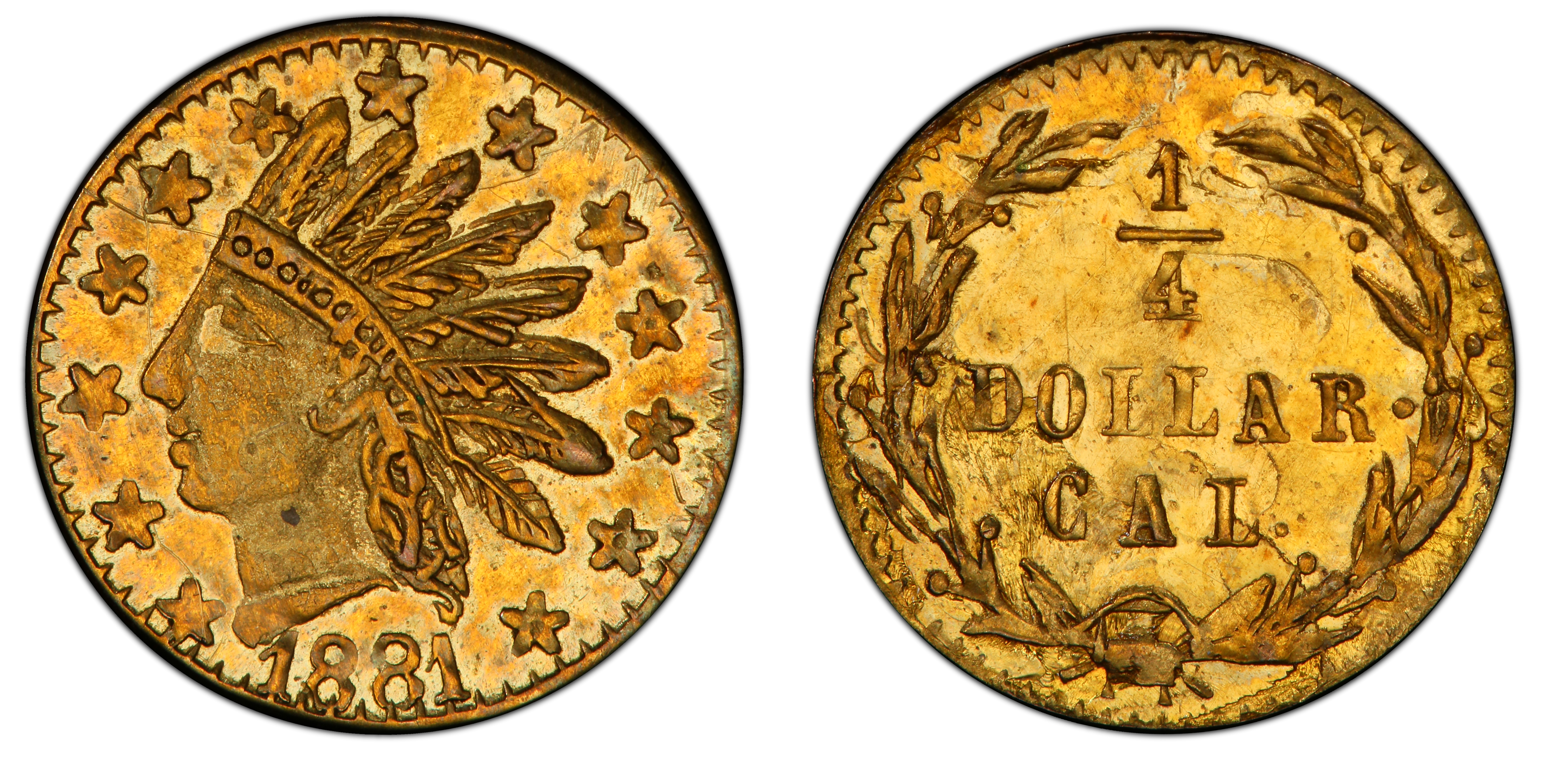
Obverse & Reverse
The 1881 G25C BG-853A is a product of the twilight years of a uniquely American numismatic chapter: the California Fractional Gold series. By 1881, the chaotic fervor of the initial Gold Rush had long subsided, replaced by industrialized mining and a more stable, though still developing, regional economy. The initial impetus for these tiny gold coins—a severe shortage of small denomination federal coinage in the 1850s—had been largely resolved by the establishment and output of the San Francisco Mint. However, the tradition of producing fractional gold pieces persisted, transforming from a vital commercial necessity into a popular enterprise for jewelers catering to tourists, merchants, and souvenir collectors. These later issues, designated as 'Period Two' (1858-1882) by researchers Walter Breen and Ronald Gillio, were not intended to alleviate a currency shortage but to serve as keepsakes of the romanticized Gold Rush era. Despite the Private Coinage Act of 1864 making such minting illegal, lax enforcement allowed production to flourish throughout the 1870s and into the early 1880s. Jewelers in San Francisco, like the successors to Robert B. Gray & Co. (who had sold his firm to the Levison Brothers' California Jewelry Co. in 1871), continued to strike these denominated tokens. They were legal quasi-currency, toeing the line of federal law. The BG-853A, dated 1881, represents one of the final expressions of this tradition. The very next year, 1882, would mark the end of denominated fractional gold production, as Secret Service Chief James J. Brooks finally cracked down, determining the pieces posed a risk of fraud and effectively shuttering the industry by 1883. These last issues thus capture the end of a 30-year period of private minting that began in necessity and concluded as a popular commercial novelty, leaving behind a complex and fascinating series for future numismatists.
Associated EventPost-Gold Rush California Economy
Reason For MintingPrimarily struck as souvenirs and jewelry items during a period when the original need for circulating small change had passed.
Minter HistoryWhile not definitively signed, the style and period of BG-853A are often attributed to the successors of Robert B. Gray & Co., a prominent San Francisco jewelry firm. Robert B. Gray was a known producer of fractional gold in the earlier years. In 1871, he sold his interests to the California Jewelry Co., owned by the Levison Brothers. These firms were major players in the San Francisco luxury goods market, manufacturing and importing fine jewelry, watches, and silverware, and had the skilled artisans and equipment necessary to produce such miniature coinage.
Historical SignificanceRepresents the final phase of privately issued gold 'coinage' in California, produced as a souvenir rather than for circulation, just before federal authorities halted the practice in 1883.
BG-853A
DenominationG25C
Minting Period1881
Assayer/MinterAttributed to Robert B. Gray & Co. (Successors)
Geographic OriginSan Francisco, California
Obverse DescriptionA diminutive portrait of a Native American princess facing left, wearing a feathered headdress. The portrait is encircled by 13 six-pointed stars.
Obverse InscriptionNo inscription.
Reverse DescriptionThe denomination '1/4' is centered within an open wreath of leaves and berries. The date '1881' is positioned below the wreath.
Reverse Inscription1/4
CompositionGold
Stated Fineness Actual FinenessVaries, typically 10 to 14 Karat for this later period.
Weight0.25 grams
Diameter9.80 mm
EdgePlain
Unknown
Survival EstimateFewer than 100
Rarity ScaleR-7 (76-200 known)
This variety appeals to collectors completing date sets of late-period California fractionals, those specializing in the Indian Head motif across all US coinage, and historians interested in the final year of this unique private coinage era before the government shutdown.
Key VarietiesBG-853A is a 'Regular Strike' business issue. No proof or special collector strikings from the period are known. It is crucial to distinguish genuine Breen-Gillio Period Two pieces like this from the myriad of non-denominated, often gilt brass 'charms' or replicas that were produced after 1882 and into the 20th century. Genuine pieces must bear a denomination (e.g., '1/4', 'DOLLAR', or 'CENTS').
Authentication TipsAuthentic BG-853A specimens often exhibit a somewhat crude, handmade quality. The strike can be uneven, with weakness in the stars or wreath details. The planchets are typically very thin. Look for the specific die characteristics cataloged by Breen and Gillio. Counterfeits or later charms are often thicker, have a soapy or cast-like appearance, may lack a denomination, and are frequently made of gilt brass, which can sometimes be identified by wear on the high points revealing the base metal. Professional third-party authentication is highly recommended for any uncertified example.
Shopping ConsiderationsA premium quality example for this issue will exhibit an unusually sharp strike for the type, with clear details in the Indian's headdress and the wreath's leaves. Original, undisturbed luster is paramount and commands a significant premium. Surfaces should be free of distracting marks, cleaning, or evidence of having been mounted in jewelry (a common fate for these pieces). Look for attractive, original reddish-gold or deep yellow-gold toning. Avoid examples with harsh cleaning, scratches, rim bumps, or repairs. Given the often weak strikes, a well-struck coin with good eye appeal is far more desirable than a poorly struck example in the same numerical grade.
A coin's grade is its condition, rated on a 1-70 scale. For rare coins, this is the most critical factor in determining value, as a tiny difference in preservation can mean a huge difference in price.
Relevant Grade TypesOriginal issues of BG-853A were business strikes created for sale as souvenirs, not for general circulation. They are found in both Circulated (1-58) and, more commonly, Mint State (MS, 60-70) grades. No Proofs (PR/PF) were struck during the original period of issue, and there are no known later-date collector restrikes of this specific variety.
Mint State CharacteristicsUncirculated examples are characterized by their luster, which is typically satiny rather than deeply frosty. The strike is a key variable; most specimens show some weakness on the high points of the Indian's hair and the leaves of the wreath. Planchet quality can be inconsistent, with minor striations or adjustment marks sometimes visible from the manufacturing process. Bag marks are less common than handling marks, given their nature as souvenirs.
Circulated Wear PatternsOn circulated examples, wear first appears on the high points of the Indian's cheek, hair, and the feathers in the headdress. On the reverse, the highest points of the wreath and the digits of the date will show initial friction and loss of detail. In lower grades (VF and below), the stars on the obverse and the individual leaves on the reverse will begin to merge.
Key Factors For ValueFor the BG-853A, the primary value drivers are grade and surface quality. An example with original, uncleaned surfaces and minimal marks will always be prized. Strike sharpness is the next critical factor; a coin with a full, bold strike can be worth significantly more than a weakly struck counterpart in the same grade. Eye appeal, encompassing attractive original color and luster, plays a major role. Finally, certification by a top-tier grading service (PCGS or NGC) is essential for market acceptance and value, with an added premium for coins approved by CAC.
PCGS Price Guide
| Grade | Price | Population |
|---|---|---|
| 50 | $2,000.00 | N/A |
| 63 | $7,500.00 | 2 |
| 66 | N/A | N/A |