1867 G25C BG-825 (Regular Strike)
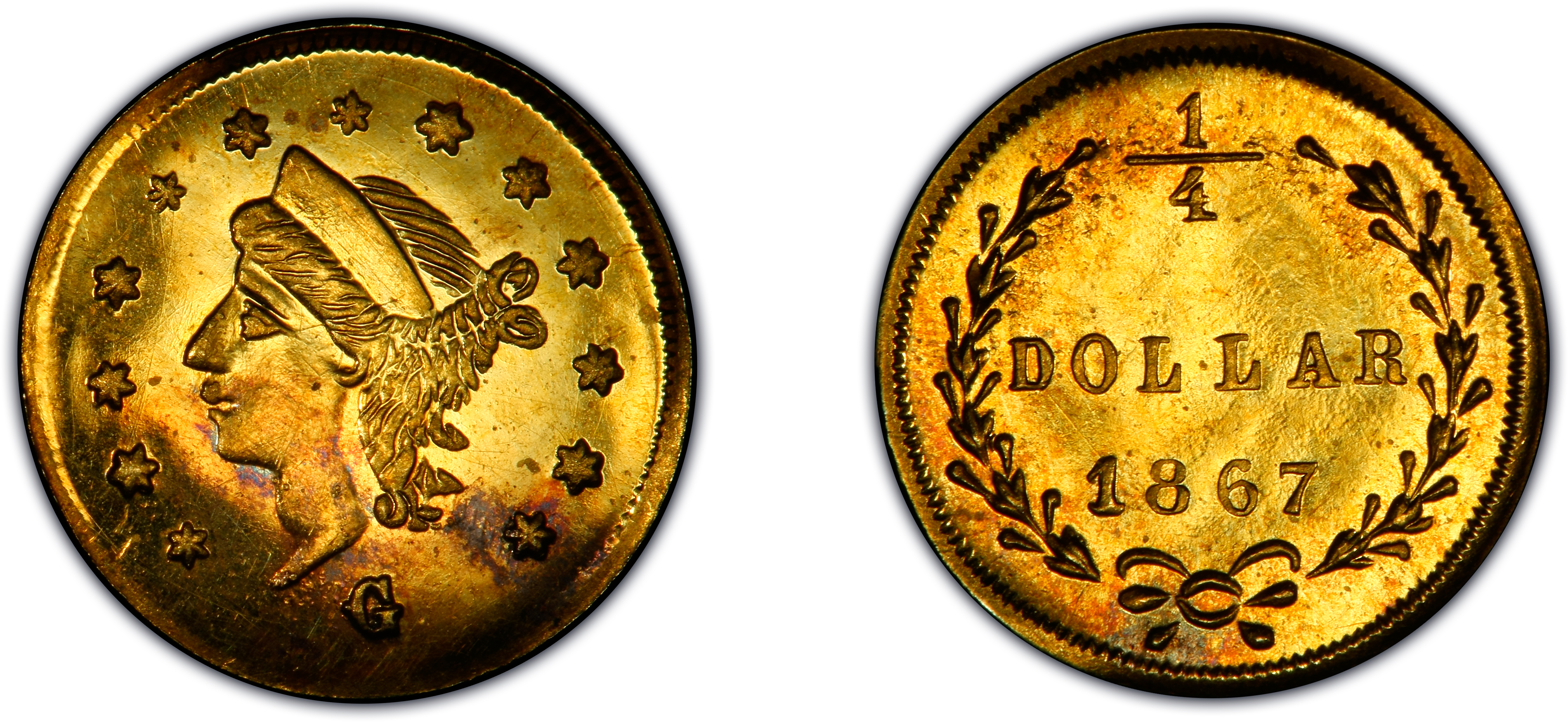
Obverse & Reverse
The 1867 G25C BG-825 is a product of the second period of California Fractional Gold production (1859-1882), a fascinating era that saw these miniature gold coins transition from a medium of necessity to items of novelty and private enterprise. By 1867, the acute shortage of small change that characterized the initial Gold Rush years had largely subsided due to the output of the San Francisco Mint. The Coinage Act of 1864 had officially outlawed all private coinage, rendering the continued production of fractional gold illegal. However, enforcement was lax, and the public's fascination with these tiny gold pieces, coupled with their utility in small-scale transactions where federal coinage remained scarce, ensured a persistent demand. Local jewelers in San Francisco, many of whom had been involved in the earlier, heavier issues, continued to strike these pieces. The BG-825 is a quintessential 'jeweler's issue'—often lighter and of a lower fineness than the earlier Period One coins, their value was more symbolic than intrinsic. They were popular as souvenirs for tourists, gifts, and adornments, serving as tangible mementos of California's gold mystique. These coins were typically produced using a crude hammer-striking method, where a planchet was placed between two dies and struck with a sledgehammer. This process resulted in inconsistent strike quality, with many pieces being weakly struck on one side or around the periphery. The continued production in the face of federal prohibition speaks to the independent spirit of the West and the unique economic conditions that persisted in California long after the initial rush had ended. The BG-825, therefore, represents not a coin made to solve a currency crisis, but a privately-minted token of commerce and culture operating in the grey market of a post-Gold Rush economy.
Associated EventCalifornia Gold Rush Aftermath
Reason For MintingTo serve a continued, though diminished, need for small denomination coinage and to satisfy a growing market for gold souvenirs and jewelry items.
Minter HistoryThe specific minter of the BG-825 variety is unknown, a common trait for many Period Two issues that lack a specific maker's mark or hallmark. Production is attributed to one of the many jewelers operating in San Francisco during the 1860s. These artisans, including notable figures like Robert B. Gray & Co. and Frontier, Deviercy & Co., possessed the die-sinking and striking capabilities necessary for such work. They produced a wide array of varieties to satisfy a public enchanted by gold, effectively creating a popular collectible long before the field of numismatics was formally established.
Historical SignificanceThe BG-825 is historically significant as an example of the persistence of private minting in defiance of federal law. It illustrates the evolution of fractional gold from essential currency to a commercial product, reflecting California's changing economy and its burgeoning identity as a tourist destination. These 'jeweler's issues' are a direct link to the culture of San Francisco in the 1860s and the enduring legacy of the Gold Rush.
N/A
Denomination25 Cents
Minting Period1867
Assayer/MinterUnknown San Francisco Jeweler
Geographic OriginSan Francisco, California
Obverse DescriptionA head of Liberty facing left, with loosely curled hair. She is encircled by thirteen six-pointed stars, representing the original colonies. The date, 1867, is positioned below the bust.
Obverse Inscription1867
Reverse DescriptionThe denomination '25 CENTS' is displayed on two lines within a wreath composed of two olive branches. The wreath is open at the top and tied with a bow at the bottom.
Reverse Inscription25 CENTS
CompositionGold
Stated Fineness Actual FinenessVaries, but typically lower than the .900 fineness of federal gold. Period Two issues are known to range from 14 to 22 carats.
Weight0.38 grams
Diameter9.80 mm
EdgePlain
Unknown
Survival Estimate76-200
Rarity ScaleR-4
This coin appeals to collectors of pioneer gold, numismatists fascinated by the Gold Rush era, and specialists in the extensive California Fractional Gold series. Its affordability relative to Period One issues and its status as a dated, denominated piece make it a popular type coin. The challenge of acquiring a well-struck, high-grade example adds to its allure.
Key VarietiesThere are no major, recognized varieties of BG-825 from the original minting period. This is a single die marriage. No known patterns, trial pieces, or later-date restrikes exist for this specific variety.
Authentication TipsAuthentication requires careful examination. Genuine examples often exhibit a somewhat crude, hand-struck appearance with imperfect centering and strike softness in areas. The details of Liberty's hair and the wreath's leaves are key diagnostic points. Compare the style of the numerals and letters to high-resolution photos of certified examples. Counterfeits are often cast, showing a mushy or porous surface, or are modern strikes with unnaturally sharp, uniform details. Weight and diameter should conform to the known specifications for this variety.
Shopping ConsiderationsWhen purchasing an 1867 BG-825, prioritize strike quality. Due to the hammer-striking process, many are weakly struck. A 'premium quality' example will show clear details in Liberty's hair and the wreath, even if some softness is present. Look for original, uncleaned surfaces, which may exhibit a soft, satiny luster or attractive reddish-gold toning. Avoid coins that have been harshly cleaned, polished, or used as jewelry, as this severely impairs their value. Pay close attention to the fields for distracting marks or planchet flaws, which are common but less desirable. A coin with superior eye appeal and a sharp strike will always command a significant premium.
A coin's grade is its condition, rated on a 1-70 scale. For rare coins, this is the most critical factor in determining value, as a tiny difference in preservation can mean a huge difference in price.
Relevant Grade TypesOriginal 1867 BG-825 coins were business strikes intended for commerce or sale as souvenirs, and they are found in both Circulated (grades 1-58) and Mint State (MS, grades 60-70). The vast majority of surviving examples are in Mint State, as their small size made them easy to lose but also likely to be kept as keepsakes. No Proof (PR/PF) examples were struck during the original period of issue, and no later-date Proof restrikes are known to exist.
Mint State CharacteristicsIn uncirculated (MS) condition, the quality is determined by the sharpness of the strike and the quality of the surfaces. A typical BG-825 will show some weakness on the high points of Liberty's hair and the bow of the wreath. Luster is typically soft and satiny rather than deeply prooflike. Because they were privately produced from gold of varying alloys, small planchet flaws or laminations are not uncommon. Contact marks, though small, can be prominent on such a tiny canvas and will affect the grade.
Circulated Wear PatternsOn circulated examples, wear first appears on the highest points of the design. For the obverse, this includes Liberty's cheek, the hair above her eye, and the highest strands of her bun. On the reverse, the high points of the wreath's leaves and the knot of the bow will show flatness first. In lower grades (VF and below), the stars on the obverse and the letters in the inscriptions will begin to lose their sharpness and merge with the fields.
Key Factors For ValueThe primary driver of value is grade, with a sharp jump between grade points in Mint State. Beyond the technical grade, the most valuable examples exhibit a combination of a sharp, well-centered strike, clean and original surfaces free of distracting marks or cleaning, and excellent eye appeal. Coins with a vibrant, original reddish-gold hue are particularly prized by collectors. A sticker from CAC (Certified Acceptance Corporation) indicating A-quality for the grade will add a significant premium, as it confirms the coin's superior quality and originality.
PCGS Price Guide
| Grade | Price | Population |
|---|---|---|
| 45 | $205.00 | 1 |
| 45+ | $210.00 | N/A |
| 50 | $215.00 | 4 |
| 50+ | $220.00 | N/A |
| 53 | $225.00 | 7 |
| 53+ | $230.00 | N/A |
| 55 | $235.00 | 10 |
| 55+ | $240.00 | N/A |
| 58 | $250.00 | 12 |
| 58+ | $260.00 | N/A |
| 60 | $275.00 | 4 |
| 61 | $300.00 | 7 |
| 62 | $350.00 | 38 |
| 62+ | $425.00 | N/A |
| 63 | $525.00 | 16 |
| 63+ | $625.00 | N/A |
| 64 | $850.00 | 3 |