1876 25C BG-799D, PL (Regular Strike)
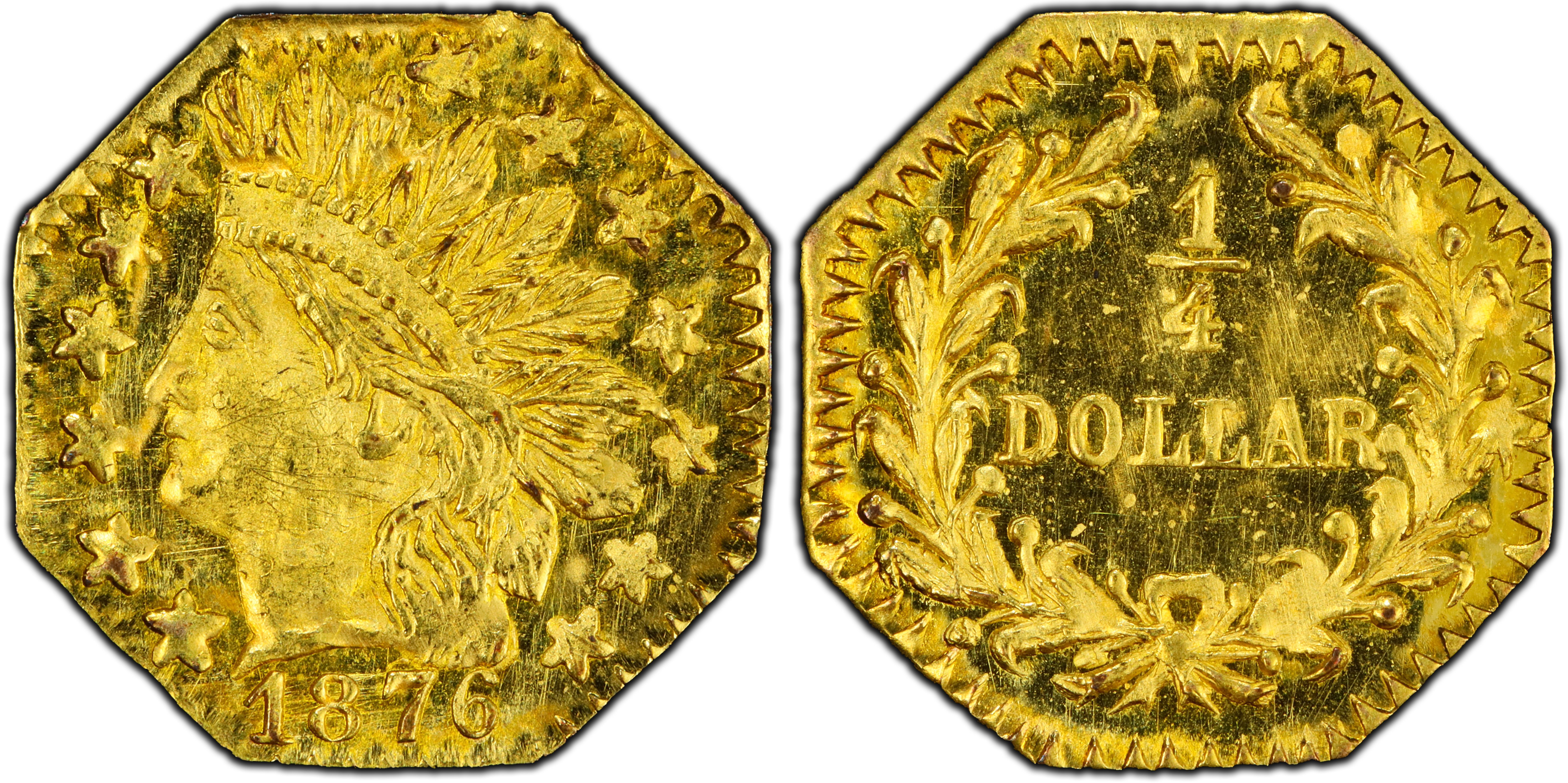
Obverse & Reverse
The 1876 25-cent piece, cataloged as Breen-Gillio 799D, is a fascinating artifact from the second period of California's private gold coinage. By the mid-1870s, the initial, urgent need for small-denomination circulating currency that fueled the Period One (1852-1856) issues had largely subsided due to the robust output of the San Francisco Mint. The pieces struck from 1859 to 1882, known as 'jeweler's issues,' transitioned from utilitarian coinage to souvenirs and keepsakes. These tiny gold coins were popular mementos of the great California Gold Rush, often purchased by tourists or sent back East as novelties. This specific variety was struck by Christopher Ferdinand Mohrig, a San Francisco jeweler and minter responsible for a wide array of fractional gold pieces (BG-790 through BG-799V). The year 1876 was significant as it marked the nation's Centennial, an event celebrated with great patriotic fervor and the Philadelphia Centennial Exposition, which likely spurred demand for historical souvenirs like these fractional gold pieces. Mohrig's operation, however, came to an abrupt end. On August 10, 1876, he was arrested by the U.S. Secret Service for violating the Coinage Act of 1864, which prohibited private coinage. His dies and existing stock of coins were confiscated and subsequently destroyed. This seizure is the primary reason for the rarity of many Mohrig issues, including BG-799D. The coins that survived were those already in public hands, creating a small, finite population for modern collectors. Numismatically, the BG-799D is a product of this specific historical moment—a souvenir celebrating a bygone era of gold fever, struck in the nation's centennial year by a minter whose activities were actively being suppressed by federal authorities.
Associated EventCalifornia Gold Rush (Later Souvenir Period)
Reason For MintingPrimarily produced as souvenirs and keepsakes for the tourist trade rather than to alleviate a currency shortage.
Minter HistoryChristopher Ferdinand Mohrig was a San Francisco-based jeweler and private minter active during the 1870s. He produced a significant number of the 'Period Two' California Fractional Gold varieties, specifically those cataloged from BG-790 to BG-799V. His prolific output was cut short on August 10, 1876, when he was arrested by federal agents for the illegal manufacture of private coins. The confiscation and destruction of his equipment and stock are the direct cause of the notable rarity of his surviving issues.
Historical SignificanceThe BG-799D is significant as it represents the later 'jeweler's issue' phase of fractional gold, highlights the federal government's efforts to suppress private coinage, and its rarity is a direct result of its minter's arrest and the confiscation of his works in the U.S. Centennial year.
BG-799D
Denomination25C
Minting Period1876
Assayer/MinterChristopher Ferdinand Mohrig
Geographic OriginSan Francisco, California
Obverse DescriptionAn Indian Head profile facing left, adorned with a feathered headdress. The portrait is surrounded by 13 six-pointed stars, representing the original colonies. The date '1876' is positioned below the bust truncation. The entire design is enclosed within the eight sides of the octagonal planchet.
Obverse Inscription1876
Reverse DescriptionThe reverse features the denomination '1/4 DOLLAR CAL.' within a wreath. The wreath is composed of two branches tied together at the bottom with a bow. The design is simple and functional, typical of the later period jeweler's issues.
Reverse Inscription1/4 DOLLAR CAL.
CompositionGold
Stated Fineness Actual FinenessVariable, typically lower than official U.S. coinage of the era, consistent with Period Two jeweler's issues which were not intended to circulate at full face value.
Diameter9.80 mm
EdgePlain
Unknown; part of the inventory seized and destroyed upon Mohrig's arrest in August 1876.
Survival Estimate13-30 known (R-6)
Rarity ScaleR-6
This coin is highly sought after for its specific date (U.S. Centennial), octagonal shape, high rarity (R-6), and compelling backstory involving the minter's arrest by the Secret Service. Examples with a Prooflike (PL) designation are particularly prized.
Key VarietiesThe BG-799 designation encompasses a series of die marriages using a common obverse die. The BG-799D is a specific reverse die variety. Other known BG-799 varieties from the same period include BG-799A, BG-799B, BG-799C, and others with different dates or minor die changes. There are no known special collector issues, patterns, or official restrikes for this variety; all known examples are business strikes from the original 1876 minting period.
Authentication TipsGenuine pieces often exhibit a somewhat weak or uneven strike due to the manual coining process (hammered strikes). Replicas are often sharply and perfectly struck. The lettering and stars on genuine pieces should match known die states and not appear modern or 'tool-like.' Many fakes and souvenir tokens feature a bear on the reverse; genuine denominated fractional gold pieces do not. The fabric of the coin should appear original, and not have the artificial feel of modern gold-plated copies. Authentication by a major grading service (PCGS or NGC) is highly recommended.
Shopping ConsiderationsA premium quality example for its grade will possess a sharp strike, particularly on the high points of the Indian's headdress and the details of the wreath. Look for original, undisturbed luster; many surviving examples are Mint State and may be Prooflike (PL) or Deep Prooflike (DMPL). Due to their small size, these coins are susceptible to damage, so inspect carefully for bends, rim bumps, or evidence of having been mounted in jewelry. Avoid examples that have been harshly cleaned or polished, as this drastically reduces value. Original, reddish-gold toning is considered attractive and adds to eye appeal. The specific die markers that identify the BG-799D reverse should be verified against a reference like the Breen-Gillio book.
A coin's grade is its condition, rated on a 1-70 scale. For rare coins, this is the most critical factor in determining value, as a tiny difference in preservation can mean a huge difference in price.
Relevant Grade TypesAll original BG-799D coins are business strikes, intended for sale as souvenirs. They are found in both Circulated (Good-4 to AU-58) and, more commonly, Mint State (MS-60 to MS-70) grades. No official Proofs were struck during the original minting period. The 'PL' (Prooflike) and 'DMPL' (Deep Mirror Prooflike) designations are applied to business strikes that exhibit deeply reflective, mirror-like surfaces from being struck with polished dies, and these command significant premiums.
Mint State CharacteristicsUncirculated examples of BG-799D are defined by their luster. A typical piece has satiny to semi-prooflike fields. Strike quality varies; some are weakly struck in the center, showing softness on the Indian's cheek or the wreath's bow. Premium examples will have a bold strike across the entire piece. Being very small and made of soft gold, even high-grade specimens can show minor handling marks or 'flyspecks' that do not impede the grade but should be noted for eye appeal.
Circulated Wear PatternsOn the obverse, wear first appears on the highest points of the design: the cheekbone of the Indian and the feathers in the headdress. On the reverse, the highest points of the wreath leaves and the bow will show the first signs of friction. In lower grades (VF and below), the stars on the obverse will begin to lose their sharpness and the finer details of the wreath will merge.
Key Factors For ValueThe primary value driver is the grade, with Mint State examples carrying a large premium over circulated ones. Within Mint State, the PL or DMPL designation can double the value or more. Surface quality is paramount; an example with clean, original surfaces and strong eye appeal will be worth significantly more than a cleaned, scratched, or otherwise impaired coin of the same grade. A sharp, well-centered strike is highly desirable. Certification by PCGS or NGC is standard, and a CAC sticker indicating premium quality for the grade adds a further premium.
PCGS Price Guide
| Grade | Price | Population |
|---|---|---|
| 65 | $3,150.00 | 2 |