1876 G25C BG-853 (Regular Strike)
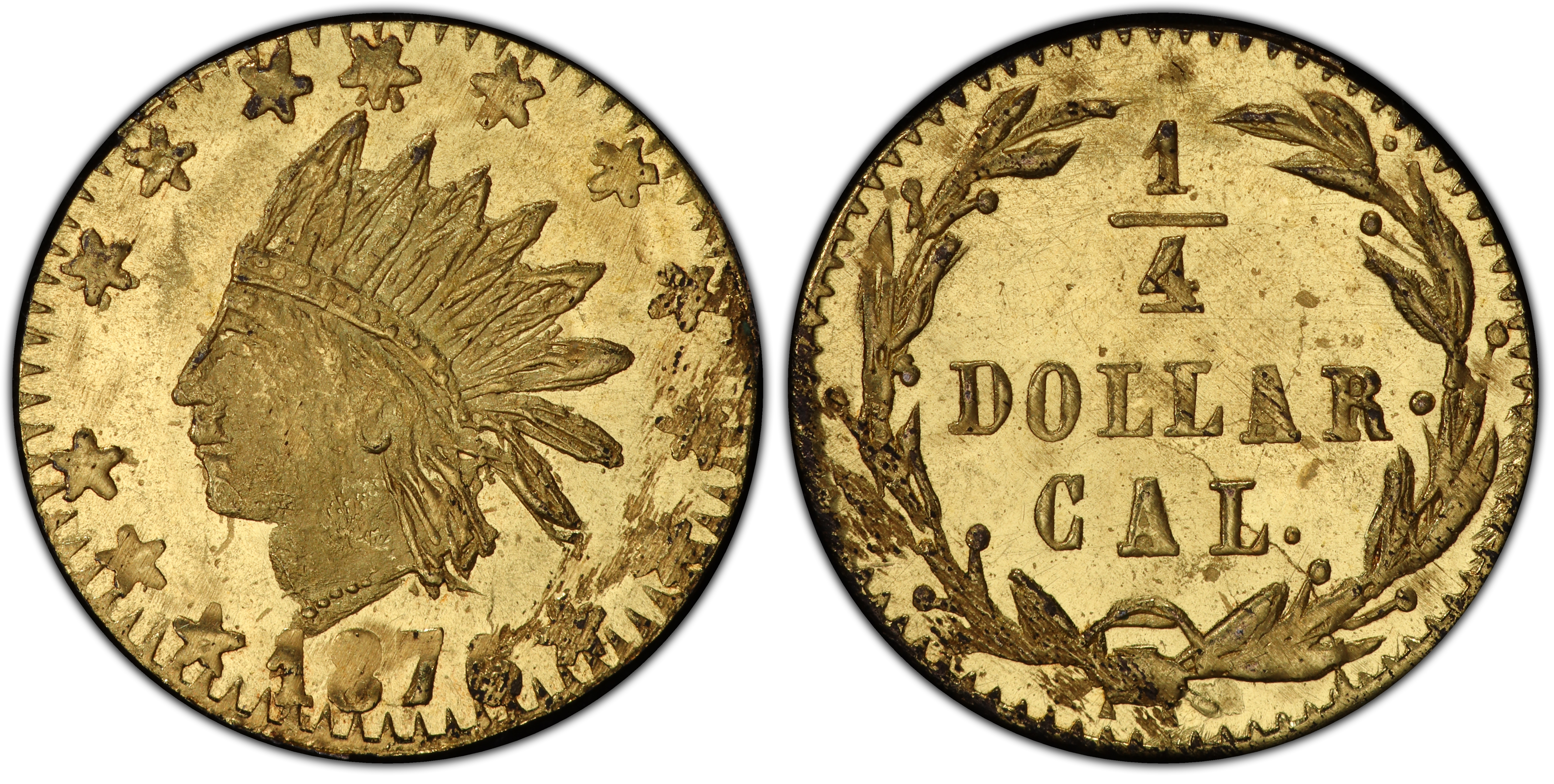
Obverse & Reverse
The 1876 BG-853 25 Cents is a quintessential example from the second period of California Fractional Gold production (1859-1882), often referred to by numismatists as 'Jeweler's Issues.' Unlike the 'Period One' pieces (1852-1857) which were struck out of a genuine necessity for small-denomination coinage during the chaotic peak of the Gold Rush, the Period Two issues emerged in a different economic climate. By the mid-1870s, the San Francisco Mint was in full operation, supplying the region with ample federal coinage. The acute shortage of circulating money that had plagued the West Coast was largely a memory. Consequently, the reason for producing these minuscule gold pieces shifted from commerce to souvenir and novelty. San Francisco jewelers, leveraging the romantic allure of the Gold Rush that still captivated the nation, began striking these small tokens for tourists, collectors, and for use in jewelry. The year 1876 was particularly significant as it marked the Centennial of the United States, an event celebrated with great patriotic fervor and a booming market for memorabilia. The BG-853, with its popular Indian Head motif—a design romanticizing the American frontier—would have been a perfect keepsake. These pieces were not intended to circulate widely as money and were often significantly lighter than their stated face value would suggest, functioning more as denominated tokens. The production methods were rudimentary, typically involving a sledgehammer to strike a gold planchet between two hand-engraved dies. This 'hammer method' resulted in inconsistent strike quality and frequent die failures, contributing to the proliferation of numerous die varieties cataloged by Walter Breen and Ronald Gillio. The Coinage Act of 1864 had made private coinage illegal, but the law was not strictly enforced against these small pieces until the early 1880s, allowing their production to flourish for two decades after the law was passed. Today, the BG-853 is a tangible link to this later, more commercialized phase of the Gold Rush legacy, valued not for its intrinsic gold content but for its historical significance, rarity, and connection to one of America's most foundational narratives.
Associated EventCalifornia Gold Rush Era (Souvenir Period)
Reason For MintingPrimarily created as souvenirs and for use in jewelry during the U.S. Centennial year, rather than to alleviate a coin shortage.
Minter HistoryThe specific minter for BG-853 is unknown, which is characteristic of the Period Two 'Jeweler's Issues.' These were produced by various, often anonymous, jewelers and artisans in San Francisco who capitalized on the souvenir market. Unlike some Period One issuers who marked their coins with initials (e.g., 'FD' for Frontier, Deviercy & Co.), most Period Two makers left their work unsigned.
Historical SignificanceRepresents the transition of California Fractional Gold from necessary circulating coinage to commercial souvenir items. Its 1876 date ties it to the American Centennial, a period of heightened national nostalgia. The coin is a numismatic artifact of how the Gold Rush was memorialized and marketed, long after its initial frenzy had passed.
BG-853
Denomination25 Cents (G25C)
Minting Period1876
Assayer/MinterUnknown Private Minter
Geographic OriginSan Francisco, California
Obverse DescriptionAn Indian Head motif facing left, wearing a feathered headdress. The portrait is surrounded by 13 stars, representing the original colonies. The date '1876' appears below the bust.
Obverse Inscription1876
Reverse DescriptionThe denomination '1/4' is centrally located within a decorative wreath. The inscription 'CALIFORNIA GOLD' encircles the wreath, sometimes abbreviated.
Reverse InscriptionCALIFORNIA GOLD 1/4
CompositionGold
Stated Fineness Actual FinenessVariable, but generally lower than federal coinage, often ranging from 14 to 22 karats. The intrinsic value was typically less than the 25-cent face value.
Diameter9.70 mm
EdgePlain
Unknown, but very low.
Survival EstimateFewer than 75 known specimens are estimated to exist across all grades, based on grading service population reports and auction appearances.
Rarity ScaleR-5 (Very Scarce)
This variety appeals to collectors of California Fractional Gold, those specializing in Indian Head motifs, and enthusiasts of Gold Rush history. Its specific date, 1876, also attracts collectors of U.S. Centennial-related items. The small size and intricate design present a unique collecting challenge.
Key VarietiesThe primary variety is the regular strike BG-853. The Breen-Gillio reference catalogs minute differences in die states or die pairings, but for the general collector, obtaining any sound example of BG-853 is the goal. There are no known official restrikes or patterns associated with this specific variety. Collectors should be aware of a related variety, BG-853A, which is dated 1881 but uses a similar obverse die.
Authentication TipsAuthentic pieces exhibit sharp, albeit sometimes uneven, details from a hammer strike. The luster is often prooflike in the fields but satiny on the devices. Look for characteristic die markers, such as faint cracks or specific alignments of the date and stars, which can be matched to known genuine examples. Counterfeits are common and often have a soft, cast-like appearance, incorrect weight, or design details that do not match the BG-853 die marriage. Many non-denominated tokens or modern replicas exist with bear motifs on the reverse; genuine Period Two fractionals are always denominated.
Shopping ConsiderationsA premium quality example for this issue is defined by a sharp, well-centered strike, especially on the feathers of the headdress and the details of the wreath. Original, prooflike surfaces are highly desirable and command significant premiums. Avoid examples that have been cleaned, which will appear hazy or have hairline scratches. Check carefully for evidence of having been mounted in jewelry, such as rim damage, solder marks, or tooling. Because these coins are so small, even minor imperfections are magnified. A specimen with excellent eye appeal, free of distracting marks or surface impairments, is a top-tier acquisition.
A coin's grade is its condition, rated on a 1-70 scale. For rare coins, this is the most critical factor in determining value, as a tiny difference in preservation can mean a huge difference in price.
Relevant Grade TypesOriginal period issues were business strikes, but as they were made by jewelers primarily for collectors and tourists, they were not intended for vigorous circulation. They are found in Circulated (1-58) grades, though this is less common, and more frequently in Mint State (MS, 60-70) grades. No true Proofs were struck during the original period. However, many Mint State examples display 'Prooflike' (PL) surfaces due to the use of polished dies and planchets, a common characteristic of these jeweler's issues. These are designated as MS PL, not PR/PF, and are highly sought after.
Mint State CharacteristicsUncirculated examples often exhibit a contrast between mirrored fields and frosted devices, lending a cameo-like appearance. The strike can be inconsistent; a fully struck piece will show complete feather details in the headdress and sharp leaves in the wreath. Due to the primitive manufacturing process, it's common to see minor planchet flaws or a slightly uneven rim, which may not detract from the grade if they are as-made. Luster is typically bright and flashy, not subdued.
Circulated Wear PatternsOn circulated examples, wear first appears on the high points of the design. For the obverse, this includes the cheek of the Indian Head and the feathers of the headdress. On the reverse, the highest points of the wreath and the fraction '1/4' will show initial friction and loss of detail. In lower grades (VF and below), the stars and legends will begin to merge with the fields.
Key Factors For ValueThe primary value drivers are grade and surface quality. An example with original, undisturbed prooflike surfaces is far more valuable than a cleaned or circulated piece. Sharpness of strike is crucial; collectors pay a substantial premium for coins with full details. Eye appeal is paramount for this series—a well-centered, vibrantly lustrous coin with a pleasing gold color will always command more than a poorly struck or marked-up specimen. Certification by a major grading service (PCGS or NGC) is essential for authenticity and liquidity, and a CAC sticker indicates premium quality for the assigned grade.
PCGS Price Guide
| Grade | Price | Population |
|---|---|---|
| 45 | $190.00 | 1 |
| 45+ | $192.00 | N/A |
| 50 | $195.00 | N/A |
| 50+ | $200.00 | N/A |
| 53 | $205.00 | N/A |
| 53+ | $210.00 | N/A |
| 55 | $225.00 | 1 |
| 55+ | $235.00 | N/A |
| 58 | $250.00 | 4 |
| 58+ | $265.00 | N/A |
| 60 | $300.00 | N/A |
| 61 | $315.00 | 1 |
| 62 | $325.00 | 14 |
| 62+ | $375.00 | N/A |
| 63 | $500.00 | 11 |
| 63+ | $550.00 | N/A |
| 64 | $725.00 | 14 |
| 64+ | $800.00 | N/A |
| 65 | $1,100.00 | 4 |
| 65+ | $1,350.00 | N/A |
| 66 | $1,650.00 | 1 |