1871 G25C BG-840 (Regular Strike)
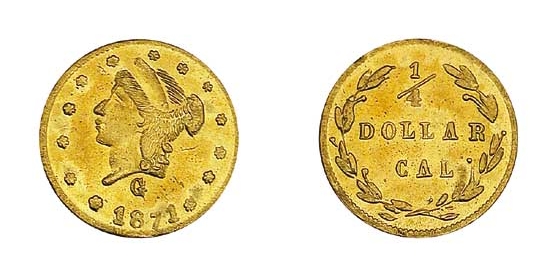
Obverse & Reverse
The 1871 BG-840 25 Cents falls into 'Period Two' (1859-1882) of California Fractional Gold production, a fascinating era that transitioned from practical necessity to commercial enterprise. The initial gold rush coinage shortage had largely been resolved by the establishment of the San Francisco Mint in 1854. However, a persistent lack of small-denomination silver coinage, combined with a burgeoning market for curiosities and souvenirs, created a new purpose for these minuscule gold pieces. Jewelers and private minters, many of French origin, stepped in to fill this niche. These 'jewelers' issues' were no longer primarily intended to facilitate commerce, but rather to be sold as keepsakes, charms, and mementos of the California Gold Rush. Unlike the earlier Period One issues, which often contained gold value close to their face value, Period Two pieces were significantly lighter and produced for profit. The Coinage Act of 1864 made private currency illegal, but production continued, skirting the law by technically being 'tokens' rather than coins. The public, both locally and back East, was captivated by these tiny gold pieces, which could be easily mailed as affordable gifts. The BG-840 variety, with its classic Liberty Head motif mimicking official U.S. coinage, was a popular design. It represents a mature phase in the fractional gold series, where established designs were struck in large quantities to meet a steady demand for souvenirs. This period eventually waned in the early 1880s after increased scrutiny from the Secret Service, who saw the continued production of denominated tokens as a violation of federal law, leading manufacturers to switch to non-denominated issues.
Associated EventPost-Gold Rush Economic Expansion
Reason For MintingPrimarily produced to be sold as souvenirs, jewelry, and curiosities rather than to alleviate a coin shortage.
Minter HistoryThe specific minter of BG-840 is unknown, which is typical for many Period Two California Fractional Gold pieces. Production during this time was dominated by various jewelers and merchants in San Francisco who created the dies and struck the pieces for commercial sale. Prominent manufacturers of the era included Deriberpe & Nouizillet (D.N.) and Frontier & Deviercy (F.D.), though this specific variety is not attributed to a known maker.
Historical SignificanceThe BG-840 is significant not as a circulating coin, but as a tangible artifact of the commercialization of the Gold Rush legacy. It demonstrates the shift from utilitarian private coinage to the production of novelty and souvenir items, reflecting a maturing California economy and a nationwide fascination with the West.
BG-840
Denomination25 Cents
Minting Period1871
Assayer/MinterUnknown, likely various jewelers in San Francisco.
Geographic OriginSan Francisco, California
Obverse DescriptionA beaded border encircles a Liberty Head portrait facing left, similar in style to contemporary federal gold coinage. She wears a coronet inscribed with 'LIBERTY', although the inscription is often not fully legible. Thirteen stars, representing the original colonies, surround the portrait.
Obverse InscriptionLIBERTY (on coronet)
Reverse DescriptionWithin a wreath of two olive branches tied with a bow at the bottom, the denomination '1/4' appears above the word 'DOLLAR' and the date '1871'. The 'G' for gold is sometimes implied or part of the design context rather than explicitly stated on this variety.
Reverse Inscription1/4 DOLLAR 1871
CompositionGold
Stated Fineness Actual FinenessVaries, but typically between .500 and .800 fine gold, significantly less than federal issues.
Weight0.25 grams
Diameter9.00 mm
EdgePlain
Unknown, but considered relatively common for the series.
Survival EstimateSeveral hundred to a few thousand pieces are estimated to exist across all grades.
Rarity ScaleR-4- (meaning 76-200 known)
This variety is popular among collectors as a relatively affordable and accessible example of a genuine denominated California Fractional Gold piece. Its classic Liberty Head design makes it a representative type coin for the Period Two 'jewelers' issues'.
Key VarietiesThe primary variety is the regular business strike. There are no known proof restrikes or special collector issues from the period of minting for BG-840. Varieties in this series are cataloged by Breen-Gillio (BG) numbers, which differentiate minute changes in dies, lettering, and design elements. For BG-840 itself, collectors may focus on different die states, which show the progression of die wear or cracks, but there are no major recognized sub-varieties.
Authentication TipsAuthentic pieces have a specific 'look' to their luster and strike that is softer than modern copies. Check for sharp, uniform reeding on the edge, which is a sign of a modern fake, as genuine pieces have plain edges. The numerals in the date and the style of the lettering should match known examples precisely. Counterfeits often have incorrect lettering fonts, mushy details, or a soapy, prooflike surface not characteristic of originals. Weight can be a key indicator; underweight pieces are common, but fakes are often made of brass and will be significantly off-weight.
Shopping ConsiderationsA premium quality example for its grade will possess a sharp, well-centered strike, especially on Liberty's coronet and the reverse wreath. Original, uncleaned surfaces with a hint of reddish-gold toning are highly desirable. Luster can range from satiny to slightly prooflike. Avoid coins that are holed and repaired, as is common in this series due to their use in jewelry. Also, look out for tooling in the fields or around the devices, which was sometimes done to 'improve' a coin's appearance. A coin certified by a major grading service (PCGS, NGC) is highly recommended for authenticity and accurate grading.
A coin's grade is its condition, rated on a 1-70 scale. For rare coins, this is the most critical factor in determining value, as a tiny difference in preservation can mean a huge difference in price.
Relevant Grade TypesOriginal period issues were business strikes intended for the souvenir market, though some may have circulated briefly. They are found in Circulated grades (AG-3 to AU-58) and, more commonly, in Mint State (MS, 60-70) grades due to their nature as keepsakes. No original proofs were struck during the 1870s. Any piece described as a 'Proof' is a modern copy or fantasy piece, not a later restrike from original dies.
Mint State CharacteristicsUncirculated examples of BG-840 often show weakness in the strike, particularly on the highest points of Liberty's hair and the word 'LIBERTY' on the coronet. The luster is typically satiny and can have a slightly reflective quality in the fields. Due to the softness of the gold and crude production methods, it is common to see planchet flaws, adjustment marks, or small die cracks, which do not necessarily detract from the grade unless severe. Bag marks are common, even on high-grade specimens, given how they were handled in bulk.
Circulated Wear PatternsWear first appears on the high points of Liberty's hair, cheek, and coronet. On the reverse, the leaves of the wreath and the bow will show the first signs of friction. In lower grades (Fine and below), the stars on the obverse will begin to merge with the field, and the date and denomination on the reverse will become faint.
Key Factors For ValueThe primary value drivers are grade and surface quality. An example with original, lustrous surfaces free of cleaning, scratches, or jewelry-related damage (like solder or tooling) will command a significant premium. The sharpness of the strike is crucial; a well-struck piece with full details on the Liberty head is much more desirable than a weakly struck example of the same grade. Eye appeal, including attractive original toning, also plays a major role. Certification by PCGS or NGC is almost essential for market acceptance, and a CAC sticker for this issue indicates superior quality for the grade and adds a strong premium.
PCGS Price Guide
| Grade | Price | Population |
|---|---|---|
| 40 | $180.00 | 1 |
| 45 | $183.00 | N/A |
| 45+ | $184.00 | N/A |
| 50 | $185.00 | 4 |
| 50+ | $187.00 | N/A |
| 53 | $190.00 | 4 |
| 53+ | $195.00 | N/A |
| 55 | $200.00 | 16 |
| 55+ | $205.00 | N/A |
| 58 | $210.00 | 16 |
| 58+ | $220.00 | N/A |
| 60 | $250.00 | 7 |
| 61 | $315.00 | 19 |
| 62 | $400.00 | 37 |
| 62+ | $435.00 | N/A |
| 63 | $475.00 | 26 |
| 63+ | $575.00 | N/A |
| 64 | $800.00 | 12 |
| 64+ | $875.00 | N/A |
| 65 | $1,150.00 | 3 |