1876 G50C BG-932A, PL (Regular Strike)
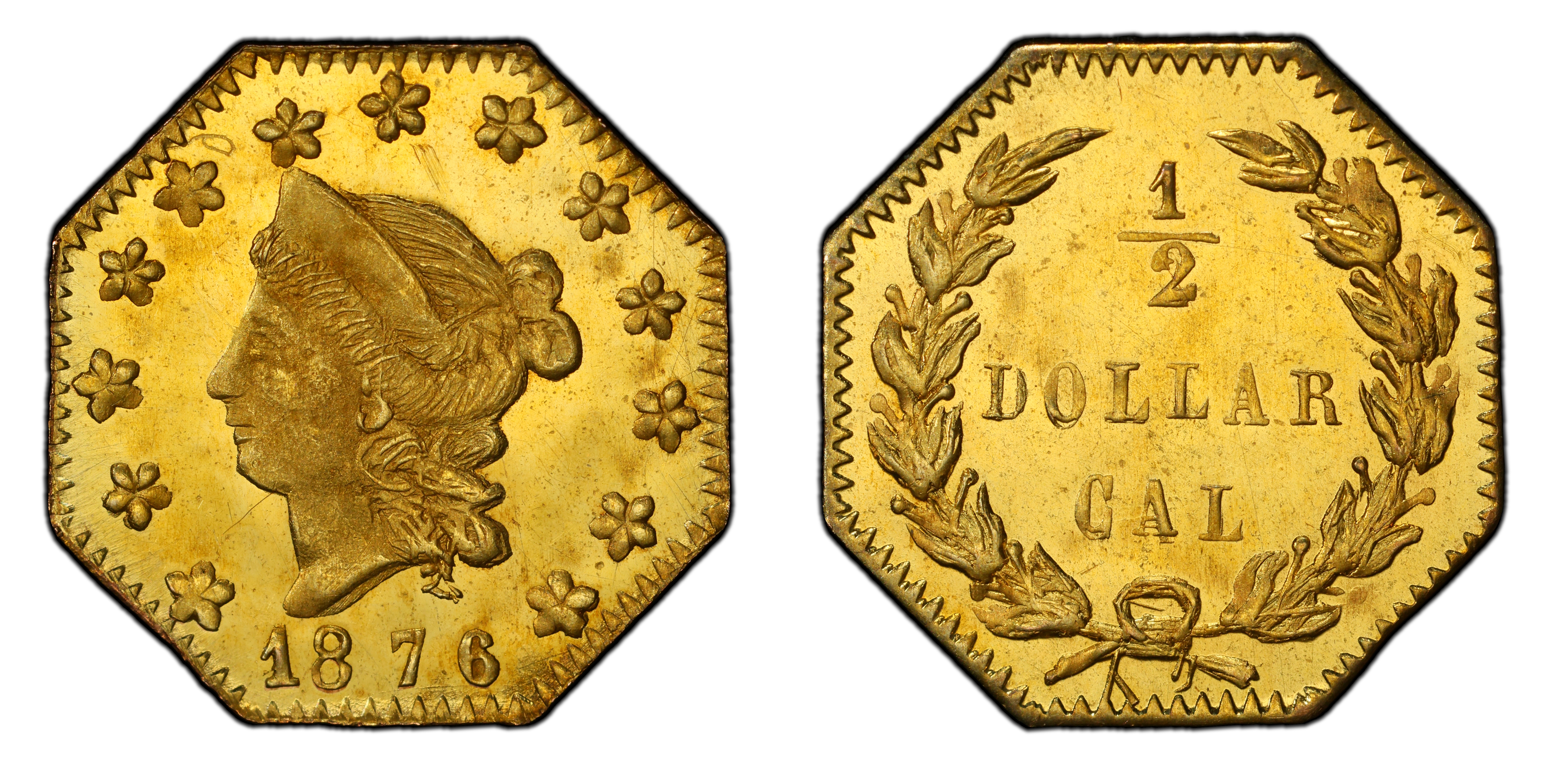
Obverse & Reverse
The 1876 Octagonal Gold 50 Cents, cataloged as Breen-Gillio 932A, is a quintessential example of 'Period Two' California Fractional Gold. Unlike the earlier 'Period One' issues (1852-1857), which were struck to alleviate a severe shortage of small change during the initial Gold Rush frenzy, Period Two pieces were created after the acute need had subsided. The San Francisco Mint, opened in 1854, had largely saturated the region with federal coinage. Consequently, jewelers like Robert B. Gray & Co. began producing these small-denomination gold pieces primarily as souvenirs, keepsakes, and novelty items. These pieces were often backdated or bore contemporary dates, like this 1876 issue, to coincide with significant events such as the Centennial of the United States, enhancing their appeal as mementos. Struck by jewelers with commercial machinery, the quality could be exceptional, often featuring prooflike or cameo surfaces intended to appeal to collectors and tourists rather than to withstand the rigors of circulation. The Coinage Act of 1864 had made private coinage illegal, but lax enforcement allowed this practice to continue until a Secret Service crackdown in the early 1880s. The BG-932A is a product of this legally gray era, a time when the romance of the Gold Rush was being packaged and sold in miniature gold form. These pieces contained less than their face value in gold, functioning essentially as high-quality, privately issued tokens. Their existence speaks to a mature California economy where gold was not just a medium of exchange but also a symbol of the state's identity and a popular commodity for its burgeoning tourist trade. Today, they are prized by collectors not for their intrinsic value, but for their direct connection to the Gold Rush legacy and the fascinating story of private enterprise filling a perceived market niche.
Associated EventPost-Gold Rush Era / U.S. Centennial
Reason For MintingPrimarily created as souvenirs and collector's items for the jewelry trade, not for general circulation.
Minter HistoryRobert B. Gray & Co. was a prominent San Francisco-based manufacturing jeweler active during the mid-to-late 19th century. In late 1858 or 1859, Gray acquired the business of Antoine Louis Nouzillet, another jeweler and early producer of fractional gold. This purchase included Nouzillet's dies, hubs, and punches. Gray continued to strike pieces, sometimes using old dies and sometimes creating new ones, often marked with a distinctive 'G'. The firm's output is noted for its high quality and represents a significant portion of the Period Two issues. They were a key player in the transition of fractional gold from quasi-currency to pure numismatic souvenir.
Historical SignificanceThis coin is significant as an artifact of the commercialization of the Gold Rush mythos. It represents a later, more commercial phase of private minting in California, where the pieces served as keepsakes rather than essential currency, and it showcases the craftsmanship of San Francisco's jewelers during that period.
BG-932A
DenominationG50C (Gold 50 Cents)
Minting Period1876
Assayer/MinterRobert B. Gray & Co.
Geographic OriginSan Francisco, California
Obverse DescriptionA Liberty Head, facing left, with hair tied in a bun. The portrait is surrounded by 13 six-pointed stars. The date '1876' is below the bust.
Obverse Inscription1876
Reverse DescriptionThe denomination '1/2' is centered within a wreath of two olive branches tied with a bow at the bottom. The legend 'CALIFORNIA GOLD' encircles the top periphery of the wreath.
Reverse InscriptionCALIFORNIA GOLD 1/2
CompositionGold
Stated Fineness Actual FinenessTypically less than face value; varied by minter but generally around .500 to .750 fine for Period Two issues.
Weight0.25 grams
Diameter10.00 mm
EdgePlain
Unknown, but very low, as with all Period Two fractionals.
Survival Estimate31-75 coins known. This is consistent with its R-5+ rating.
Rarity ScaleR-5+
Sought for its high quality of strike, octagonal shape, and status as a collectible 'Period Two' issue from a known San Francisco jeweler. The prooflike (PL) designation adds significant appeal, highlighting its intended status as a special presentation piece rather than a circulation strike.
Key VarietiesThe primary variety distinction for BG-932A is between the regular business strike and the Prooflike (PL) or Deep Mirror Prooflike (DMPL) examples, which are considerably scarcer and more desirable. No major die varieties from the original minting period are widely recognized for this specific BG number. No official restrikes were made, but collectors should be aware of a vast world of contemporary counterfeits and modern, non-denominated replicas.
Authentication TipsAuthentic BG-932A pieces have a sharp, well-defined strike from genuine dies. Check for the precise placement and font of the date and legends as illustrated in the Breen-Gillio reference. The surfaces on PL examples should show clear reflectivity in the fields, distinct from the frosty devices. Many modern fakes are cast or poorly struck, with incorrect weight, mushy details, and often a 'soapy' or unnatural luster. Weight is a critical diagnostic; genuine pieces are very light. Third-party grading is highly recommended.
Shopping ConsiderationsA premium quality example of BG-932A is defined by its surface preservation and strike. For a prooflike specimen, look for deep, clean, and undisturbed mirrored fields with strong frost on the devices (Liberty's portrait and the wreath). Avoid examples with hairlines, wipe marks, or excessive contact marks, which are particularly distracting on mirrored surfaces. The strike should be sharp on the stars, the details of Liberty's hair, and the leaves in the wreath. Due to their jeweler-made nature, some inherent planchet imperfections can be acceptable if not distracting. Original, uncleaned surfaces with a hint of reddish-gold toning are highly prized.
A coin's grade is its condition, rated on a 1-70 scale. For rare coins, this is the most critical factor in determining value, as a tiny difference in preservation can mean a huge difference in price.
Relevant Grade TypesOriginal period issues were business strikes, although many were produced with prooflike surfaces for collectors and were never intended to circulate. They are found in both Circulated (1-58) and, more commonly for this issue, Mint State (MS, 60-70) grades. No true 'Proofs' in the modern sense were struck during this period. The 'PL' (Prooflike) and 'DMPL' (Deep Mirror Prooflike) designations are applied to business strikes that exhibit mirrored fields and are highly sought after, representing the pinnacle of quality for this issue.
Mint State CharacteristicsUncirculated examples of BG-932A are characterized by their luster, which for PL examples is a distinct, mirror-like reflectivity in the fields. The strike is typically sharp, as they were made with care. However, planchet quality can vary, and it is not uncommon to see minor, as-made striations or specks. The highest quality pieces have a strong cameo contrast between the frosty devices and the mirrored fields. Contact marks, even small ones, can be very noticeable and will significantly impact the grade.
Circulated Wear PatternsAlthough not intended for circulation, some examples show light wear. The first signs of friction appear on the highest points: Liberty's cheek, the hair above her ear, and the knot of the bow on the reverse wreath. On lower-grade examples, the mirrored fields will be dulled and covered in fine scratches, and the finer details of the wreath will begin to merge.
Key Factors For ValueThe single most important factor for this coin is the quality and depth of the prooflike surfaces. A true DMPL or heavily cameoed PL coin will command a massive premium over a standard Mint State example. Surface preservation is paramount; any cleaning, hairlines, or significant contact marks will drastically reduce value. A sharp, complete strike and attractive, original toning also add to eye appeal and value. A CAC sticker for this issue is highly significant, confirming both the grade and the quality of the surfaces, and will result in a substantial price premium.
PCGS Price Guide
| Grade | Price | Population |
|---|---|---|
| 65 | N/A | 1 |