1876 25C BG-799GG (Regular Strike)
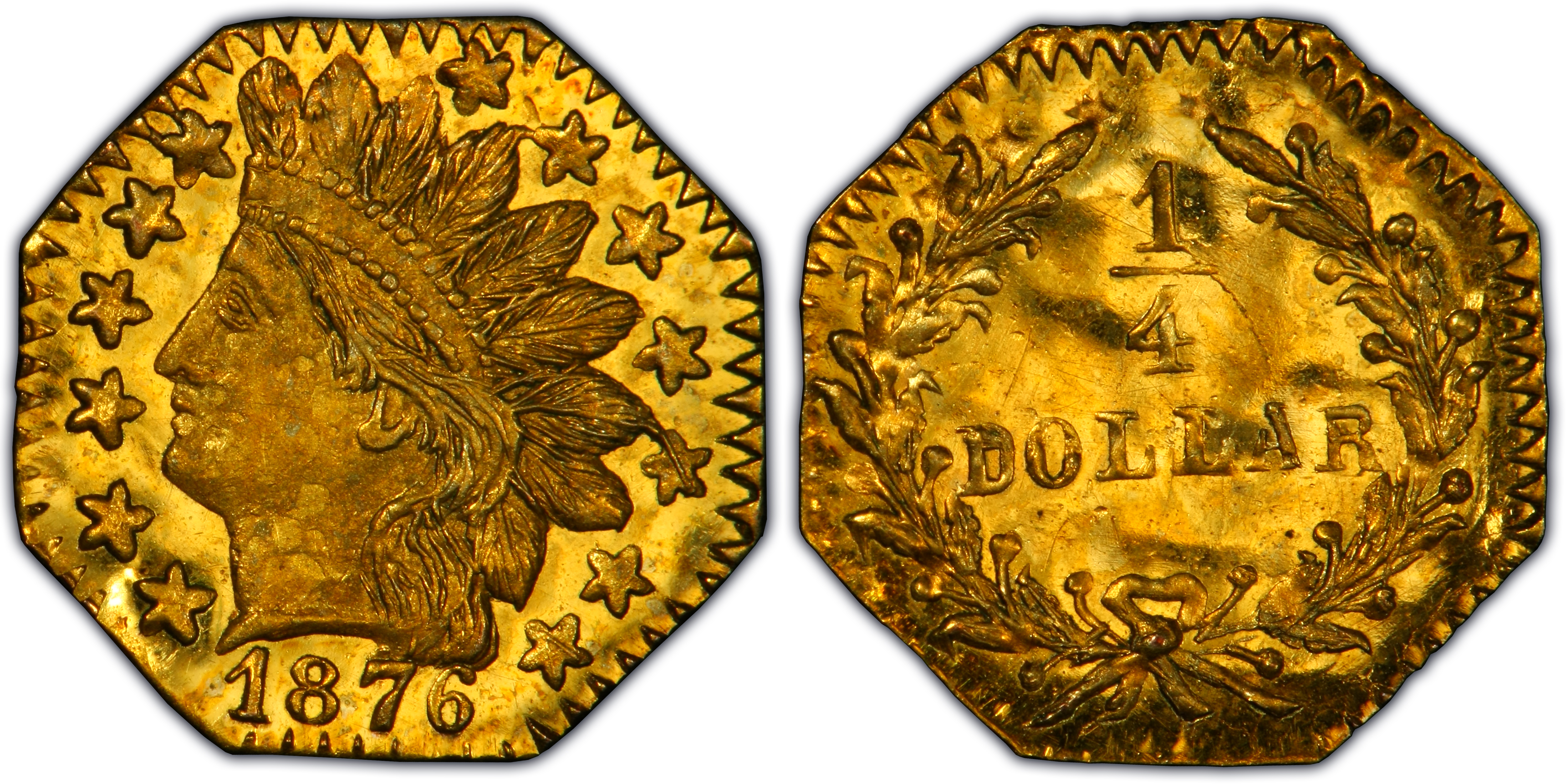
Obverse & Reverse
The 1876 25C BG-799GG is an artifact from the twilight of America's private coinage era, a period when the entrepreneurial spirit of the frontier clashed with federal authority. By 1876, the initial, pressing need for small denomination coinage that had fueled the creation of 'Cal Fracs' during the Gold Rush had long since been met by the San Francisco Mint, which opened in 1854. The fractional gold pieces of this later 'Period Two' (1858-1882) were not struck to facilitate commerce but to satisfy a burgeoning tourist and souvenir market. These miniature gold coins, often called 'jeweler's issues,' served as keepsakes of the romanticized Gold Rush past. The minter of the BG-799 series, Christopher Ferdinand Mohrig, was a San Francisco jeweler operating in this environment. The legal ground for these private issues was precarious. The Private Coinages Act of 1864 had outlawed the practice, but enforcement by the U.S. Secret Service was inconsistent for over a decade. This federal ambivalence allowed numerous jewelers to continue production. However, by the mid-1870s, Secret Service Chief James J. Brooks began a determined campaign to suppress these private mintages, viewing them as a potential avenue for fraud. Mohrig's operation fell victim to this crackdown. On August 10, 1876, Secret Service agents arrested Mohrig, confiscating his coining equipment, dies, and inventory. This dramatic event is the single most important factor in the history of the BG-799GG; the seizure and subsequent destruction of the dies instantly created a great rarity. The BG-799GG variety itself was unknown to the numismatic community for over a century, being formally discovered and reported by Heritage Auctions cataloger Brian Koller in 2009. It utilizes a known obverse die (shared with varieties BG-799A through BG-799D) paired with a unique, previously unrecorded reverse die. The coin's existence as a die-state rarity, combined with its maker's dramatic legal troubles, makes it a quintessential example of the fascinating and complex history of suppressed private coinage in the American West.
Associated EventSuppression of Private Coinage by the U.S. Secret Service
Reason For MintingStruck not for circulation, but primarily as a souvenir or collectible for the jewelry and tourist trade in post-Gold Rush California.
Minter HistoryChristopher Ferdinand Mohrig was a jeweler and private minter active in San Francisco during the 1870s. He produced a range of California Fractional Gold pieces, including the quarter dollar varieties cataloged as BG-790 through BG-799V. Like other jewelers of the era, he capitalized on the romantic appeal of the Gold Rush by creating these miniature gold tokens. His numismatic legacy is defined by his arrest on August 10, 1876, for violating the Private Coinages Act of 1864. The federal seizure and destruction of his minting apparatus ensured that many of his issues, particularly those from the specific dies in use at the time, would become exceptionally rare.
Historical SignificanceThe BG-799GG is significant as a tangible link to the final chapter of private minting in California. Its extreme rarity is a direct result of federal law enforcement action, making it a numismatic 'time capsule' from the very moment this chapter was forcibly closed. Its recent discovery highlights the dynamic and evolving nature of numismatic scholarship for this complex series.
Not applicable; Breen-Gillio is the standard reference.
Denomination25 Cents
Minting Period1876
Assayer/MinterChristopher Ferdinand Mohrig
Geographic OriginSan Francisco, California
Obverse DescriptionAn Indian Head profile facing left, wearing a feathered headdress. The portrait is surrounded by 13 stars. The date, 1876, appears below the bust. This obverse die is shared with varieties BG-799A through BG-799D.
Obverse Inscription1876
Reverse DescriptionA wreath composed of two branches tied with a bow at the bottom encircles the denomination. The reverse die is unique to this variety, distinguished by a recut 'D' in 'DOLLAR' and a unique leaf arrangement within the wreath.
Reverse Inscription1/4 DOLLAR CAL.
CompositionGold
Stated Fineness Actual FinenessPeriod Two issues were often of a lower, variable fineness compared to earlier Period One coins, ranging from 14 to 22 karats.
Weight0.25 grams
Diameter9.50 mm
EdgePlain
Extremely small; struck shortly before Mohrig's arrest and the confiscation of his dies.
Survival EstimateFewer than 5 known; population reports from PCGS and NGC list 4 examples.
Rarity ScaleHigh R-7 (4 to 6 known)
This coin is a 'holy grail' for advanced specialists in California Fractional Gold. Its appeal stems from its extreme rarity, its status as a recently discovered variety, and its compelling backstory tied directly to the Secret Service's suppression of private coinage. The connection to a named and arrested minter, C.F. Mohrig, adds a layer of historical drama.
Key VarietiesThe BG-799GG is itself a key variety, defined by its unique reverse die. The broader BG-799 series contains several other varieties (BG-799A, BG-799R, etc.) struck by Mohrig, distinguished by different die pairings or die states. It is important to note that the 'GG' suffix in the Breen-Gillio catalog number for this variety does not appear to stand for a minter's hallmark (as Mohrig is the established minter), but is a designation assigned by modern catalogers to distinguish this unique die marriage. No special collector restrikes from the original Mohrig dies are known, as they were confiscated and destroyed by federal authorities in 1876.
Authentication TipsAuthentic Period Two fractionals are thin and struck on solid gold planchets. Key diagnostics for BG-799GG are the specific reverse die characteristics: a clearly visible repunching on the 'D' of DOLLAR and the unique wreath leaf pattern. Both known genuine specimens exhibit a significant die rotation. Counterfeits of California gold are rampant; fakes are often thicker, have a soapy or cast-like appearance, incorrect details, and may be gold-plated brass. A common red flag for fakes of the series is the depiction of a bear on the reverse; no genuine 19th-century issues feature this design. Given its rarity and value, authentication by a top-tier grading service (PCGS or NGC) is essential.
Shopping ConsiderationsAcquiring a BG-799GG is a major event, likely only possible via a major auction of a landmark collection. A premium quality example would be defined by a sharp strike, particularly on the Indian's headdress and the fine details of the wreath. The known examples are Mint State, often with prooflike or deep mirror prooflike surfaces, which should be deeply reflective and free of impairments. Eye appeal is paramount; look for unabraded surfaces with original, lustrous 'sun-gold' toning. Avoid any examples with signs of cleaning, polishing, or evidence of having been mounted in jewelry. Given the 'hammered' striking process, some minor weakness in peripheral areas opposite high-relief elements can be expected and is not necessarily a major detriment.
A coin's grade is its condition, rated on a 1-70 scale. For rare coins, this is the most critical factor in determining value, as a tiny difference in preservation can mean a huge difference in price.
Relevant Grade TypesOriginal period issues like this were technically business strikes, although as 'jeweler's issues' they were not intended for vigorous circulation and were often sold to collectors. They are found in both Circulated (1-58) and Mint State (MS, 60-70) grades. Due to their status as souvenirs, high-grade examples are the norm for this variety. No true Proofs were struck during the original period. The terms 'Prooflike' (PL) and 'Deep Mirror Prooflike' (DMPL) are designations added to Mint State grades to describe coins with highly reflective, mirror-like surfaces, a characteristic seen on the finest known examples of the BG-799GG.
Mint State CharacteristicsA top-grade BG-799GG will exhibit exceptionally strong luster, often with deep, watery prooflike reflectivity. The strike, while made by hand, should be sharp on the central devices like the Indian's profile and the wreath. Mohrig's pieces are known for their quality. Due to the nature of their production, some minor striking weakness may be present on the wreath directly opposite the high points of the obverse portrait. The soft gold is susceptible to contact marks, so the quality and placement of any such marks are critical to the grade. Flawless, unabraded surfaces are the ultimate prize.
Circulated Wear PatternsAlthough the known examples are uncirculated, if a circulated specimen were to surface, wear would first appear on the highest points of the design. On the obverse, this would be the cheek of the Indian and the feathers of the headdress. On the reverse, the high points of the wreath's leaves and the bow would show the first traces of friction. In lower grades (VF and below), the fine details of the feathers and individual leaves would merge, and the sharpness of the octagonal corners would become rounded.
Key Factors For ValueFor the BG-799GG, value is driven by its absolute rarity. Among the few known specimens, grade is the primary differentiator. Surface quality is paramount; a coin with original, undisturbed luster and deep mirrors will command a significant premium over one that is merely 'Mint State.' The presence of distracting contact marks or hairlines, especially in the focal fields, will temper the value. Eye appeal, defined by the quality of luster and attractive original gold toning, is a critical, albeit subjective, factor. A CAC sticker, indicating premium quality for the assigned grade, would add a substantial premium for an ultra-rarity like this.
PCGS Price Guide
| Grade | Price | Population |
|---|---|---|
| 65 | $10,000.00 | 2 |