1871 G25C BG-839, DMPL (Regular Strike)
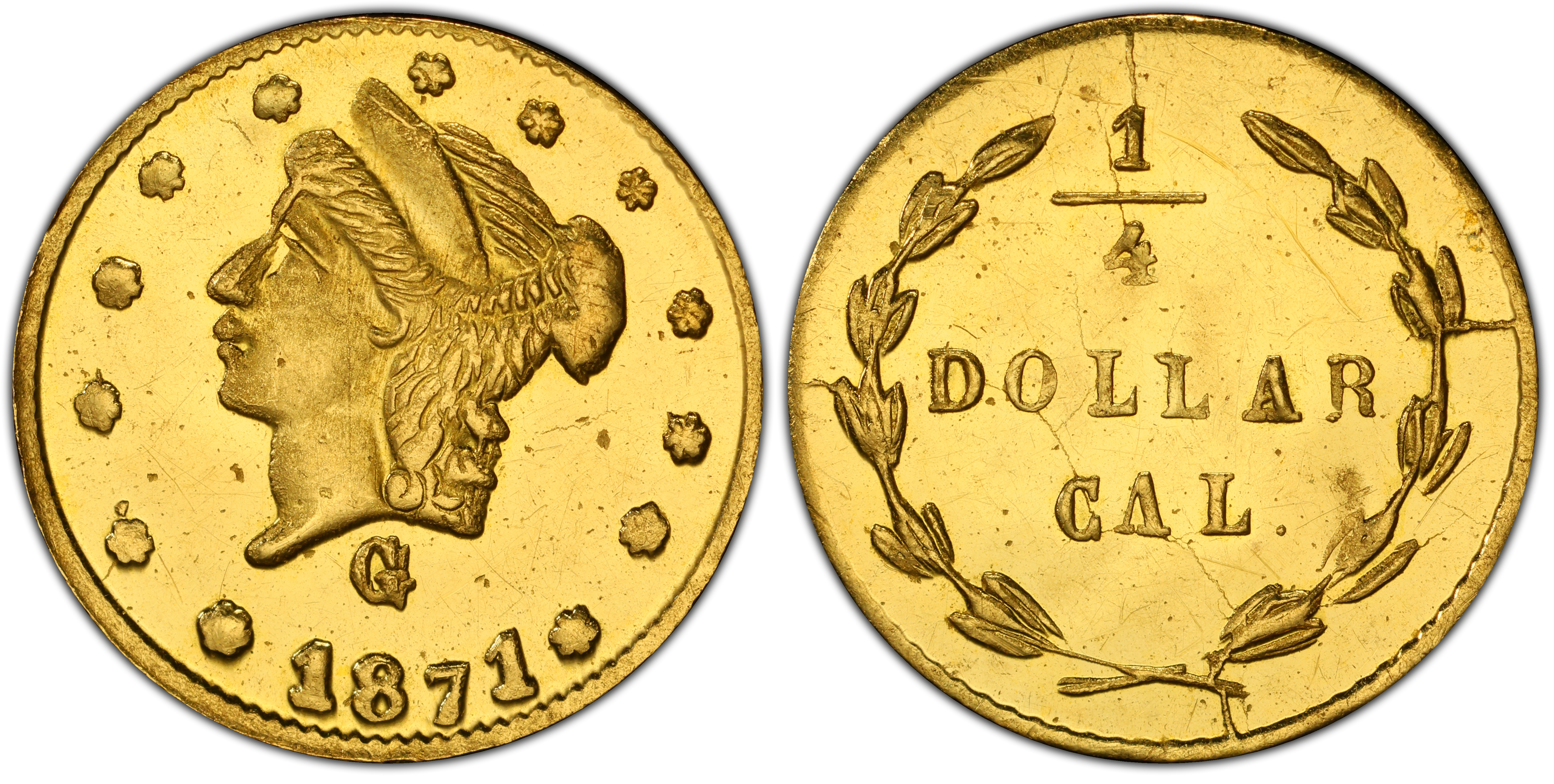
Obverse & Reverse
The 1871 BG-839 25 Cents is a product of the second period of California Fractional Gold production (post-1856), an era when these diminutive gold pieces transitioned from being essential instruments of commerce to popular souvenirs and keepsakes. The initial Gold Rush created a severe shortage of small change, which private minters filled from 1852 to 1856 with fractional gold coins that genuinely circulated. However, by the late 1850s and into the 1870s, the San Francisco Mint was in full operation, obviating the commercial need for these private issues. Jewelers and private minters, recognizing a new market, continued to produce them for eastern tourists, merchants, and those wanting a tangible, glittering memento of California's gold wealth. These later issues, often called 'souvenir' or 'jeweler's' pieces, were not intended to and did not circulate in the same manner as their Period One predecessors. The year 1871 marks a significant point in this transition, as it was the year Robert B. Gray, the likely minter, sold his interests to the California Jewelry Company. The production technique for these coins remained rudimentary, often utilizing a sledgehammer to strike the top die, which resulted in coins of varying strike quality. Many pieces from this era were struck on highly polished planchets to enhance their visual appeal, leading to the Prooflike (PL) and Deep Mirror Prooflike (DMPL) designations seen on exceptional surviving examples today. The passage of the Coinage Act of 1864 had made the private issuance of coinage illegal, but production of these pieces continued clandestinely, often backdated to avoid legal repercussions, though the 1871 date on this piece suggests a more open defiance or a belief that their status as tokens or souvenirs placed them outside the law's purview. Their intrinsic value was almost always significantly less than their face value, solidifying their status as tokens rather than true coins. Today, they are prized by collectors as a direct link to the entrepreneurial spirit of post-Gold Rush California.
Associated EventPost-California Gold Rush Economic Expansion
Reason For MintingPrimarily struck to be sold as souvenirs and keepsakes to tourists and merchants, rather than to alleviate a coinage shortage.
Minter HistoryRobert B. Gray & Co. was a prominent San Francisco jewelry firm that became involved in the production of fractional gold. The firm acquired the business of another minter, Antoine Nouizillet, around 1859-1860. Gray & Co. continued to use some of Nouizillet's dies while also creating their own, which are identifiable by the initial 'G' found on the coins, as seen on the BG-839 variety below Liberty's bust. The year 1871 is particularly significant as it marks the end of Gray's involvement; he sold his interests to the California Jewelry Co. during this year. The coins produced under Gray's tenure are part of the extensive and complex series of 'Period Two' California fractionals.
Historical SignificanceThe BG-839, as a 'Period Two' issue, represents the commercial evolution of fractional gold from necessary currency to a popular collectible and souvenir. It demonstrates the continued romantic allure of California gold long after the initial rush had subsided and highlights the legally ambiguous but persistent private minting activities of San Francisco jewelers.
BG-839
Denomination25 Cents
Minting Period1871
Assayer/MinterRobert B. Gray & Co.
Geographic OriginSan Francisco, California
Obverse DescriptionA head of Liberty facing left, her hair tied in the back with a ribbon. Thirteen stars encircle the portrait along the rim. The date 1871 is below the truncation of the neck. The minter's initial 'G' is located below the bust.
Obverse Inscription1871
Reverse DescriptionThe denomination '1/4' is centered within a wreath of two olive branches tied with a bow at the bottom. The legend 'CALIFORNIA GOLD' appears above the wreath, arching along the upper rim.
Reverse InscriptionCALIFORNIA GOLD 1/4
CompositionGold
Stated Fineness Actual FinenessVaries, typically 14 to 22 karats for this era.
Weight0.25 grams
Diameter9.50 mm
EdgePlain
Unknown
Survival EstimateFewer than 100 known across all grades based on combined PCGS and NGC census data.
Rarity ScaleLow R-4
This variety appeals to collectors due to its specific date, known minter initial, and the potential for exceptionally mirrored surfaces (DMPL). It represents a tangible piece of San Francisco's post-Gold Rush commercial history and is one of the more available, yet still scarce, varieties of dated fractional gold.
Key VarietiesThe primary variety is the BG-839 itself. One known diagnostic is a double-punched 'G' below the bust, which would be considered a minor sub-variety. The most significant variation for collectors is the surface characteristic: examples exist with standard business strikes, Prooflike (PL) surfaces, and the highly desirable Deep Mirror Prooflike (DMPL) surfaces, which command significant premiums. No original proof strikings or later restrikes are known to exist.
Authentication TipsAuthentic pieces should exhibit die characteristics consistent with the BG-839 variety. The style of the Liberty head, the font of the date, and the shape of the wreath are key. On genuine examples, the word 'GOLD' is often softly struck. Counterfeits of California fractionals are common, but they often have incorrect details, a soapy or cast-like appearance, incorrect weight, or may be gold-plated brass. Look for sharp, albeit sometimes uneven, details consistent with a die-struck piece. The 'G' initial should be clear and properly formed. Some genuine pieces exhibit minor planchet flaws or striking weaknesses, which is not unusual.
Shopping ConsiderationsFor a premium quality example, a buyer should seek out a specimen with a sharp strike on both Liberty's hair details and the reverse wreath. The ultimate prize for this variety is a coin designated DMPL by PCGS or NGC, which signifies deeply reflective, mirror-like fields. Eye appeal is paramount; look for clean surfaces free of distracting marks, cleaning scratches, or evidence of having been mounted in jewelry. Original, lustrous honey-gold or reddish-gold toning is highly desirable and adds a significant premium. Avoid pieces that are dull, heavily abraded, or show signs of harsh cleaning or tooling.
A coin's grade is its condition, rated on a 1-70 scale. For rare coins, this is the most critical factor in determining value, as a tiny difference in preservation can mean a huge difference in price.
Relevant Grade TypesOriginal issues of BG-839 were business strikes, many struck on polished planchets to enhance their appeal as souvenirs. They are found in Circulated (1-58) and, more commonly, Mint State (MS, 60-70) grades. No proofs were struck during the original period of issue. The special designations of Prooflike (PL) and Deep Mirror Prooflike (DMPL) are applicable to high-grade Mint State examples that were struck using highly polished dies on polished planchets, creating a distinct cameo contrast between the devices and mirrored fields. These are not a different type of strike but rather a special surface characteristic of a business strike.
Mint State CharacteristicsUncirculated examples are defined by their luster and lack of wear. For the BG-839, a typical Mint State coin may still show some softness in the strike, particularly on the highest points of the hair and the letters in 'GOLD'. Luster can range from satiny to intensely reflective on PL and DMPL specimens. Due to their small size and handling over time, even high-grade examples can show minute contact marks or 'ticks' that will affect the numerical grade (e.g., MS-62 vs. MS-64). A truly superb example will have sharp details, booming luster or deep mirrors, and virtually mark-free surfaces.
Circulated Wear PatternsOn circulated examples, wear first appears on the highest points of the design. For the obverse, this includes Liberty's cheek, the high points of her hair above the ear, and the eyebrow. On the reverse, the leaves and bow of the wreath will show the first signs of friction and flattening. In lower grades (VF and below), the stars on the obverse and the letters in the legends will become weak and begin to merge with the fields.
Key Factors For ValueThe single most important factor for value is the grade, followed closely by surface characteristics. A DMPL example will trade for a massive premium over a standard MS example of the same numerical grade. Surface quality is critical; original, uncleaned surfaces with attractive toning command strong prices. Strike sharpness is also key; a coin with a full strike on all elements is more desirable than a weakly struck example. Finally, certification by a top-tier service (PCGS or NGC) is essential for market acceptance, and a CAC sticker on a certified coin would add a further premium, indicating superior quality for the grade.
PCGS Price Guide
| Grade | Price | Population |
|---|---|---|
| 64 | N/A | 1 |