1881 G50C BG-965 (Regular Strike)
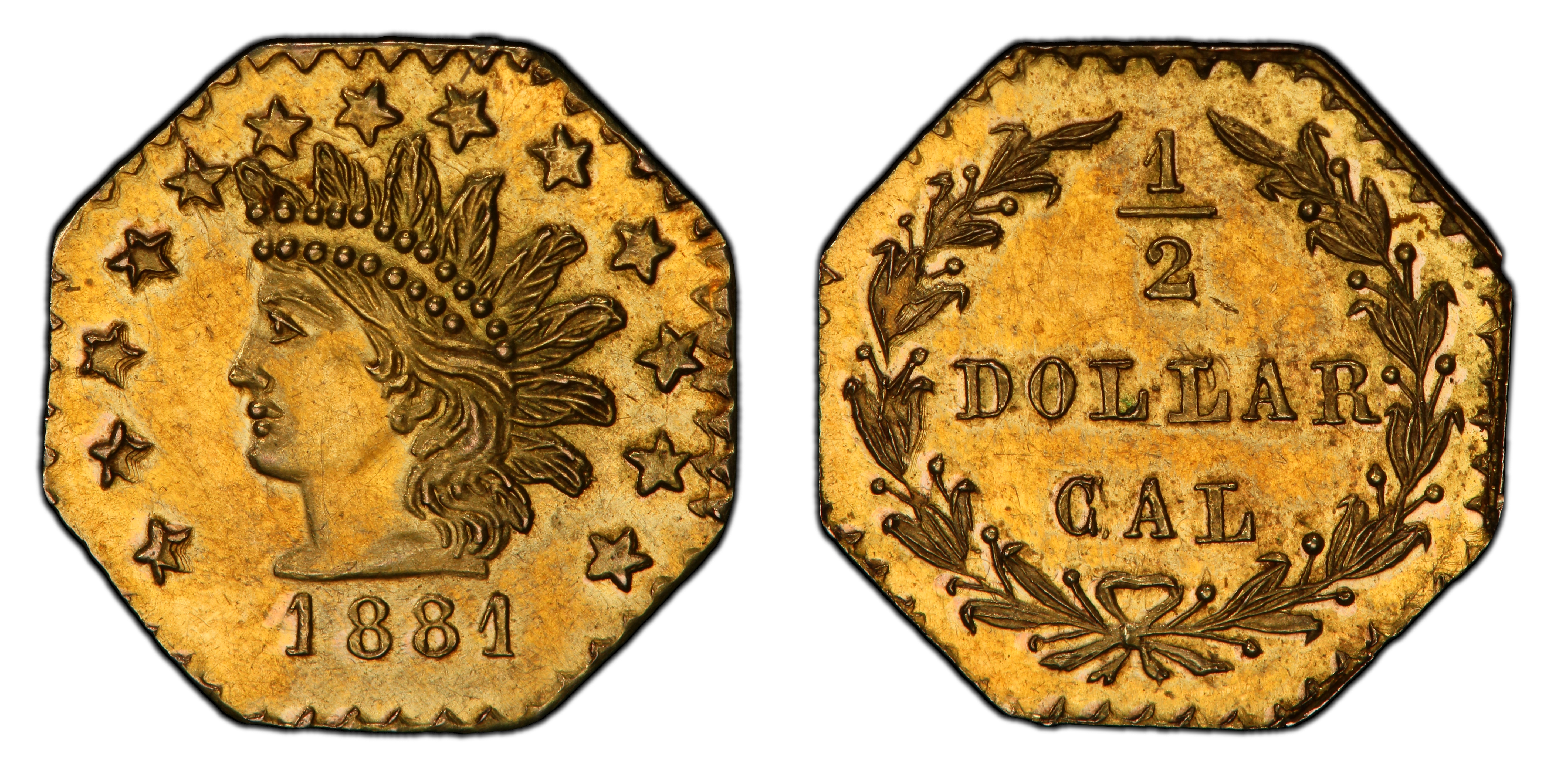
Obverse & Reverse
The 1881 G50C BG-965 is a quintessential example of a 'Period Two' or 'Jeweler's Issue' California Fractional Gold piece. By 1881, the frantic, commerce-driven need for small denomination coinage that characterized the 1850s Gold Rush had long subsided. The San Francisco Mint was producing ample federal coinage for daily transactions. Instead, these later fractional gold pieces catered to a different market: tourism, nostalgia, and the jewelry trade. The California Gold Rush had already passed into the realm of legend, and these tiny, meticulously crafted gold tokens served as popular souvenirs for visitors and sentimental keepsakes for residents. Struck by anonymous jewelers in San Francisco, these pieces operated in a legal gray area. The Coinage Act of 1864 had explicitly outlawed private coinage, but the law was not aggressively enforced by the Secret Service against these small 'tokens' until 1883. This allowed for a final flourishing of production in the late 1870s and early 1880s. The makers of BG-965, while unknown, were clearly skilled engravers, as the quality of the dies is noted by numismatists to be quite high. However, the intrinsic value of these pieces was often significantly less than their stated face value, a common trait of the jeweler's issues which were sold at a premium as novelties. Most examples were likely purchased, set aside in drawers, or mounted into jewelry, which accounts for the high proportion of survivors in Mint State condition, albeit often with signs of handling or evidence of being removed from settings. The impending enforcement of federal law brought an end to the production of denominated fractional gold in 1882, making this 1881 issue one of the last of its kind and a tangible link to the closing chapter of a uniquely American numismatic era.
Associated EventPost-Gold Rush California Tourism Boom
Reason For MintingPrimarily created as souvenirs and for use in the jewelry trade, not for general circulation.
Minter HistoryThe specific maker of the BG-965 die pair is unknown, a common characteristic for many Period Two fractional gold issues. They were part of a group of San Francisco-based jewelers and artisans who produced a wide variety of these small gold pieces to satisfy a growing tourist and novelty market in the decades following the initial Gold Rush. Their anonymity was likely a prudent measure, given the questionable legal status of privately issued, denominated coinage.
Historical SignificanceThis coin represents the twilight of private gold coinage in the United States. Produced just before the federal government began enforcing the 1864 Act in 1883, it marks the transition of fractional gold from a circulating medium of necessity to a purely commercial souvenir, reflecting California's burgeoning identity as a tourist destination built on the legend of its Gold Rush past.
BG-965
Denomination50 Cents
Minting Period1881
Assayer/MinterUnknown Maker
Geographic OriginSan Francisco, California
Obverse DescriptionAn octagonal planchet featuring a Native American (Indian) head facing left, adorned with a feathered headdress. The portrait is surrounded by thirteen stars, representing the original colonies. The date '1881' is positioned below the bust.
Obverse Inscription1881
Reverse DescriptionA wreath of 18 berries (nine per side) tied with a bow at the bottom encircles the denomination. The legend 'CALIFORNIA GOLD' would typically be outside the wreath, but on this variety, the reverse is dominated by the wreath and central denomination.
Reverse Inscription1/2
CompositionGold
Stated Fineness Actual FinenessVariable, but typically lower than U.S. Mint standard, common for jeweler's issues.
Weight0.25 grams
Diameter10.50 mm
EdgePlain
Unknown, but presumed to be very small.
Survival EstimateFewer than 20 believed extant across all grades (combining BG-965 and its thin planchet counterpart, BG-965A).
Rarity ScaleR-6 (Very Rare)
Sought for its high rarity, attractive octagonal Indian Head design, and its status as one of the final denominated issues of the California Fractional Gold series. Its well-engraved details make it a particularly appealing type.
Key VarietiesThe primary variety associated with this issue is the BG-965A, which is struck from the exact same dies as BG-965 but on a noticeably thinner planchet. No other significant contemporary varieties, patterns, or restrikes are known.
Authentication TipsAuthentic examples of BG-965 and BG-965A are characteristically struck from boldly clashed dies; evidence of the wreath from the reverse will be visible on the obverse, particularly in front of the Indian's face. The engraving style is sharp and distinct, unlike the soft, soapy details of modern replicas. Replicas often feature a bear on the reverse, which is absent from all genuine denominated fractional gold. Genuine pieces must have a denomination; those without are tokens or charms. Due to the prevalence of counterfeits, third-party authentication is highly recommended.
Shopping ConsiderationsA premium quality example for this issue is defined by a sharp strike, especially on the high points of the headdress feathers and the details of the wreath. Luster is paramount; many surviving examples are uncirculated and should exhibit either satiny or prooflike luster. Look for attractive, original reddish-gold or lemon-gold toning. Check carefully for evidence of having been previously mounted in jewelry, such as rim filing, solder marks, or tooling in the fields. The prominent die clash is a characteristic of the variety and should not be considered a major flaw unless it is unusually distracting. Given its rarity, any certified example is a significant acquisition.
A coin's grade is its condition, rated on a 1-70 scale. For rare coins, this is the most critical factor in determining value, as a tiny difference in preservation can mean a huge difference in price.
Relevant Grade TypesOriginal period issues were business strikes, although by the 1880s they were sold as souvenirs rather than for circulation. They are found in Circulated (1-58) grades, though this is uncommon, and more frequently in Mint State (MS, 60-70). No true Proofs were struck during the original period of issue. The highly reflective surfaces sometimes seen on these pieces are a result of polished planchets and are designated as Prooflike (PL) or Deep Prooflike (DPL), not as actual Proof strikings.
Mint State CharacteristicsIn uncirculated grades, BG-965 often displays a sharp, well-defined strike, a testament to the maker's skill. Luster can range from a soft, satiny texture to highly reflective, prooflike fields. Due to the prominent die clash inherent to this variety, expect to see clash marks on even the highest-grade specimens; this is a diagnostic feature, not an impairment. Contact marks, even small ones, can significantly impact the grade and value due to the coin's diminutive size.
Circulated Wear PatternsOn circulated examples, wear first appears on the high points of the Indian's cheek, the bridge of the nose, and the feathers of the headdress. On the reverse, the highest points of the wreath's leaves and the numerals of the fraction will show initial friction. In lower grades (VF and below), the stars on the obverse will begin to lose their sharp points and merge with the fields.
Key Factors For ValueFor the BG-965, value is driven by rarity and grade. Surface quality is paramount; an example with original, undisturbed luster and attractive eye appeal will command a significant premium over one that has been cleaned, polished, or previously used as jewelry. The sharpness of the strike is a key differentiator. The presence of a CAC sticker, indicating premium quality for the grade, adds a substantial premium for this and other rare territorial issues.
PCGS Price Guide
| Grade | Price | Population |
|---|---|---|
| 58 | $400.00 | N/A |
| 58+ | $440.00 | N/A |
| 60 | $500.00 | N/A |
| 61 | $600.00 | 2 |
| 62 | $750.00 | 2 |
| 62+ | $900.00 | N/A |
| 63 | $1,300.00 | 8 |
| 63+ | $1,500.00 | N/A |
| 64 | $1,850.00 | 5 |
| 66 | N/A | N/A |