1871 25C BG-838, PL (Regular Strike)
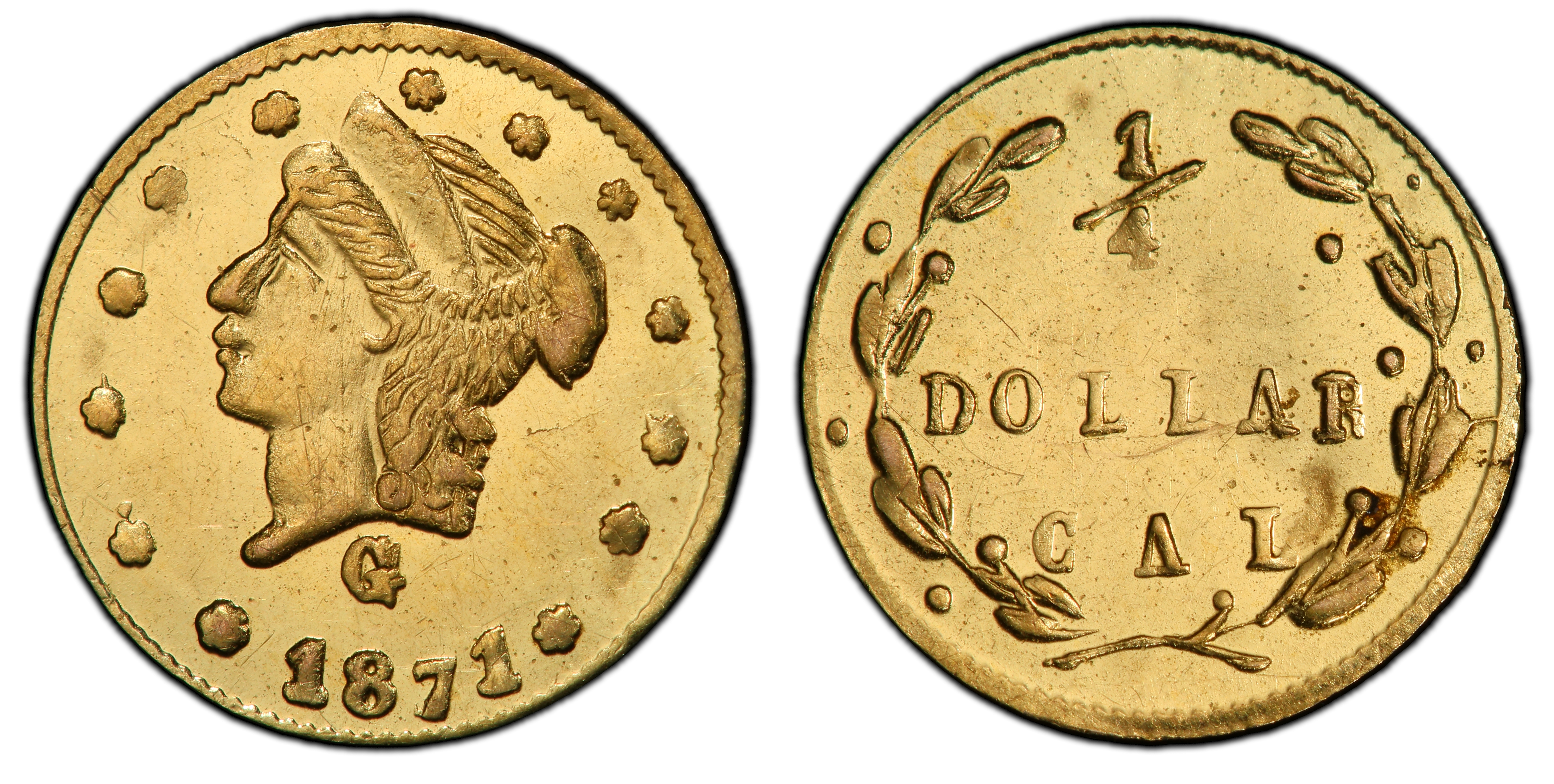
Obverse & Reverse
The 1871 BG-838 quarter dollar is a fascinating artifact from the second period of California's private gold coining era, a time when the initial chaos of the Gold Rush had subsided but the need for small-denomination coinage remained acute. Following the massive influx of population that began in 1849, California was rich in gold dust but critically poor in circulating currency, especially for minor transactions. A pinch of gold dust for a drink was an inaccurate and wasteful system. To fill this void, private minters, often jewelers by trade, began striking their own coins in the early 1850s. The first period issues (1852-1856) were genuinely intended to circulate and somewhat mirrored federal issues. However, by the time the BG-838 was produced in 1871, the landscape had changed. This coin is classified as a 'Period Two' or 'Jeweler's Issue' (1859-1882). While still addressing the coinage shortage, these pieces were often lighter in gold content than their face value suggested and served a dual purpose as both currency and popular souvenirs for Easterners fascinated by the Golden State. The production method was rudimentary; most were hand-struck using a hammer, where a planchet was placed on a bottom die and the top die was struck with a sledgehammer, leading to wide variations in strike quality. This particular variety, BG-838, is attributed to the San Francisco firm of Robert B. Gray & Co. The presence of the 'G' mintmark, for Gray, on the reverse firmly links it to his prolific output. Despite the passage of the Private Coinage Act of 1864 which made such private issues illegal, the law was not strictly enforced in the West until 1883, allowing minters like Gray to continue production. These tiny gold pieces were essential cogs in California's unique economy for decades, facilitating everyday commerce in a region geographically and economically isolated from the rest of the nation. Their eventual suppression by the Secret Service in the early 1880s marked the end of a remarkable and freewheeling chapter in American monetary history.
Associated EventPost-Gold Rush Economic Expansion
Reason For MintingTo alleviate a chronic shortage of small-denomination circulating coinage for daily commercial transactions in California.
Minter HistoryRobert B. Gray & Co. was a significant San Francisco-based jeweler and a prolific producer of California fractional gold during the second period of issue. Gray's involvement in the trade deepened around 1859 when he reportedly purchased the business of another private minter, Antoine Louis Nouzillet. From his San Francisco establishment, Gray produced a wide variety of fractional gold pieces, typically marked with a 'G' on the reverse. His coins, including both round and octagonal quarter dollars, half dollars, and dollars, are characteristic of the 'jeweler's issues' of the era—often professionally crafted but not always containing their full face value in gold. His operation continued well after the 1864 federal law prohibiting private coinage, a testament to the lax enforcement on the distant West Coast and the continued local demand for these convenient coins.
Historical SignificanceThe BG-838 is a tangible link to the unique economic conditions of post-Gold Rush California. It represents a period when private enterprise, not the federal government, provided the necessary medium for everyday trade in a remote but booming economy. As a 'jeweler's issue,' it also highlights the evolution of these pieces from pure necessity to popular souvenirs, reflecting California's growing identity and mystique in the national consciousness. The coin's very existence, struck in defiance of federal law, speaks to the independent and pragmatic character of the American West.
BG-838
Denomination25C
Minting Period1871
Assayer/MinterRobert B. Gray & Co.
Geographic OriginSan Francisco, California
Obverse DescriptionA head of Liberty facing left, with loosely curled hair tied by a band inscribed LIBERTY. She is encircled by thirteen six-pointed stars, representing the original colonies. The date, 1871, is below the truncation of the bust.
Obverse InscriptionLIBERTY
Reverse DescriptionThe denomination '1/4 DOLLAR' is enclosed within a simple wreath composed of two olive branches tied together at the bottom with a bow. Above the wreath is the inscription 'CAL.' and below the bow is a small letter 'G', the mintmark of Robert B. Gray.
Reverse InscriptionCAL. 1/4 DOLLAR G
CompositionGold
Stated Fineness Actual Fineness Diameter10.00 mm
EdgePlain
Unknown
Survival Estimate200-300
Rarity ScaleR-2
This coin is highly sought after for its direct connection to the romantic California Gold Rush era, its status as a privately minted coin, and its affordability relative to other territorial gold. The BG-838 is a popular and relatively common variety, making it an accessible entry point into the complex series of California Fractional Gold. The distinct 'G' mintmark provides a clear link to a known San Francisco minter.
Key VarietiesThe primary variety is the regular business strike. However, specimens with deeply mirrored fields and frosty devices are designated as Proof-Like (PL) by grading services. These PL coins are significantly scarcer than the standard strikes and command a substantial premium. No true proof examples were struck during the original minting period. A unique pair of BG-838s struck on single and double clipped planchets from the same gold strip is known, representing a major mint error for the series.
Authentication TipsAuthentic BG-838 specimens have several key diagnostics. The initial 'G' on the reverse is often boldly repunched. On the reverse, the letters 'CAL' are very widely spaced. The overall strike can be weak in areas, a common characteristic of the hammer-striking process; in fact, an unusually sharp, perfect strike can be a sign of a modern replica. Genuine pieces are tiny and thin. Beware of counterfeits which are often thicker, have a soapy or cast appearance, incorrect details, or feature a bear on the design (no genuine fractional gold coins from this era depicted bears). Referencing the Breen-Gillio photographic plates is essential for verification.
Shopping ConsiderationsWhen acquiring an 1871 BG-838, prioritize examples with problem-free surfaces and minimal marks. For its grade, a premium quality specimen will exhibit a sharp strike on the highest points of Liberty's hair and the wreath on the reverse. Luster is a key value determinant; coins with original, satiny mint luster are far more desirable than cleaned or processed examples. For Proof-Like (PL) designated coins, the level of reflectivity in the fields and the frost on the devices defines the quality. Avoid pieces that have been harshly cleaned, bent, holed for jewelry (a common fate for these small coins), or show evidence of tooling or repairs. Third-party certification by PCGS or NGC is highly recommended for this series due to the prevalence of counterfeits.
A coin's grade is its condition, rated on a 1-70 scale. For rare coins, this is the most critical factor in determining value, as a tiny difference in preservation can mean a huge difference in price.
Relevant Grade TypesOriginal period issues of BG-838 were business strikes intended for circulation and as such are found in Circulated (1-58) and Mint State (MS, 60-70) grades. No true Proofs were struck in 1871. A special category exists for business strikes that exhibit exceptional surface characteristics from freshly polished dies; these are designated as Proof-Like (PL). A PL designation is not a separate strike type but an attribute of a business strike, and these examples are highly prized by collectors and are much rarer than typical Mint State specimens.
Mint State CharacteristicsIn uncirculated grades, the BG-838 often displays a soft, satiny luster. The strike can be inconsistent due to the manual hammer-striking process; it is common to see some weakness in the center of the obverse or reverse. High-grade examples will show strong details in Liberty's hair and the wreath leaves. Because the gold is soft, contact marks are common, even on Mint State examples. The quality of luster and the absence of distracting marks are the primary drivers of grade within the MS-60 to MS-70 range. Proof-Like (PL) examples are judged by the depth of the mirror-finish in the fields.
Circulated Wear PatternsWear first appears on the highest points of the design. On the obverse, look for flattening on the strands of Liberty's hair above her eye and on her cheekbone. On the reverse, the high points of the wreath's leaves and the bow will show wear first. In lower grades (VF and below), the word 'LIBERTY' on the headband will become indistinct, and the fine details of the wreath will merge.
Key Factors For ValueFor the BG-838, value is primarily determined by grade, surface preservation, and strike quality. A sharp, well-centered strike is always preferred. Original, uncleaned surfaces with attractive luster command significant premiums. Eye appeal is critical; coins with a pleasing, original reddish-gold toning are highly desirable. The Proof-Like (PL) designation adds a substantial premium due to its rarity and beauty. Finally, given the challenges of this series, a CAC sticker, indicating a premium quality coin for its assigned grade, will often result in a much higher market value.
PCGS Price Guide
| Grade | Price | Population |
|---|---|---|
| 62 | N/A | 1 |
| 63 | $500.00 | 2 |
| 63+ | $575.00 | N/A |
| 64 | $675.00 | 2 |