1881 G50C BG-956, PL (Regular Strike)
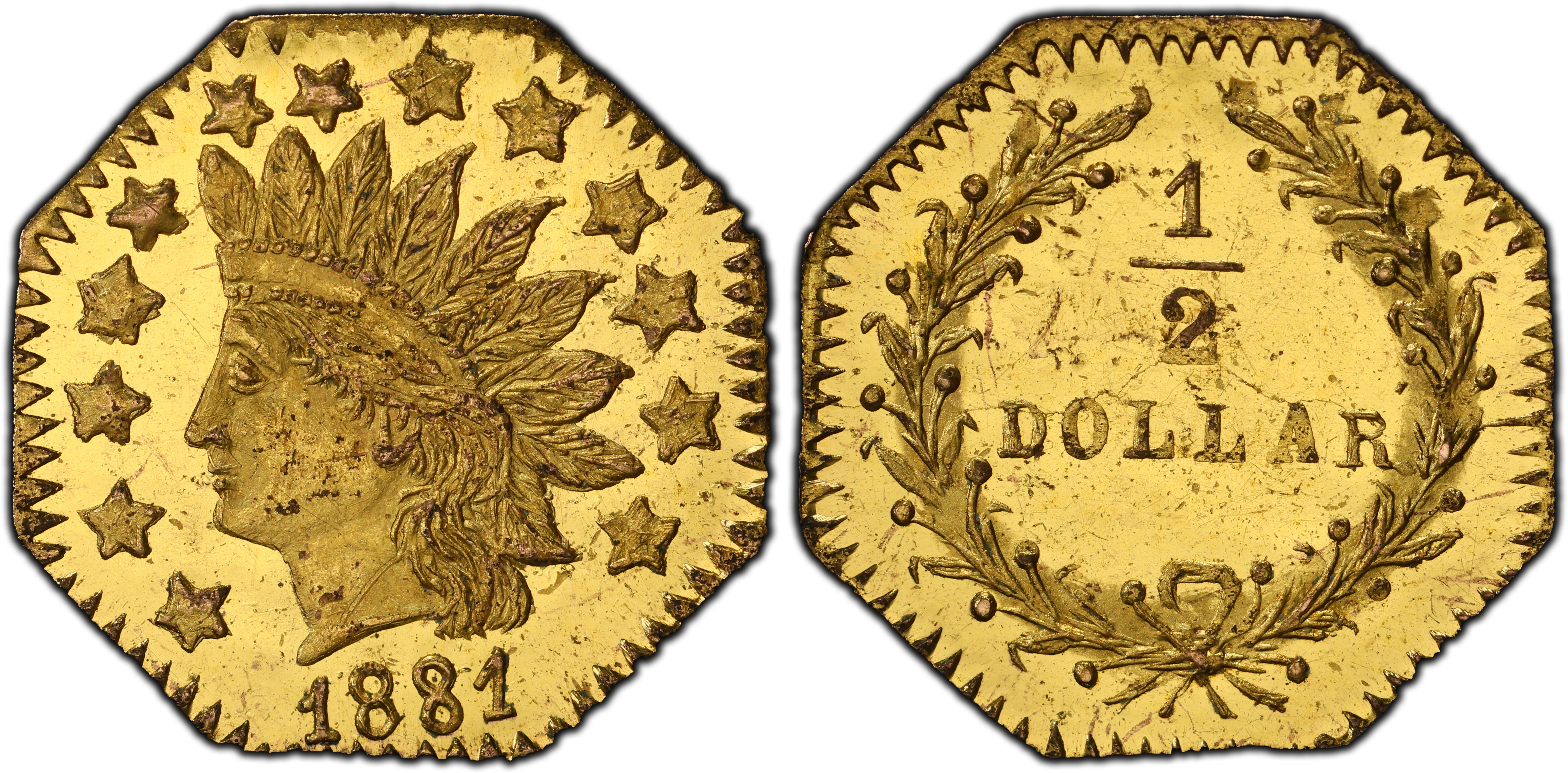
Obverse & Reverse
The 1881 BG-956 50 Cents piece emerges from the second major period of California Fractional Gold production (1858-1882), a fascinating era that saw these miniature coins transition from urgent necessity to commercial souvenirs. The initial gold rush frenzy (1849-1856) had created a severe shortage of small change, as the massive influx of gold dust and nuggets overwhelmed the limited supply of federal coinage. Private minters stepped into this vacuum, producing fractional gold coins in 25c, 50c, and $1 denominations to facilitate everyday trade. However, by the 1870s and early 1880s, the economic landscape of California had matured. The United States Mint in San Francisco was in full operation, and the acute coinage shortage had largely abated. The Coinage Act of 1864 had officially outlawed private coinage, yet it was not strictly enforced in the West until 1883. This legal gray area allowed for the continued production of 'Cal Fracs,' but their purpose shifted. No longer essential for commerce, they became popular keepsakes and curiosities for tourists and collectors. Jewelers in San Francisco, many of whom were the successors to the original private minters, recognized this new market. They began striking a wide variety of attractive, often intricate designs, like the Indian Head motif seen on BG-956. These later issues, sometimes called 'jeweler's issues,' were often struck with greater care than their utilitarian predecessors, frequently exhibiting prooflike surfaces from polished dies, intended to appeal to a buyer's eye. The 1881-dated issues represent the twilight of this unique numismatic chapter, struck just before the Secret Service finally cracked down on all private issues, bringing the era of circulating private gold in the United States to a definitive close.
Associated EventPost-Gold Rush California Economic Expansion
Reason For MintingPrimarily produced as souvenirs and collector's items during a period when the original commercial need for fractional gold had subsided but private minting was not yet fully suppressed.
Minter HistoryThe specific minter of BG-956 is unrecorded, a common trait for many 'Period Two' California Fractional Gold pieces. The production during this time was dominated by various jewelers and private entities in San Francisco who often did not apply a specific maker's mark. These craftsmen, successors to minters like Antoine Nouizillet and Robert B. Gray & Co., leveraged their skills in metalworking to create these small-denomination gold pieces for the growing souvenir market. Their operations were typically small-scale, using hand-operated screw presses or even the older hammer-and-anvil method, which resulted in coins of varying strike quality.
Historical SignificanceThe BG-956 is significant not as a coin of necessity, but as a representation of the commercial adaptation of a uniquely American coinage tradition. It marks the final phase of a 30-year period of private minting in California, reflecting the transition from a frontier economy to a more established and touristed state. These late-date pieces are tangible links to the enduring legacy of the Gold Rush, transformed into mementos of that adventurous era just before federal law ended the practice for good.
BG-956
Denomination50 Cents
Minting Period1881
Assayer/MinterUnknown, likely San Francisco-based jeweler
Geographic OriginSan Francisco, California
Obverse DescriptionAn octagonal planchet featuring a stylized portrait of a Native American princess facing left, wearing a feathered headdress. The portrait is encircled by 13 six-pointed stars, representing the original colonies. The date '1881' is positioned below the bust.
Obverse Inscription1881
Reverse DescriptionThe central device is the denomination '1/2' surrounded by an ornate wreath of leaves and berries, tied with a bow at the bottom. The legend 'CALIFORNIA GOLD' is inscribed in an arc above the wreath.
Reverse InscriptionCALIFORNIA GOLD 1/2
CompositionGold
Stated Fineness Actual FinenessVaries, but typically lower than federal standards for the period, often between .500 and .800 fine.
Weight0.25 grams
Diameter10.10 mm
EdgePlain
Unknown, but very low
Survival Estimate76-150 known
Rarity ScaleR-4+
This variety is sought after for its attractive Indian Head design, octagonal shape, and status as a late-date, high-quality 'jeweler's issue.' The frequent prooflike (PL) surfaces provide exceptional eye appeal for the type, making it a favorite among collectors building sets of California Fractional Gold.
Key VarietiesThe primary variety is the regular business strike, BG-956, which itself is often found with prooflike surfaces due to being struck from polished dies. There are no known major die varieties, patterns, or official restrikes for this specific catalog number. The Breen-Gillio reference is the definitive guide, and any piece not listed is considered a replica or fantasy piece.
Authentication TipsGenuine BG-956 pieces will have a denomination ('1/2') and will not feature a bear on the reverse, a common motif on modern replicas. The strike can be uneven, a characteristic of genuine, thinly-rolled planchets struck by hand. Fakes are often overly sharp and uniform. The stars on the obverse should be distinct but may show some softness. The lettering should match the font illustrated in the Breen-Gillio reference. Third-party grading by PCGS or NGC, who attribute by BG number, is highly recommended for authentication.
Shopping ConsiderationsA premium quality example of BG-956 will exhibit sharp details on the high points of the Indian's headdress and the leaves of the wreath. Look for original, undisturbed prooflike or semi-prooflike luster in the fields. These coins are tiny and prone to damage; inspect carefully for bends, rim bumps, or evidence of having been mounted in jewelry. Avoid examples that have been harshly cleaned, which will appear unnaturally bright and have hairline scratches. A specimen with attractive, original reddish-gold toning and minimal contact marks commands a significant premium.
A coin's grade is its condition, rated on a 1-70 scale. For rare coins, this is the most critical factor in determining value, as a tiny difference in preservation can mean a huge difference in price.
Relevant Grade TypesOriginal period issues were business strikes intended for the souvenir market, not general circulation. Therefore, they are typically found in high circulated grades (AU) or, more commonly, Mint State (MS, 60-70). While no official 'Proofs' were struck, the use of polished dies was common, resulting in coins with prooflike (PL) or deep mirror prooflike (DMPL) surfaces, a desirable characteristic noted by grading services. These are not a separate issue but a quality of the original strike.
Mint State CharacteristicsUncirculated examples of BG-956 are defined by their luster and strike. High-grade specimens display reflective, prooflike fields, though often with some light friction or 'cabinet rub' that doesn't break the luster. The strike is characteristically weak on the centermost feathers of the headdress and the bow on the reverse wreath due to the challenges of striking such a small, thin planchet. A well-struck piece with strong central details is rare and desirable.
Circulated Wear PatternsAlthough most examples are uncirculated, any wear would first appear on the highest points: the cheek and feathers of the Indian princess on the obverse, and the high points of the wreath leaves and the numerals '1/2' on the reverse. In lower grades, the delicate stars on the obverse would begin to merge with the fields.
Key Factors For ValueThe primary value driver for BG-956 is the quality of its surface preservation. A coin with deep, original prooflike fields and minimal distracting marks will be far more valuable than a hazy or heavily marked MS-62. Strike sharpness is the second key factor; a bold strike that brings up the details in the center of the design is highly prized. Eye appeal, encompassing attractive toning and mark-free surfaces, is paramount. A CAC sticker for this issue confirms premium quality for the grade and adds a significant premium.
PCGS Price Guide
| Grade | Price | Population |
|---|---|---|
| 62 | $500.00 | N/A |
| 62+ | $550.00 | N/A |
| 63 | $625.00 | 1 |
| 63+ | $700.00 | N/A |
| 64 | $775.00 | N/A |
| 64+ | $900.00 | N/A |
| 65 | $1,050.00 | 1 |
| 65+ | $1,300.00 | N/A |
| 66 | $1,750.00 | 1 |
| 68 | N/A | N/A |