1874 G25C BG-843 (Regular Strike)
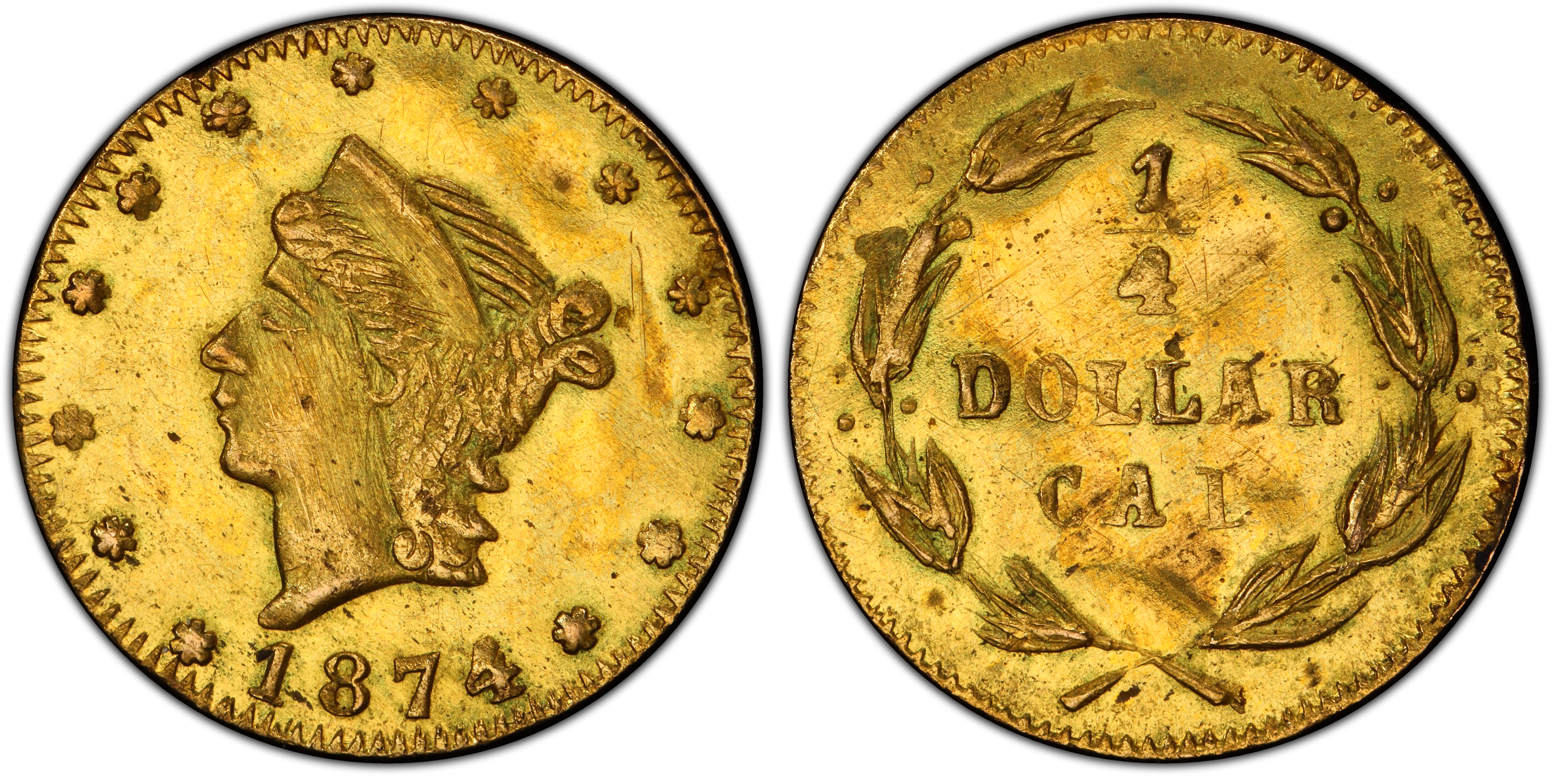
Obverse & Reverse
The 1874 BG-843 25 Cents is a quintessential example of a 'Period Two' California Fractional Gold piece, a fascinating and complex chapter in American numismatics. The story of these coins begins two decades earlier during the California Gold Rush. The massive influx of gold dust and nuggets created a booming economy, but a severe shortage of small-denomination circulating coinage made daily transactions cumbersome. To fill this void, private jewelers and metallurgists began striking their own fractional gold coins in 25-cent, 50-cent, and one-dollar denominations starting in 1852. These 'Period One' issues (1852-1857) were generally of good weight and genuinely served a vital commercial need. However, the landscape changed dramatically with the passage of the Private Coinage Act of 1864, which explicitly made such private minting illegal. By the 1870s, the initial commercial necessity had largely vanished due to increased output from the San Francisco Mint. Despite the federal prohibition, enforcement was notoriously lax, especially within California. This legal ambiguity gave rise to the 'Period Two' or 'Jewelers' Issues' (1858-1882), of which the BG-843 is a part. These later pieces were not minted to facilitate commerce but were instead created as souvenirs, charms, and keepsakes for tourists and locals captivated by the romance of the Gold Rush. Struck by various jewelers, primarily in San Francisco, these coins were often underweight, thinner, and produced with a focus on novelty rather than intrinsic value. The production of BG-843 in 1874 occurred during the peak of this souvenir trade. San Francisco was a bustling, cosmopolitan city, and these tiny gold tokens were popular mementos. Their existence was a quiet act of defiance against federal law, a practice that would continue until the Secret Service finally cracked down on all private minting operations in 1883, bringing the era of California Fractional Gold to a definitive end. Today, the BG-843 is valued not as a coin that saw heavy circulation, but as a rare artifact of a unique economic and cultural period, representing the persistent entrepreneurial spirit of the West and the enduring legacy of the Gold Rush.
Associated EventCalifornia Gold Rush (Later Souvenir Period)
Reason For MintingPrimarily created as a souvenir or charm for the tourist trade, not for general circulation, during a period when private minting was illegal but unenforced.
Minter HistoryThe specific minter or jeweler who produced the BG-843 variety is not definitively known, a common trait for many 'Period Two' issues. Research by specialists like Walter Breen and Ronald Gillio has identified numerous San Francisco-based jewelers who were active in this trade, such as Nouizillet, Deriberpe, Frontier & Deviercy, and Herman J. Brand. These artisans operated in a quasi-legal space, creating dies and striking these miniature gold pieces often by hand using hammer presses. Given the extreme rarity of the BG-843, it was likely produced in a very small batch by one of these small-scale operations.
Historical SignificanceThe BG-843 is significant as it represents the later, souvenir-driven phase of California's private gold coinage. Unlike its 'Period One' predecessors, its existence highlights the transition from utilitarian necessity to commercial nostalgia. It stands as a tangible artifact of a legally gray market that thrived on the mythos of the Gold Rush, produced in defiance of federal law until enforcement finally caught up, ending a unique 30-year chapter of American monetary history.
N/A
Denomination25 Cents
Minting Period1874
Assayer/MinterUnknown Private Minter
Geographic OriginSan Francisco, California
Obverse DescriptionFeatures a Liberty Head facing left, modeled after contemporary federal gold coinage but often of a cruder, more stylized execution. The portrait is surrounded by 13 six-pointed stars representing the original colonies. The date '1874' is positioned below the bust truncation.
Obverse Inscription1874
Reverse DescriptionA wreath of two branches tied with a bow at the bottom encircles the denomination. The design is typically simple, with the fraction '1/4' appearing at the center, and the word 'DOLLAR' below it.
Reverse Inscription1/4 DOLLAR
CompositionGold
Stated Fineness Actual FinenessVaries, but 'Period Two' issues are notoriously underweight and often of a lower fineness than federal issues, sometimes as low as 14 karat.
Weight0.24 grams
Diameter9.50 mm
EdgePlain
Unknown
Survival Estimate4 to 12 pieces known.
Rarity ScaleR-7
The BG-843 is highly coveted for its extreme rarity (R-7). As a 'Period Two' issue, it appeals to specialists completing Breen-Gillio variety sets and collectors of historical Americana who appreciate the souvenir and 'suppressed issue' aspects of the series. Its tiny size and connection to the Gold Rush mythos add to its allure.
Key VarietiesNo major varieties of the BG-843 itself are cataloged. As a 'Period Two' issue, it is considered a business strike intended for sale as a souvenir. No proof or presentation strikings are known to exist for this specific variety. The primary variations in the broader series relate to obverse and reverse die pairings, resulting in over 500 distinct BG numbers.
Authentication TipsAuthentic BG-843 specimens will feature the denomination '1/4 DOLLAR'. Many contemporary counterfeits and later fantasy pieces will say '1/4 CAL GOLD' or omit a denomination entirely to circumvent laws. The strike on genuine pieces is often soft in areas, particularly on the stars or parts of the wreath. Replicas are often sharply struck with a uniform, lifeless surface. Look for diagnostic die markers if high-quality images of certified examples are available. Genuine pieces were struck in gold, though often of low purity; fakes are typically gold-plated base metal and will have an incorrect weight and specific gravity.
Shopping ConsiderationsFor a coin of this rarity, any example is a major acquisition. A 'premium quality' example would be one that avoids the common problems of jewelry use, such as being holed, bent, or showing evidence of solder. Look for an example with a sharp, well-centered strike, as many fractionals are weakly struck or off-center. Shimmering, prooflike surfaces are sometimes encountered and are highly desirable. Pay close attention to the surfaces; because of their history as souvenirs, many were harshly cleaned or polished over the years. An example with original skin and minimal distracting marks, even if in a circulated grade like AU, is far superior to a cleaned mint state piece. Third-party grading by PCGS or NGC is essential for authenticity and liquidity.
A coin's grade is its condition, rated on a 1-70 scale. For rare coins, this is the most critical factor in determining value, as a tiny difference in preservation can mean a huge difference in price.
Relevant Grade TypesOriginal period issues were business strikes intended for sale as souvenirs, not for circulation. Therefore, they are found in both Circulated (1-58, often from handling or light pocket wear) and Mint State (MS, 60-70) grades. Due to their purpose as novelties, high-grade examples are more common than with 'Period One' issues, though problem-free coins are still scarce. No Proof (PR/PF) examples of BG-843 were struck during the original minting period, and no later restrikes are known.
Mint State CharacteristicsAn uncirculated BG-843 is defined by its luster, though it can vary. Some exhibit shimmering, prooflike fields, while others may have a more subdued, satiny texture. The strike is a key differentiator; many are softly struck, especially on the highest points of Liberty's hair and the leaves of the wreath. A well-struck example with full details is rare and commands a significant premium. Due to being stored as keepsakes, contact marks can be minimal but are often present. The quality of the planchet is also a factor, with some showing inherent roughness or striations from their crude method of production.
Circulated Wear PatternsAlthough not intended for heavy circulation, wear from handling first appears on the highest points of the design. On the obverse, look for flattening on Liberty's hair above the eye and on the cheekbone. On the reverse, the highest leaves of the wreath and the bow will show the first signs of friction. In lower grades (VF and below), the finer details of the hair and leaves will merge, and the stars will begin to lose their points.
Key Factors For ValueFor the BG-843, rarity is the primary value driver. Beyond that, the key factors are surface quality and strike. An example with original, uncleaned surfaces and attractive prooflike or frosty luster will be prized. Strike is critical; a specimen with a bold impression of the date, stars, and wreath details is far more valuable than a weakly struck, mushy example of the same grade. Eye appeal, encompassing toning (some develop a reddish-gold patina) and the absence of distracting marks or planchet flaws, is paramount. A CAC sticker would provide a strong premium, confirming that the coin is of superior quality for its assigned grade.
PCGS Price Guide
| Grade | Price | Population |
|---|---|---|
| 50 | $300.00 | 1 |
| 50+ | $310.00 | N/A |
| 53 | $325.00 | N/A |
| 53+ | $335.00 | N/A |
| 55 | $350.00 | 1 |
| 55+ | $360.00 | N/A |
| 58 | $400.00 | 1 |
| 58+ | $425.00 | N/A |
| 60 | $500.00 | N/A |
| 61 | $600.00 | 1 |
| 62 | $700.00 | N/A |
| 62+ | $750.00 | N/A |
| 63 | $950.00 | 7 |
| 63+ | $1,175.00 | N/A |
| 64 | $1,500.00 | 1 |