1875 25C BG-797, PL (Regular Strike)
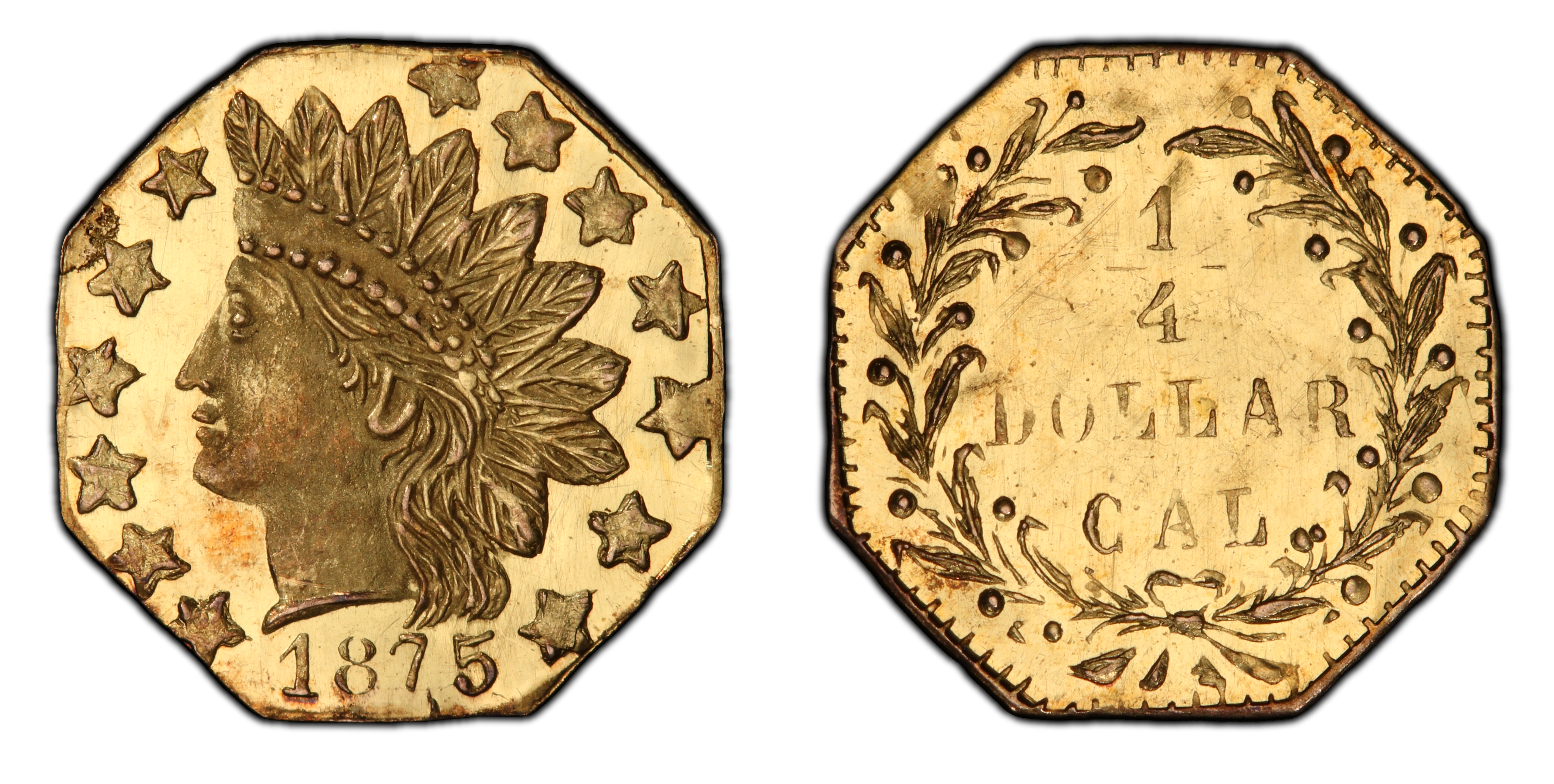
Obverse & Reverse
The 1875 Octagonal 25 Cents, cataloged as Breen-Gillio 797, is a quintessential example of a 'Period Two' California Fractional Gold piece. By the mid-1870s, the initial, desperate need for small denomination coinage that characterized the California Gold Rush had largely subsided. The establishment and high output of the San Francisco Mint had saturated the region with official federal silver and gold coins, rendering the original purpose of privately-issued fractional gold obsolete. However, a new market had emerged, driven by tourism, nostalgia, and the American fascination with the 'Wild West.' Jewelers and private minters, recognizing this demand, continued to produce these miniature gold pieces, not for circulation, but as souvenirs, keepsakes, and jewelry items. These 'jeweler's issues' were typically underweight for their face value and often struck with less care than their Period One predecessors, though many, like the BG-797, exhibit surprisingly sharp details and prooflike surfaces. The BG-797 is attributed to Christopher Ferdinand Mohrig, a prominent San Francisco jeweler and one of the most prolific producers of these souvenir coins. Mohrig's operation created a wide range of varieties in the BG-790s series. His activities, however, drew the attention of the U.S. Secret Service, which viewed the private minting of denominated coins as a violation of the Coinage Act of 1864. On August 10, 1876, Mohrig was arrested, and his minting equipment and remaining coin stock were confiscated and destroyed. This dramatic end to his operation explains the relative scarcity of many of his issues, including those dated 1875, as they were produced just before his enterprise was forcibly shuttered. The existence of the BG-797 today is a direct link to this final, contentious chapter of private coining in California, representing a piece made not for the miner's pouch, but for the tourist's pocket, a memento of a Gold Rush that had already passed into legend.
Associated EventPost-Gold Rush California Tourism
Reason For MintingPrimarily produced as souvenirs and keepsakes for the growing tourism trade, not for monetary circulation.
Minter HistoryChristopher Ferdinand Mohrig was a San Francisco-based jeweler and a significant, prolific minter of 'Period Two' California Fractional Gold. He is credited with producing many of the varieties cataloged in the BG-790s range. His enterprise came to an abrupt end when he was arrested by the U.S. Secret Service on August 10, 1876, for violating federal laws against private coinage. His dies and coins were seized, contributing to the rarity of his surviving pieces.
Historical SignificanceThe BG-797 is significant as a product of the commercialization of the Gold Rush legend. It represents the transition of fractional gold from a circulating medium of necessity to a souvenir item, and its minter's eventual suppression by federal authorities highlights the final chapter of private coinage in the United States.
K-N/A (BG-797)
Denomination25 Cents
Minting Period1875
Assayer/MinterChristopher Ferdinand Mohrig
Geographic OriginSan Francisco, California
Obverse DescriptionFeatures a stylized Indian Head facing left, wearing a feathered headdress. The portrait is surrounded by 13 five-pointed stars, typically arranged with seven to the left and six to the right. The date '1875' is below the bust truncation.
Obverse Inscription1875
Reverse DescriptionA simple wreath composed of two branches tied with a bow at the bottom encircles the denomination. The berries and leaves can vary in sharpness depending on the strike.
Reverse Inscription1/4 DOLLAR CAL.
CompositionGold
Stated Fineness Actual FinenessTypically around .500 to .750 fine, though varies.
Weight0.25 grams
Diameter9.80 mm
EdgePlain
Unknown, but very small.
Survival Estimate75-125 known examples across all grades.
Rarity ScaleR-4 (Low R-4)
This variety is highly popular due to its classic Indian Head design, octagonal shape, and the high frequency of surviving examples with deeply reflective, prooflike (PL) or deep prooflike (DPL) surfaces, which create a stunning cameo effect. Its connection to the well-documented minter Christopher Mohrig adds historical appeal.
Key VarietiesThe primary variety is the regular business strike. No major die varieties from the original minting period are widely collected. Importantly, no later-date restrikes or special collector issues are known for BG-797; all known examples are original 'jeweler's issues' from 1875.
Authentication TipsGenuine BG-797 pieces must have the denomination '1/4 DOLLAR' and 'CAL.' on the reverse; replicas often have a bear or lack a denomination. The strike is often uneven, with some softness in the stars or wreath, a characteristic of the crude hammer-striking process. Replicas are often perfectly struck and unnaturally uniform. Look for die polish lines in the fields, which are common on authentic pieces and contribute to the prooflike appearance. The surfaces should be consistent with 19th-century gold, not a modern brassy or plated look.
Shopping ConsiderationsA premium quality example for its grade is defined by the depth and clarity of its prooflike surfaces. Look for coins with a strong cameo contrast between the frosty devices (Indian Head, wreath) and the mirrored fields. A sharp strike is critical; check for full details in the headdress feathers and the leaves of the wreath. Many pieces were used as jewelry, so carefully inspect for evidence of mounting, tooling, or harsh cleaning which will drastically reduce value. Original, reddish-gold toning is highly desirable and commands a significant premium.
A coin's grade is its condition, rated on a 1-70 scale. For rare coins, this is the most critical factor in determining value, as a tiny difference in preservation can mean a huge difference in price.
Relevant Grade TypesAll original BG-797s were business strikes intended for sale as souvenirs. They are found in Circulated (1-58) grades, though this is uncommon, and are primarily collected in Mint State (MS, 60-70) grades. No true Proofs were struck in 1875. However, many were struck using polished dies on polished planchets, resulting in Prooflike (PL) and Deep Prooflike (DPL) surfaces, which are not a separate issue but a manufacturing characteristic that adds significant value.
Mint State CharacteristicsUncirculated examples are defined by their luster and strike. Luster is typically very flashy and reflective ('prooflike'). The strike quality can be inconsistent; a well-struck piece will show sharp details on the feathers of the headdress and the central reverse wreath, but some weakness on peripheral stars is common and acceptable. Bag marks are less common than on larger coins, but the soft gold is susceptible to small, detracting hairlines and contact marks, particularly on the high points of the cheek and headdress.
Circulated Wear PatternsWear first appears on the highest points: the cheek and brow of the Indian Head, and the feathers in the headdress. On the reverse, the highest points of the wreath and the fractional denomination will show rubbing and loss of detail first. In lower grades (VF and below), the stars on the obverse will begin to merge with the fields, and the date can become weak.
Key Factors For ValueThe single most important factor for value is the quality of the surfaces. A coin designated PL or DPL by a third-party grading service will command a substantial premium over a standard MS example. Eye appeal is paramount; collectors seek specimens with clean, mirrored fields and frosty, well-defined devices. A sharp strike, displaying full feather and wreath detail, is also critical. A CAC sticker, verifying premium quality for the grade, is highly desirable for this issue and adds significant value.
PCGS Price Guide
| Grade | Price | Population |
|---|---|---|
| 63 | $500.00 | 1 |
| 63+ | $600.00 | N/A |
| 64 | $725.00 | 1 |
| 64+ | $850.00 | N/A |
| 65 | $1,000.00 | 1 |
| 65+ | $1,250.00 | N/A |
| 66 | $2,000.00 | N/A |