1878/6 G25C BG-884 (Regular Strike)
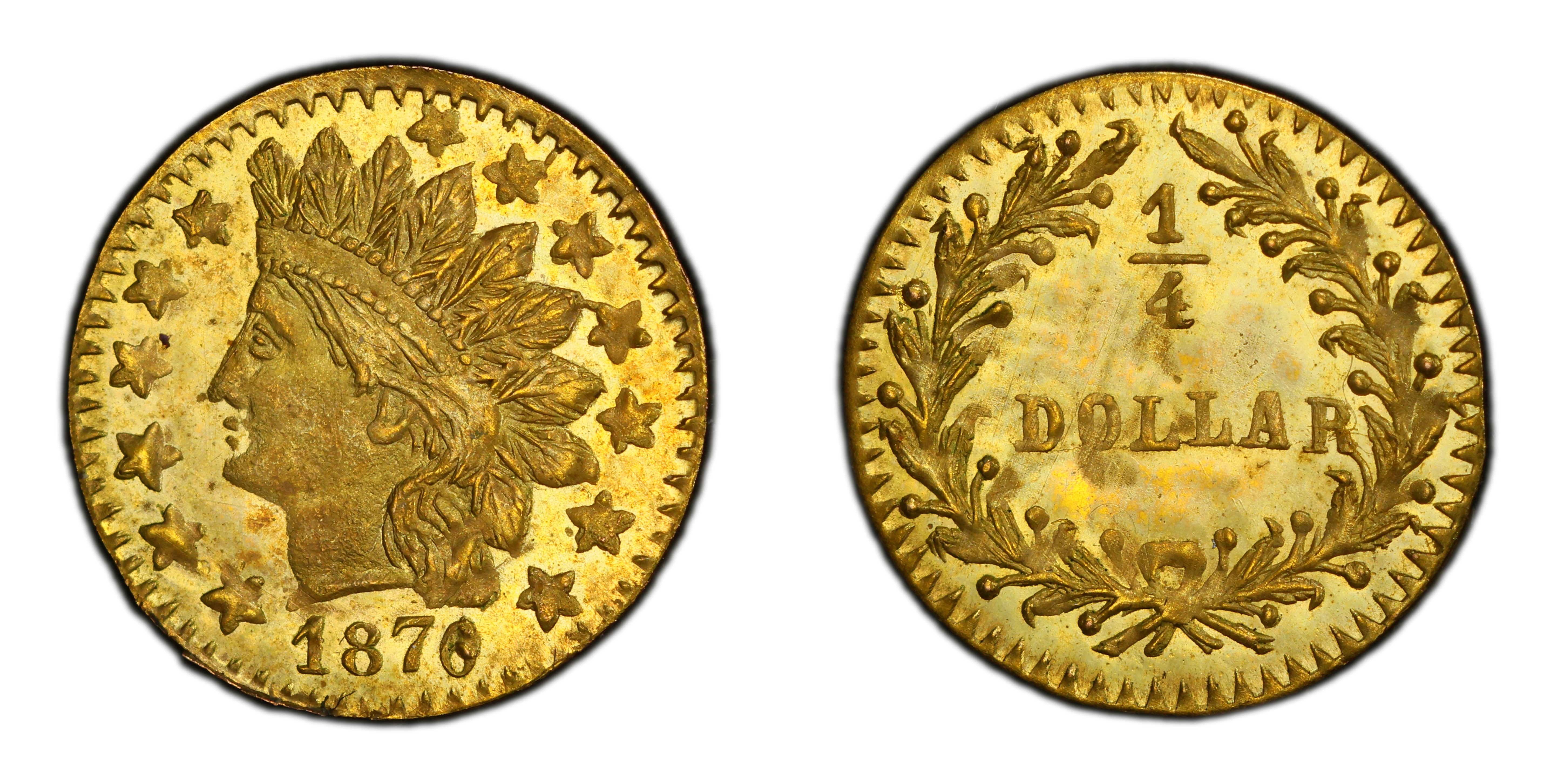
Obverse & Reverse
The 1878/6 BG-884 25 Cents represents a fascinating chapter in the story of California's privately issued gold coinage, belonging to what numismatists classify as 'Period Two' (1858-1882). By the late 1870s, the initial, desperate need for small denomination coinage that characterized the Gold Rush had long since vanished. The San Francisco Mint, operating since 1854, produced ample federal silver and minor coinage to facilitate daily commerce. The raison d'être for these minuscule gold pieces had thus shifted dramatically from utility to novelty. San Francisco had blossomed into a major metropolis and a tourist destination. Visitors from the East Coast and abroad were captivated by the romantic legacy of the '49ers and the mystique of gold. Local jewelers and private minters astutely capitalized on this sentiment, producing these small gold tokens as keepsakes and souvenirs. The BG-884 is a quintessential example of this 'jeweler's issue.' It was never intended to circulate as money in the traditional sense. The Coinage Act of April 22, 1864, had technically made all private coinage illegal. However, enforcement by the U.S. Secret Service was inconsistent and primarily focused on larger-denomination pieces that could more easily defraud the public. For nearly two decades, the production of these tiny tokens, which contained a value in gold far below their stated denomination, was largely ignored. This legal gray area allowed for a prolific and diverse series of souvenir coins to be struck. The 1878/6 overdate itself is telling; an obverse die from 1876 was crudely re-engraved to create a new 'variety' for collectors and tourists, a purely commercial motivation. These pieces were often struck using the hammer method, resulting in variability in strike quality and planchet preparation, a characteristic evident in the striated surfaces commonly seen on the BG-884. This era of souvenir gold came to a close in the early 1880s when James J. Brooks, the zealous Chief of the Secret Service, finally cracked down on their manufacture, bringing an end to the nearly 30-year tradition of private gold coin production in California.
Associated EventPost-Gold Rush California Tourism Boom
Reason For MintingTo serve as a collectible souvenir for tourists and numismatists, capitalizing on the romantic legacy of the California Gold Rush.
Minter HistoryThe BG-884 variety is not attributed to a single, known minter. It was produced by one of the numerous San Francisco-based jewelers who created a wide array of these souvenir tokens in the 1870s and early 1880s. Firms like Robert B. Gray & Co. and others were active during this period, but specific die pairs are often unattributed. These craftsmen operated in a competitive market, creating new designs and varieties, such as this overdate, to appeal to the robust tourist trade.
Historical SignificanceThe BG-884 is significant not as a circulating coin but as a tangible artifact of California's transition from a raw frontier to a romanticized tourist destination. It represents the commercialization of the Gold Rush legacy and the final, legally ambiguous phase of America's private gold coinage tradition before federal enforcement ended the practice.
BG-884
Denomination25 Cents
Minting Period1878
Assayer/MinterAttributed to San Francisco Jewelers
Geographic OriginSan Francisco, California
Obverse DescriptionAn Indian Head facing left, wearing a feathered headdress. The portrait is surrounded by thirteen six-pointed stars. The date, 1878, is below the bust. The '8' is crudely punched over a '6', with remnants of the underlying digit often visible.
Obverse Inscription1878
Reverse DescriptionThe denomination '1/4 DOLLAR' is inscribed within a wreath. The wreath is composed of two branches tied together with a bow at the bottom.
Reverse Inscription1/4 DOLLAR
CompositionGold
Stated Fineness Actual Fineness EdgePlain
Unknown; likely very small as with most Period Two issues.
Survival Estimate31-75 (per R-5 rating)
Rarity ScaleHigh R-5
This variety is highly sought after due to its status as a clear and interesting overdate (1878/6), its inclusion in the popular Indian Head motif, and its defined place within the completable Breen-Gillio catalog system. It offers a tangible connection to the later, souvenir-driven phase of California's gold story.
Key VarietiesThe primary variety is the 1878/6 overdate itself, cataloged as BG-884. This is a business strike issue. BG-881 is from the same die pair but is considered the state before the overdate was punched. No known proof restrikes or special collector issues from a later period exist for this specific variety.
Authentication TipsAuthenticity hinges on the specific die characteristics. The overdate is crude, with the '8' misshapen where it covers the '6'. Genuine examples frequently exhibit parallel die striations across the fields, a byproduct of planchet preparation or die polishing; a perfectly smooth, glassy surface should be viewed with suspicion. The style of the Indian Head and the wreath should be compared to known genuine examples, as modern fakes often have incorrect details or a 'bear' on the reverse, which is never found on genuine period issues.
Shopping ConsiderationsA premium quality example for its grade will show a bold, clear overdate. The strike should be as sharp as possible, particularly on the feathers of the headdress and the details of the wreath, though some softness is common. The surfaces are characteristically heavily striated, which is accepted for the issue; however, avoid examples with distracting scratches or planchet flaws that impair eye appeal. Look for original, uncleaned surfaces that may have a slightly reddish or mellowed gold hue. Weakness on the central reverse is common due to die opposition, sometimes showing a 'ghost' of the obverse portrait. A coin that is well-centered on the planchet commands a premium.
A coin's grade is its condition, rated on a 1-70 scale. For rare coins, this is the most critical factor in determining value, as a tiny difference in preservation can mean a huge difference in price.
Relevant Grade TypesOriginal issues were business strikes, technically intended for souvenir sales rather than circulation, and are found in Circulated (1-58) and Mint State (MS, 60-70) grades. Due to their purpose as keepsakes, many survive in higher grades. No Proofs were struck during the original minting period, and no later-date Proof restrikes of this variety are known to exist.
Mint State CharacteristicsAn uncirculated BG-884 is defined by its luster and lack of wear. Luster is typically bright and can be prooflike, with highly reflective fields. A key characteristic of this variety is the presence of heavy die striations; these are part of the manufacturing process and are not considered defects unless exceptionally severe. The strike can be variable; look for sharpness in the highest points of the feathers and the letters of the denomination. Faint 'ghosting' of the Indian Head on the reverse is not uncommon and is a result of the striking process.
Circulated Wear PatternsWear first appears on the highest points of the design. On the obverse, check the cheek of the Indian Head and the upper feathers of the headdress. On the reverse, the leaves and bow of the wreath will show the first signs of friction. In lower grades (VF and below), the finer details of the feathers will merge and the legends will begin to soften.
Key Factors For ValueThe primary value driver is the grade and surface quality. High-grade Mint State examples (MS-63 and above) command significant premiums. The clarity and boldness of the 8/6 overdate are critical; a strong overdate adds to the appeal. Surface preservation is key: examples with clean, original surfaces and minimal distracting marks are prized. While die striations are normal, coins with a smoother, more prooflike appearance are particularly desirable. A CAC sticker for this issue confirms premium quality for the grade and often results in a higher market value.
PCGS Price Guide
| Grade | Price | Population |
|---|---|---|
| 58 | $345.00 | 1 |
| 58+ | $360.00 | N/A |
| 60 | $400.00 | N/A |
| 61 | $430.00 | N/A |
| 62 | $475.00 | 8 |
| 62+ | $510.00 | N/A |
| 63 | $575.00 | 9 |
| 63+ | $725.00 | N/A |
| 64 | $1,250.00 | 10 |
| 64+ | $1,500.00 | N/A |
| 65 | $2,000.00 | 2 |