1859 G50C BG-902, PL (Regular Strike)
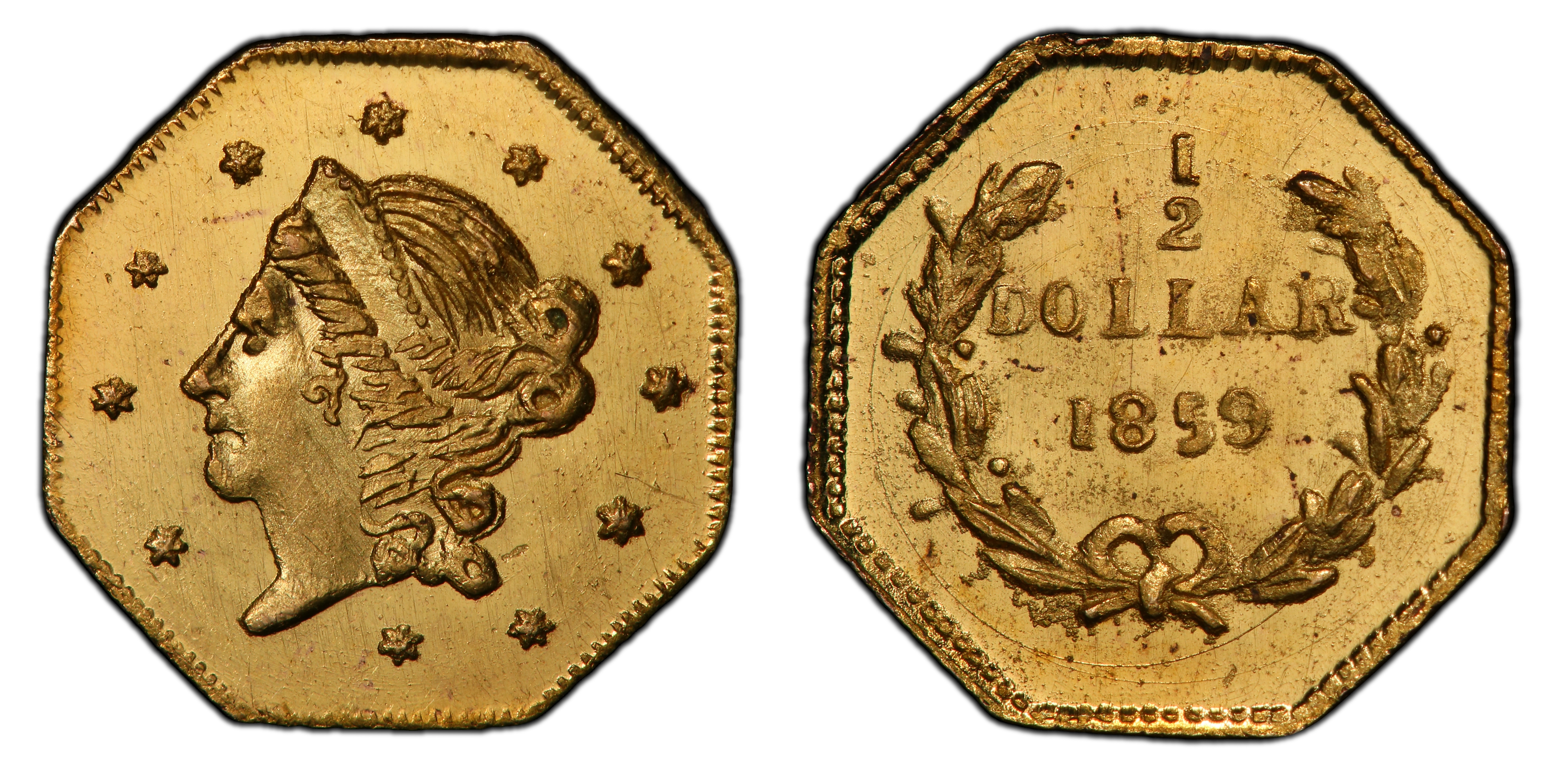
Obverse & Reverse
The 1859 BG-902 50 Cents represents a pivotal transition in the history of California Fractional Gold. It is a 'Period Two' issue, a class of coins numismatists distinguish from the earlier 'Period One' (1852-1857) pieces. While the Period One coins were struck out of genuine commercial necessity to alleviate a severe shortage of small change during the initial chaos of the Gold Rush, the Period Two issues, including BG-902, were created in a different economic climate. By 1859, the San Francisco Mint was in full operation, and federally issued silver coins had become more plentiful, largely satisfying the original need for small denominations. The impetus for striking fractional gold shifted from commerce to souvenir and jewelry sales. San Francisco was becoming a tourist destination, and its romanticized image as the heart of the Gold Rush created a robust market for keepsakes. Local jewelers, many of French origin such as Frontier, Deviercy & Co., stepped in to meet this demand. These 'jewelers' issues' were not intended to meet a specific bullion value; their gold content was often less than their face value, and metallurgical standards were inconsistent. The BG-902, an octagonal Liberty Head type, was part of this wave of commercial production. Struck in a year that saw a resurgence of fractional gold minting after a brief hiatus, it was designed to appeal to public sentiment, mimicking the style of federal gold coinage but in a diminutive, novel format. These pieces were sold as curios, mounted into rings and pins, or kept as mementos of a visit to the Golden State. The Coinage Act of 1864 would eventually prohibit private coinage, but enforcement was lax until the 1880s, allowing these fascinating 'suppressed jewelers' issues' to be produced for over two decades, serving as a tangible link to the enduring legacy and popular mythology of the California Gold Rush.
Associated EventCalifornia Gold Rush
Reason For MintingPrimarily struck as a souvenir or jewelry item for the tourist trade, rather than to fill a circulating coinage need.
Minter HistoryThe specific minter of BG-902 is unconfirmed, as is common for many 'Period Two' issues which were often unmarked. However, it was almost certainly produced by one of the several jewelry firms active in San Francisco in the late 1850s. Prominent partnerships of the era known to have produced fractional gold include Frontier, Deviercy & Co. and Deriberpe & Nouizillet. These skilled craftsmen used shared die punches and styles, making precise attribution difficult. Their business model pivoted from producing functional currency to creating profitable, low-weight novelties for a public captivated by the Gold Rush narrative.
Historical SignificanceThe BG-902 is significant as a prime example of a 'Period Two' or 'Jeweler's Issue' of California Fractional Gold, illustrating the shift from utilitarian private coinage to commercial souvenir production. It represents the commodification of the Gold Rush legacy and the entrepreneurial spirit of San Francisco's craftsmen in a post-frontier economy.
BG-902
DenominationG50C (50 Cents)
Minting Period1859
Assayer/MinterUnknown private minter
Geographic OriginSan Francisco, California
Obverse DescriptionFeatures a depiction of a Liberty Head, facing left, her hair tied in a bun. She is encircled by thirteen six-pointed stars, representing the original colonies.
Obverse Inscription Reverse DescriptionThe central device is the denomination '50 CENTS' contained within a decorative wreath of two olive branches tied with a bow at the bottom. The date '1859' is located below the wreath.
Reverse Inscription50 CENTS 1859
CompositionGold
Stated Fineness Actual FinenessVariable; Period Two issues are often of a lower fineness than Period One coins, sometimes significantly debased.
EdgePlain
Unknown
Survival Estimate150-200
Rarity ScaleR-4 (Low)
This variety is popular with collectors for its classic Liberty Head design, distinctive octagonal shape, and its status as a representative 'Period Two' issue. Its known rarity and connection to the romantic souvenir trade of Gold Rush San Francisco add to its allure.
Key VarietiesNo major varieties are widely recognized for the BG-902 die marriage itself. The primary numismatic distinctions are between this and other Breen-Gillio numbers from the same period. No later-date Proof restrikes or special collector issues are known to exist for this specific variety.
Authentication TipsAuthentic Period Two pieces are thin and struck in gold, though fineness varies. Replicas are often thicker, have a brassy color, and may feature incorrect design details, such as a bear on the reverse (no authentic 19th-century fractionals have bears). The surfaces of genuine examples can be crude, sometimes exhibiting evidence of heavy die clashing, file marks, or a generally rough planchet texture. Lettering and stars should be examined for the correct style and compared to known genuine examples, as modern fakes often have poorly executed details.
Shopping ConsiderationsA premium quality BG-902 is one that is well-struck, particularly on Liberty's hair and the leaves of the wreath. Many examples are found with prooflike (PL) or semi-prooflike surfaces, which command a significant premium. Given their use as jewelry, buyers should carefully inspect for evidence of mounting, solder, or harsh cleaning, which will significantly impair value. Original, unmolested surfaces with some remaining luster are highly desirable. While planchet quality can be naturally crude, avoid examples with distracting scratches, rim bumps, or significant spotting.
A coin's grade is its condition, rated on a 1-70 scale. For rare coins, this is the most critical factor in determining value, as a tiny difference in preservation can mean a huge difference in price.
Relevant Grade TypesOriginal period issues were business strikes, although many were produced with prooflike surfaces for sale to collectors and tourists; they are found in Circulated (1-58) and Mint State (MS, 60-70) grades. No true Proofs were struck during the original period of issue, but the term 'Prooflike' (PL) is a critical designation for this variety and significantly increases value.
Mint State CharacteristicsUncirculated examples of BG-902 are often characterized by a sharp strike, though weakness on the highest points of Liberty's hair is not uncommon. Luster can range from satiny to deeply prooflike and reflective. Due to the manufacturing process, it is common to see planchet roughness or evidence of heavy die clashing, which is not always considered a major detractor unless it is severe. Small, scattered contact marks are typical, but large, distracting marks will limit the grade.
Circulated Wear PatternsWear first appears on the high points of Liberty's hair, cheek, and the knot of the bow on the reverse wreath. On lower-grade circulated examples, the stars will begin to lose their definition and the fine details of the wreath's leaves will merge. The date is relatively protected and is usually one of the last elements to show significant wear.
Key Factors For ValueThe single most important factor for this coin is surface quality. An example with original, reflective prooflike surfaces is far more valuable than a hazy or cleaned piece of the same numerical grade. Strike sharpness is secondary but important. Eye appeal is paramount; coins with a clean, vibrant gold color and minimal distracting marks will always be in high demand. A CAC sticker carries a significant premium for this issue, as it confirms both the grade and the quality of the surfaces.
PCGS Price Guide
| Grade | Price | Population |
|---|---|---|
| 63 | $650.00 | N/A |
| 63+ | $725.00 | N/A |
| 64 | $800.00 | N/A |
| 64+ | $925.00 | N/A |
| 65 | $1,450.00 | N/A |
| 65+ | $1,650.00 | N/A |
| 66 | $2,150.00 | 1 |