1871 G25C BG-811 (Regular Strike)
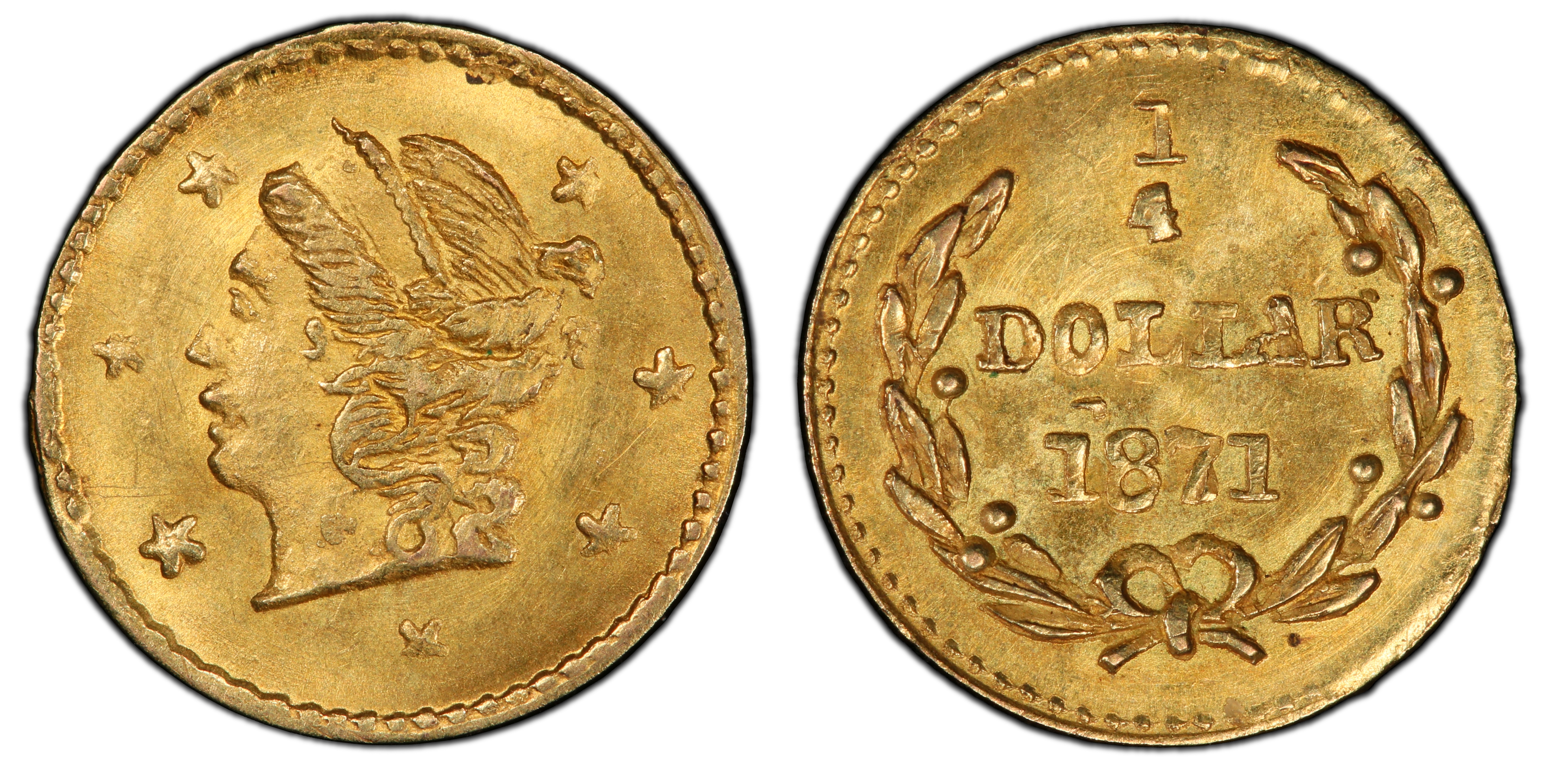
Obverse & Reverse
The 1871 BG-811 25 Cents represents a fascinating and complex chapter in American numismatics, born from the unique economic conditions of post-Gold Rush California. These privately issued gold pieces belong to what numismatists classify as 'Period Two' (1858-1882) of the California Fractional Gold series. Unlike their 'Period One' predecessors, which were struck out of genuine necessity to alleviate a shortage of small change, Period Two issues were created primarily for commercial sale to jewelers, tourists, and collectors. The initial acute need for small currency had been met by the output of the San Francisco Mint, which opened in 1854. However, the romance of the Gold Rush and the novelty of tiny gold coins sustained a healthy demand for these private issues as souvenirs and keepsakes. Jewelers in San Francisco, and even some as far away as Leavenworth, Kansas, and New York, produced a dizzying array of varieties. These Period Two pieces are often characterized by their lower gold content and lighter weight compared to their stated face value, confirming their status as tokens rather than true circulating coinage. The year 1871 was particularly fraught for the makers of these pieces. The United States Secret Service, citing the Coinage Act of 1864 which prohibited private coinage, began to crack down on their manufacture and distribution. Several prominent jewelers had their stock seized and faced legal action, effectively driving the industry underground. This government pressure makes any 1871-dated issue particularly noteworthy. The BG-811 is an artifact from this pivotal year, a testament to the persistent allure of private gold coinage even as its legality was being actively challenged. Its extreme rarity today suggests a very limited original production, perhaps curtailed by the Secret Service actions, or that it was the product of a very small, uncredited workshop. Each surviving piece is a tangible link to the entrepreneurial, and sometimes defiant, spirit of the era.
Associated EventCalifornia Gold Rush Aftermath
Reason For MintingPrimarily struck as souvenirs and for the jewelry trade rather than for circulation, meeting a commercial demand for Gold Rush keepsakes.
Minter HistoryThe specific minter or jeweler responsible for the BG-811 variety is not definitively known. During this period, numerous San Francisco jewelers, such as Robert B. Gray & Co. and Frontier, Deviercy & Co., were active producers, but attribution for this specific variety remains unconfirmed in numismatic literature.
Historical SignificanceThis coin is a prime example of a 'Period Two' California Fractional Gold piece, struck when the purpose of these items had shifted from commerce to collectibles. Its 1871 date places it squarely within the period of Secret Service crackdowns on private minters, making it a relic of a suppressed industry.
BG-811
Denomination25 Cents
Minting Period1871
Assayer/Minter Geographic OriginSan Francisco, California
Obverse DescriptionFeatures a Liberty Head portrait facing left, surrounded by thirteen stars. The date '1871' is below the bust. The specific die characteristics and style of the portrait for the BG-811 variety are not widely published.
Obverse Inscription1871
Reverse DescriptionA wreath encircles the denomination. The exact style of the wreath, number of berries, and lettering style for the BG-811 variety are not widely published.
Reverse Inscription1/4 DOLLAR CAL
CompositionGold
Stated Fineness Actual Fineness EdgePlain
Unknown
Survival EstimateFewer than 5
Rarity ScaleHigh R-7
The BG-811 is a major rarity in the California Fractional Gold series, appealing to advanced specialists. Its allure stems from its extreme scarcity, with only two examples known to the major grading services, and its status as a Period Two issue from the historically significant year of the Secret Service crackdown.
Key VarietiesThe BG-811 is itself a key variety. No major variations, restrikes, or patterns are known or documented for this specific Breen-Gillio number.
Authentication TipsAuthentication requires expert examination due to the proliferation of contemporary counterfeits and modern replicas. A genuine BG-811 will exhibit die characteristics consistent with other Period Two jeweler's issues, including sharp, albeit sometimes crude, details from a hammer strike. The luster should be appropriate for the period. Any softness of detail, incorrect weight or diameter, or casting bubbles are immediate red flags. Comparison with high-resolution images of the two certified examples is essential.
Shopping ConsiderationsAcquiring a BG-811 is an exceedingly rare event. A potential buyer should prioritize certification by a top-tier grading service (PCGS or NGC) as paramount. For a coin of this rarity, any example, regardless of grade, would be a major acquisition. A premium quality piece would be one that is well-centered and sharply struck, exhibiting original, un-cleaned surfaces and minimal distracting marks. Given the crude manufacturing process, minor planchet flaws or a slightly uneven strike may be inherent to the issue and should be evaluated in context. Due to its rarity, it is almost never available for public sale.
A coin's grade is its condition, rated on a 1-70 scale. For rare coins, this is the most critical factor in determining value, as a tiny difference in preservation can mean a huge difference in price.
Relevant Grade TypesOriginal examples of BG-811 were business strikes, although likely not intended for general circulation. They are found in Circulated (1-58) and, more commonly for surviving specimens, Mint State (MS, 60-70) grades. No proofs were struck during the original minting period, and no later-date restrikes are known to exist.
Mint State CharacteristicsAn uncirculated BG-811 would be judged on the quality of its strike, luster, and surface preservation. Strike weakness is common on California Fractionals due to the hand-hammering process; a sharply struck example with full detail on Liberty's hair and the wreath would be considered superior. Luster is typically satiny rather than frosty. As these were made by jewelers and handled as novelties, even Mint State examples may show minor handling marks or hairlines.
Circulated Wear PatternsFor a Liberty Head fractional gold coin, wear first appears on the highest points of the design. On the obverse, this includes Liberty's cheek, the hair above the ear, and the tips of the coronet. On the reverse, the high points of the wreath's leaves and the bow would show the first signs of friction. In lower grades, the stars and legends would begin to lose their sharpness and merge towards the fields.
Key Factors For ValueFor a great rarity like the BG-811, simple existence and authenticity are the primary value drivers. Beyond that, a certified Mint State grade is the most crucial factor. Surface quality is key; an example with original, undisturbed luster and skin will command a significant premium over one that has been cleaned, polished, or previously mounted in jewelry. Eye appeal, sharpness of the strike, and centering contribute significantly to the final value. A CAC sticker would provide further validation of quality for the assigned grade.
PCGS Price Guide
| Grade | Price | Population |
|---|---|---|
| 62 | $2,250.00 | 1 |
| 62+ | $2,325.00 | N/A |
| 63 | $2,600.00 | N/A |
| 63+ | $2,775.00 | N/A |
| 64 | $3,250.00 | 2 |
| 64+ | $3,750.00 | N/A |
| 65 | $4,500.00 | 1 |