1872 25C BG-725, PL (Regular Strike)
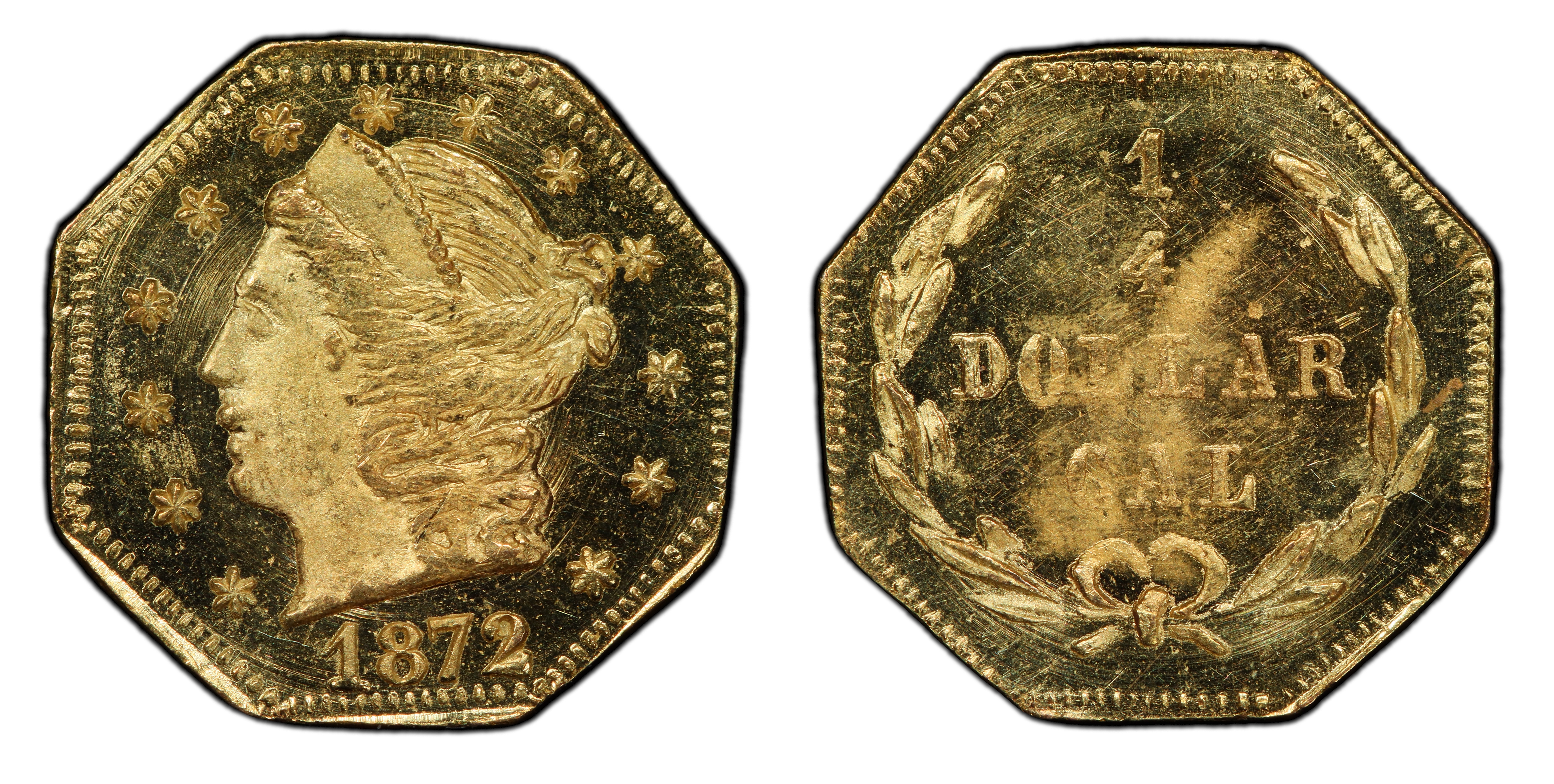
Obverse & Reverse
The 1872 25-cent BG-725 is a quintessential example of a 'Period Two' California Fractional Gold piece. By the early 1870s, the acute shortage of small change that had plagued California during the Gold Rush had largely been resolved by the output of the United States Mint in San Francisco. The impetus for producing these minuscule gold coins had shifted entirely from commerce to novelty. The completion of the transcontinental railroad in 1869 had opened California to a new wave of tourists and settlers who were captivated by the romanticism of the Gold Rush. Enterprising jewelers in San Francisco, many of whom were French immigrants with fine engraving skills, recognized a burgeoning market for affordable and easily transportable souvenirs. These small, denominated gold pieces served as perfect mementos. Unlike the earlier 'Period One' issues (1852-1857), which were intended to and did circulate, these later pieces were merchandise. They were often intentionally struck with underweight planchets, their intrinsic value being secondary to their perceived connection to California's golden identity. The year 1872 was a dynamic time in San Francisco; the city was booming, rebuilding with grander architecture after earlier fires, and establishing itself as the financial and cultural hub of the West. Tourists and businessmen alike sought keepsakes of their visit, and these 'Cal Gold' fractionals fit the need perfectly. The production of these pieces existed in a legal gray area. The Private Coinage Act of 1864 had made such private issues illegal, but the law was not aggressively enforced against these small souvenir pieces until a Secret Service crackdown in the mid-1870s, which ultimately ended their production by 1882. The BG-725, with its often proof-like, reflective surfaces, was clearly designed for eye appeal rather than durability in circulation, a testament to its role as a cherished keepsake of a bygone, yet still celebrated, era.
Associated EventPost-Gold Rush California Tourism Boom
Reason For MintingTo serve a thriving tourist and souvenir market in post-Gold Rush San Francisco.
Minter HistoryWhile the specific maker of the BG-725 die pair is not definitively recorded, the style is consistent with the work of several San Francisco jewelers active in the period. The most prominent producer of fractional gold in 1872 was Christopher Ferdinand Mohrig, a jeweler who was later arrested in 1876 for violating private coinage laws. Many varieties from this era are attributed to him or other French jewelers who dominated the trade. These artisans operated small-scale workshops, using hand-operated screw presses to strike coins. Their primary business was jewelry and watchmaking, with the fractional gold pieces being a profitable sideline.
Historical SignificanceThe BG-725 is historically significant not as a coin for circulation, but as a tangible artifact of California's transition from a raw frontier to a romanticized tourist destination. It represents the commercialization of the Gold Rush myth and the demand for souvenirs to commemorate the 'Golden State.' As a 'jeweler's issue,' it is a prime example of the creative and quasi-legal entrepreneurship that characterized 19th-century San Francisco.
K-Unlisted
Denomination25 Cents
Minting Period1872
Assayer/MinterUnknown Jeweler (Possibly Christopher Ferdinand Mohrig)
Geographic OriginSan Francisco, California
Obverse DescriptionA classic Liberty Head portrait facing left, with hair tied in a bun at the back. The portrait is somewhat crude in execution, typical of jeweler's issues. The field is surrounded by 13 five-pointed stars, often weakly struck. The date '1872' appears below the truncation of the neck.
Obverse Inscription1872
Reverse DescriptionThe central device is the denomination '1/4' with a horizontal fraction bar, enclosed within a delicate wreath. The wreath is composed of two branches tied with a bow at the bottom. The inscription 'DOLLAR' appears in an arc above the wreath, following the octagonal rim. The legend 'CAL.' is not present on this variety. The reverse often shows a wire rim.
Reverse Inscription1/4 DOLLAR
CompositionGold
Stated Fineness Actual FinenessVaries, typically 14 to 22 karats (.583 to .917 fine).
Weight0.25 grams
Diameter9.80 mm
EdgePlain
Unknown
Survival Estimate31-45 (High R-5)
Rarity ScaleHigh R-5
This variety appeals to collectors due to its high rarity, octagonal shape, and the frequent availability of proof-like (PL) examples which offer superb eye appeal. As a 'Period Two' issue, it is a key part of the narrative of how fractional gold evolved from necessity to novelty, making it a historically rich and challenging piece to acquire.
Key VarietiesThe primary variety is the regular business strike, BG-725. No major die varieties, patterns, or official restrikes are known to exist for this specific die pair. Collectors should be aware that the term 'Proof-Like' (PL) or 'Deep Mirror Proof-Like' (DMPL) are designations applied by grading services to business strikes with highly reflective surfaces and are not separate issues. No true Proofs were struck.
Authentication TipsGenuine BG-725 examples will exhibit specific die characteristics; consult the Breen-Gillio reference for die markers. The strike is often weak on the stars and central wreath. The planchets are typically thin and may show slight buckling. Counterfeits are common in the series; many are gold-plated base metal and feel light. Replicas often have a soapy, indistinct look and may feature incorrect design elements, such as a bear on the reverse, which is not found on any genuine Period One or Two pieces. Genuine pieces must have a denomination.
Shopping ConsiderationsA premium quality BG-725 will exhibit strong proof-like or deep mirror proof-like surfaces with significant reflectivity. Look for a sharp strike on Liberty's portrait and the denomination, as these are often the highest points. The 13 obverse stars are frequently flat, so a well-defined set of stars commands a premium. Original, uncleaned surfaces with minimal contact marks are paramount. Because they were sold as souvenirs, many were mishandled or mounted as jewelry; inspect carefully for evidence of removal from a mount, rim damage, or harsh cleaning. A CAC sticker on this issue is highly desirable, confirming both the grade and the superior eye appeal of the proof-like surfaces.
A coin's grade is its condition, rated on a 1-70 scale. For rare coins, this is the most critical factor in determining value, as a tiny difference in preservation can mean a huge difference in price.
Relevant Grade TypesOriginal period issues were business strikes intended for the souvenir market, not circulation. They are found in Circulated grades (1-58, though rare for this issue) and, more commonly, Mint State (MS, 60-70). Many specimens were preserved as keepsakes and survive in uncirculated condition. A significant portion of the surviving population exhibits highly reflective, mirror-like surfaces, qualifying them for a Proof-Like (PL) or Deep Mirror Proof-Like (DMPL) designation from grading services. No true Proof (PR/PF) examples were struck during the original period of issue, and no later restrikes are known.
Mint State CharacteristicsAn uncirculated BG-725 is defined by its luster and surfaces. The highest quality examples display deep, watery, or mirror-like fields. Luster is typically flashy rather than satiny. Due to the rudimentary minting process, the central strike can be weak, particularly on the highest points of the design. Small planchet flaws, alloy spots, or minor striations from the hand-fed press are common and should not be confused with post-strike damage. Bag marks are less common than handling marks, as these were not stored in bulk.
Circulated Wear PatternsOn circulated examples, wear first appears on the high points of Liberty's hair, cheek, and the bun. On the reverse, the fraction numerals and the highest leaves of the wreath will show flatness and loss of detail. In lower grades (VF and below), the stars on the obverse and the letters in 'DOLLAR' will begin to merge with the fields.
Key Factors For ValueThe primary value driver for the BG-725 is the quality and depth of its proof-like surfaces; a DMPL or PL designation dramatically increases value. Surface preservation is critical; an example with clean, mark-free fields will command a significant premium over a similarly graded piece with scattered handling marks. Strike sharpness, particularly on the stars and central reverse, is also a key factor. Finally, coins with original, attractive deep gold toning are highly prized. A CAC sticker confirms the quality for the grade and often results in a substantial premium in the marketplace for this specific issue.
PCGS Price Guide
| Grade | Price | Population |
|---|---|---|
| 66 | $3,250.00 | 1 |