1868 G25C BG-890, PL (Regular Strike)
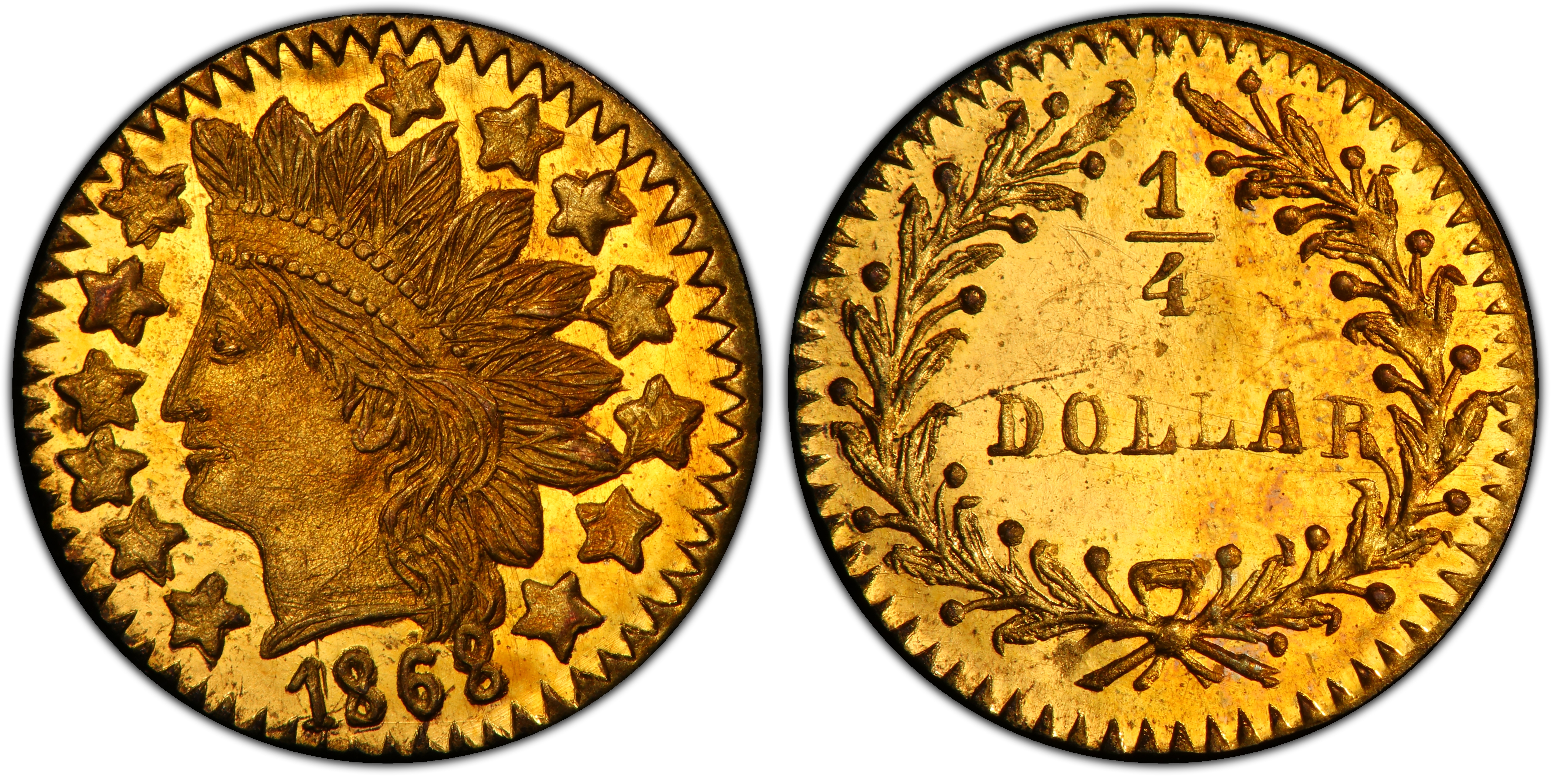
Obverse & Reverse
The 1868 BG-890 25 Cent piece is a quintessential example of 'Period Two' California Fractional Gold. By the late 1860s, the initial, urgent need for small-denomination coinage that characterized the Gold Rush (Period One, 1852-1857) had largely subsided. The establishment and output of the U.S. Branch Mint in San Francisco in 1854 had supplied the region with sufficient federal coinage for daily commerce. However, the allure of California gold and the romance of the Gold Rush had created a robust national market for souvenirs and keepsakes. Enterprising jewelers, primarily in San Francisco, stepped into this market, creating a wide variety of miniature gold 'coins' that were not intended for circulation, but rather to be sold as mementos to tourists and collectors. These 'jewelers' issues,' as they are known, were struck with dates from 1858 through 1882. The Coinage Act of April 22, 1864, had made private coinage illegal, but the law was not strictly enforced against these small, token-like pieces until 1883. The minters of Period Two pieces were less concerned with intrinsic value—most are significantly underweight for their stated denomination—and more focused on attractive and varied designs. The Indian Head motif, as seen on the BG-890, was a popular design choice of the era, mimicking the appearance of federal coinage like the Indian Head Cent and gold dollar, which lent it an air of legitimacy and popular appeal. These pieces were often produced using crude 'hammer' methods, where dies were struck by hand, leading to variability in strike quality. Because they were sold as novelties and not spent, a relatively high proportion have survived in Mint State condition, often displaying prooflike or semi-prooflike surfaces from polished dies. The BG-890 is one of many such distinct die pairings cataloged by Walter Breen and Ronald Gillio, a testament to the cottage industry that flourished by transforming California's gold into treasured symbols of an iconic American era.
Associated EventPost-Gold Rush California Economic Expansion
Reason For MintingTo serve the growing tourist and souvenir market with romantic mementos of the California Gold Rush.
Minter HistoryThe specific minter of the BG-890 die pair is unknown, a common trait for Period Two issues. The work is attributed to the many anonymous or unidentified jewelers and metalsmiths operating in San Francisco during the period. These craftsmen, many of French origin, created hundreds of distinct varieties, often with no identifying marks. Notable Period Two producers for other varieties include firms like Deriberpe & Nouizillet and Herman J. Brand, but a direct link to BG-890 has not been established.
Historical SignificanceThe BG-890 represents a shift in the purpose of private gold coinage, from a necessary medium of exchange in the 1850s to a commercial product catering to tourism and the national fascination with the West. It is a tangible artifact of 19th-century American pop culture and the commodification of the Gold Rush narrative.
BG-890
Denomination25 Cents
Minting Period1868
Assayer/MinterUnknown Jeweler
Geographic OriginSan Francisco, California
Obverse DescriptionAn Indian Head portrait faces left, adorned with a feathered headdress. The portrait is surrounded by thirteen six-pointed stars. The date, 1868, is positioned below the bust.
Obverse Inscription1868
Reverse DescriptionThe denomination '25 CENTS' is contained within a wreath. The wreath is composed of two branches tied together with a bow at the bottom.
Reverse Inscription25 CENTS
CompositionGold
Stated Fineness Actual FinenessVariable, typically between 14k and 22k for Period Two issues.
Diameter9.40 mm
EdgePlain
Unknown
Survival Estimate31-75 coins known
Rarity ScaleR-5
This variety appeals to collectors of California Fractional Gold and those specializing in the popular Indian Head motif. Its status as a 'jeweler's issue' means that high-grade, lustrous examples are attainable, offering a glimpse into the souvenir trade of the Old West. The defined R-5 rarity provides a challenge without being prohibitively rare.
Key VarietiesThe BG-890 is itself a specific die variety. No major sub-varieties, patterns, or official restrikes are recorded for this die pair. The primary variation in this series comes from the hundreds of different die pairings (BG numbers) produced by various jewelers, each with subtle differences in portrait style, lettering, and wreath design.
Authentication TipsAuthentic Period Two pieces must have a stated denomination (e.g., '25 CENTS' or '1/4 DOLLAR'). Replicas and later fantasy tokens often lack a denomination, sometimes saying 'CAL GOLD' or featuring a bear on the reverse. Genuine pieces often show weakness in the strike due to being hammer-struck; uniformly sharp, perfect strikes can be suspect. The gold color should be consistent with 14k-22k alloys, not the brassy look of modern gilt copies. Comparing the die characteristics—specifically the shape of the portrait, font of the date, and wreath details—to known genuine examples is the ultimate confirmation.
Shopping ConsiderationsA premium quality example for this issue is defined by a sharp strike, particularly on the details of the headdress and the lettering on the reverse. Seek out coins with bright, prooflike (PL) or deep-prooflike (DPL) surfaces, as many were struck from polished dies and these command a premium. Original, reddish-gold toning is highly desirable and indicates undisturbed surfaces. Avoid examples that have been harshly cleaned, which will appear hazy or show hairline scratches. Because of their small size, any damage, such as bends, scratches, or rim bumps, is magnified and should be a major deterrent. Third-party certification by PCGS or NGC is highly recommended for this series to ensure authenticity and accurate grading.
A coin's grade is its condition, rated on a 1-70 scale. For rare coins, this is the most critical factor in determining value, as a tiny difference in preservation can mean a huge difference in price.
Relevant Grade TypesOriginal period issues were business strikes, but as they were made primarily for collectors and tourists, most are found in high grades. They are graded on the standard 1-70 scale, with Circulated examples (1-58) being scarce and Uncirculated or Mint State (MS, 60-70) examples being the norm. No true Proofs were struck in 1868, but the use of polished dies was common, resulting in Prooflike (PL) and Deep Prooflike (DPL) surface designations, which are highly sought after and should not be confused with true Proof coinage.
Mint State CharacteristicsIn Mint State, the BG-890 typically exhibits a satiny to semi-prooflike luster. Strike quality varies; look for sharpness in the feathers of the headdress and the individual leaves of the wreath. Weakness is sometimes seen on the high points of the portrait or the bow on the reverse. As these were produced as souvenirs and not handled in circulation, marks should be minimal, but tiny planchet flaws or die polishing lines are common and should not be confused with post-strike damage.
Circulated Wear PatternsAlthough most examples are uncirculated, any wear would first appear on the highest points of the design. On the obverse, this includes the cheek of the Indian and the upper feathers of the headdress. On the reverse, the high points of the wreath leaves and the bow would show the first signs of friction. In lower circulated grades, the stars and legends would begin to lose their sharpness.
Key Factors For ValueFor the BG-890, the primary value drivers are grade and surface quality. A high Mint State grade (e.g., MS-64 or higher) is the baseline. The presence of a Prooflike (PL) or Deep Prooflike (DPL) designation adds a significant premium. Eye appeal is crucial; coins with original, vibrant luster and perhaps a touch of attractive reddish toning are prized above hazy or dull specimens. Strike sharpness is another key factor; a fully struck coin will always be more valuable than a weakly struck one of the same grade. A CAC sticker adds a further premium, confirming that the coin is of superior quality for its assigned grade.
PCGS Price Guide
| Grade | Price | Population |
|---|---|---|
| 64 | $1,650.00 | 1 |