1876 G50C BG-1038 (Regular Strike)
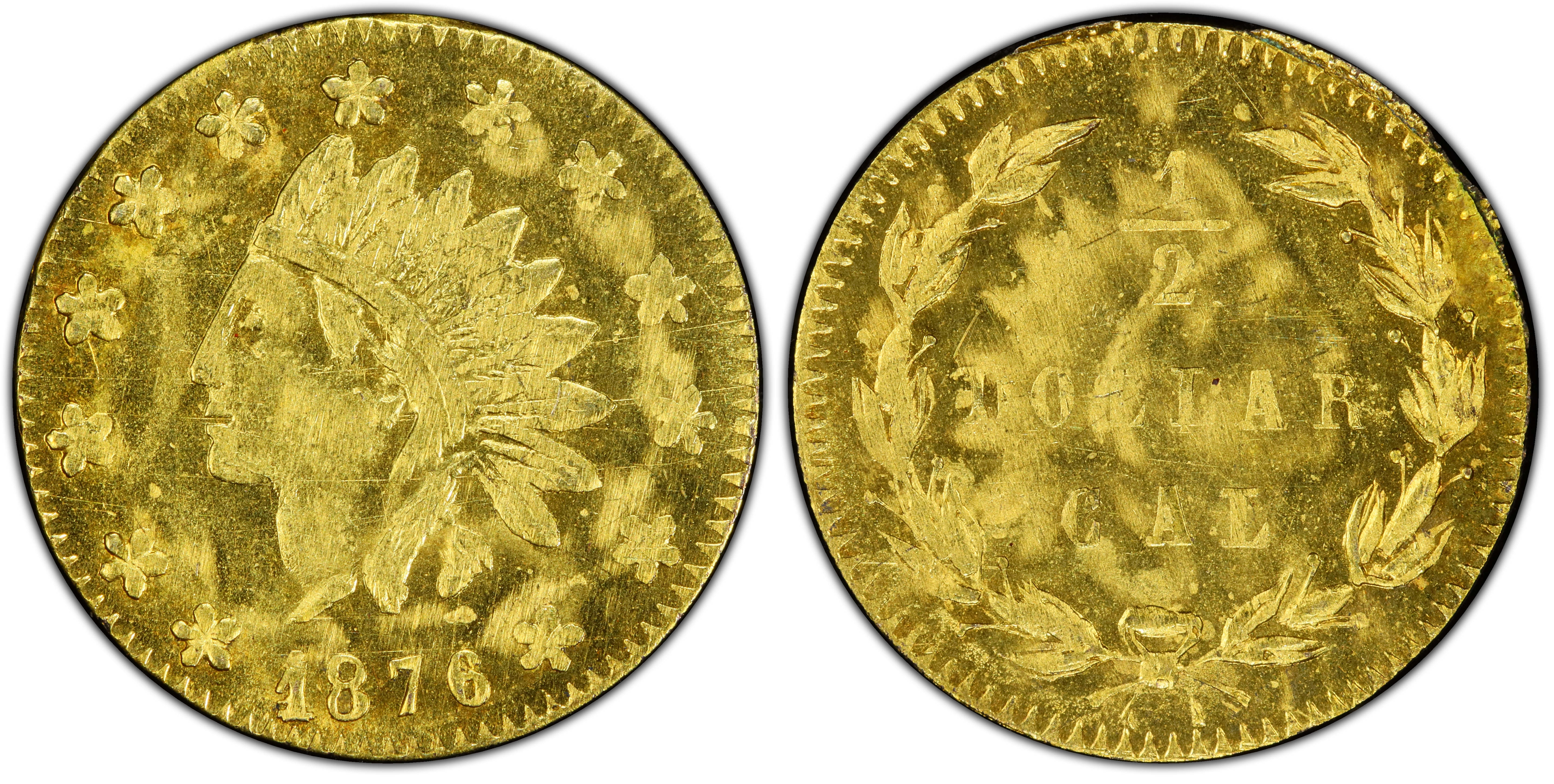
Obverse & Reverse
The 1876 BG-1038 50 Cents represents a fascinating and complex chapter in American numismatics, born from the lingering economic conditions of the California Gold Rush. These small, privately minted gold pieces, known as California Fractional Gold, were produced long after the main rush had subsided and the U.S. Branch Mint in San Francisco was well established. This specific coin belongs to what collectors categorize as 'Period Three' (1872-1882), a time when the production of these tokens was of dubious legality and primarily aimed at the souvenir and jewelry trade rather than mainstream circulation. Following the Coinage Act of 1864, which outlawed private coinage, manufacturers of these small-denomination pieces had to be circumspect. They often omitted the word 'DOLLAR' or 'CENTS' to circumvent the law, producing what were essentially tokens with an implied value. The 1876 pieces, struck during the year of the nation's Centennial Exposition in Philadelphia, found a ready market among tourists and locals alike who desired a tangible, affordable souvenir of California's gold legacy. These coins were typically made by jewelers and stamped with dies created by local artisans, such as the prolific engraver Robert B. Gray, though the specific engraver for the BG-1038 variety is not definitively known. The quality and gold content of Period Three pieces varied widely, with many being of low fineness, intended more for their novelty than as a reliable medium of exchange. Their existence highlights a persistent demand for local, tangible forms of money and souvenirs, and they serve as a testament to the entrepreneurial spirit of San Francisco's artisans and merchants, who cleverly navigated legal gray areas to meet market demand.
Associated EventPost-California Gold Rush Souvenir Trade
Reason For MintingPrimarily created as souvenirs and novelty items for the tourist trade and jewelry purposes, capitalizing on the legacy of the Gold Rush.
Minter HistoryThe specific minter for BG-1038 is unknown, a common trait for Period Three California Fractional Gold due to the legally questionable nature of their production. They were likely produced by one of several San Francisco-based jewelers or private minting concerns that created these pieces for the souvenir market. Prominent die sinkers of the era, such as Robert B. Gray, were responsible for many of the designs, but attribution of specific varieties is often difficult. These manufacturers operated outside the federal system, creating products that skirted the edges of anti-private coinage laws.
Historical SignificanceThe BG-1038, like other Period Three fractionals, is significant not as a circulating coin but as a cultural artifact. It represents the commercialization of the Gold Rush mythos and the transition of private gold coinage from a necessity to a novelty. Its existence in 1876 connects it to the national pride and historical reflection of the American Centennial, providing a tangible link to how California's unique history was packaged and sold to a wider audience. These pieces are crucial for understanding the unofficial, market-driven economies of the late 19th century American West.
N/A
Denomination50 Cents
Minting Period1876
Assayer/MinterUnknown private minter, possibly sold through jewelers like the California Jewelry Company.
Geographic OriginSan Francisco, California
Obverse DescriptionA stylized Liberty Head facing left, often described as an 'Indian Head' design. Liberty wears a feathered headdress. The portrait is surrounded by 13 six-pointed stars.
Obverse InscriptionNo textual inscription; features portrait and 13 stars.
Reverse DescriptionThe denomination '1/2' is enclosed within a wreath of two olive branches tied together with a bow at the bottom. The date '1876' is positioned below the wreath.
Reverse Inscription1/2
CompositionGold
Stated FinenessNot stated on the coin.
Actual FinenessVaries, but typically between .350 and .500 fine (9 to 12 karat gold).
Weight0.25 grams
Diameter9.90 mm
EdgePlain
Unknown
Survival Estimate500-700
Rarity ScaleR-4
The 1876 G50C BG-1038 is popular due to its affordability relative to earlier period fractionals, its attractive 'Indian Head' design, and its connection to the U.S. Centennial year. It serves as an accessible entry point into the fascinating and complex world of California Fractional Gold.
Key VarietiesThe primary variety is the regular business strike. There are no known major die varieties from the original minting period for this specific BG number. No known patterns, trial pieces, or official later-date restrikes exist. The classification system developed by Breen and Gillio (BG) is exhaustive, and BG-1038 refers to a specific die marriage. Minor die states (e.g., with small die cracks) may exist but are not typically collected as separate varieties.
Authentication TipsGenuine pieces exhibit sharp, well-defined details, especially in the feathers and stars, even if weakly struck overall. The planchets are typically thin and uniform. Counterfeits, often cast from lead or brass and plated, will have a mushy or porous appearance, soapy details, and may show a casting seam on the edge. Weight and specific gravity tests are crucial, as fakes are often incorrect in weight. Compare suspect coins to high-resolution images of certified examples.
Shopping ConsiderationsA premium quality example for its grade will possess a sharp strike, particularly on the details of the headdress and the numerals of the date. Seek out coins with smooth, lustrous surfaces that have not been harshly cleaned or used as jewelry. Many examples were mounted in rings or pins, so look carefully for evidence of solder, tooling, or rim damage. Original, uncleaned examples with a pleasing reddish-gold or deep yellow-gold patina command significant premiums. Avoid specimens with distracting planchet flaws or significant carbon spotting.
A coin's grade is its condition, rated on a 1-70 scale. For rare coins, this is the most critical factor in determining value, as a tiny difference in preservation can mean a huge difference in price.
Relevant Grade TypesOriginal period issues were business strikes, technically intended for the souvenir trade rather than circulation, but are graded along the same standards. They are found in Circulated (AU-58 and below) and Mint State (MS, 60-70) grades. No Proof (PR/PF) examples were struck during the original period of issue, nor are there any known later-date Proof restrikes for this variety. Any piece described as a 'Proof' would be highly suspect and likely a misattribution or an altered, polished business strike.
Mint State CharacteristicsUncirculated examples of BG-1038 often display a satiny or slightly prooflike luster. However, the strike is frequently weak in the center, particularly on the highest points of the feathers and the bow on the reverse wreath. Planchet quality can be inconsistent, with minor striations or adjustment marks sometimes visible from the minting process. Contact marks are common due to the softness of the low-karat gold, but a premium MS example will have minimal and well-hidden marks.
Circulated Wear PatternsWear first appears on the high points of the design: the cheek of the Indian Head and the feathers in the headdress. On the reverse, the highest points of the wreath leaves and the bow will show the first signs of friction. In grades below AU, the finer details of the feathers will begin to merge, and the stars will lose their sharpness. The date and denomination, being relatively protected, are usually the last elements to show significant wear.
Key Factors For ValueThe primary value drivers are grade and surface quality. An example with original, undisturbed luster and minimal contact marks will be far more valuable than a cleaned or polished one of the same technical grade. Strike sharpness is a key differentiator; a coin with a fully struck headdress and wreath is highly desirable. Eye appeal, encompassing attractive original color and a clean, smooth appearance, plays a major role. A CAC sticker for this issue indicates superior quality for the grade and typically results in a significant price premium.
PCGS Price Guide
| Grade | Price | Population |
|---|---|---|
| 40 | $190.00 | 2 |
| 45 | $200.00 | N/A |
| 45+ | $205.00 | N/A |
| 50 | $210.00 | 3 |
| 50+ | $215.00 | N/A |
| 53 | $220.00 | 4 |
| 53+ | $225.00 | N/A |
| 55 | $230.00 | 14 |
| 55+ | $240.00 | N/A |
| 58 | $260.00 | 18 |
| 58+ | $275.00 | N/A |
| 60 | $290.00 | 2 |
| 61 | $315.00 | 8 |
| 62 | $375.00 | 28 |
| 62+ | $500.00 | N/A |
| 63 | $750.00 | 14 |
| 63+ | $875.00 | N/A |
| 64 | $1,000.00 | 4 |
| 64+ | $1,250.00 | N/A |
| 65 | $2,250.00 | N/A |
| 66 | N/A | N/A |