1854 G$1 BG-510 (Regular Strike)
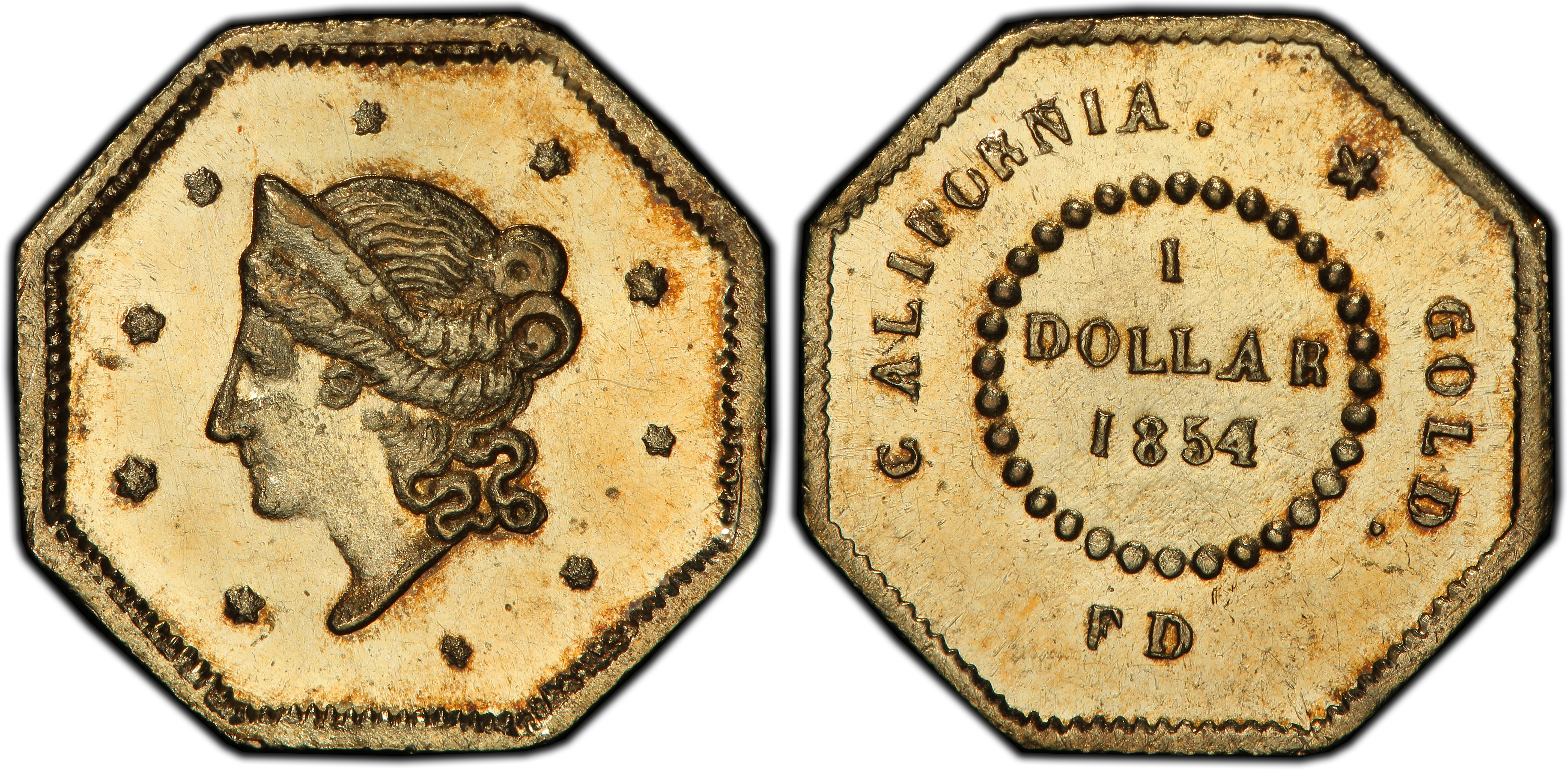
Obverse & Reverse
The 1854 BG-510 One Dollar piece is a quintessential artifact from what numismatists classify as 'Period One' (1852-1857) of the California Fractional Gold series. Its creation is inextricably linked to the socio-economic chaos of the California Gold Rush. Following the discovery of gold at Sutter's Mill in 1848, a massive influx of prospectors and merchants flooded into California, creating a vibrant but chaotic economy. While vast quantities of gold dust and large-denomination private ingots circulated, there was a severe and crippling shortage of small-denomination coinage for everyday transactions. A 'pinch' of gold dust, an inexact and often contentious measure, was used for minor purchases, leading to disputes and inefficiency. The United States Mint in San Francisco would not begin operations until April 1854 and took years to produce enough federal coinage to satisfy commercial demand. Into this monetary vacuum stepped enterprising private jewelers and metallurgists, many of French origin, who saw a clear commercial need. The firm of Frontier, Deviercy & Co. was among the most prominent of these private minters. Operating in San Francisco, they produced fractional gold coins that were intended to, and demonstrably did, circulate as currency. Unlike the later 'Period Two' issues, which were often underweight and intended as souvenirs, Period One coins like the BG-510 were generally made with an honest intrinsic value and were struck for the explicit purpose of facilitating commerce. These tiny octagonal dollars were crudely manufactured, often by the 'hammer method,' where dies were struck by hand. This resulted in significant variation in strike quality. Despite their small size, which made them easy to lose, they were a vital economic lubricant, allowing for standardized pricing for goods and services. The existence of circulated examples, including some found in contemporary shipwrecks, confirms their role as money. By 1857, with the San Francisco Mint in full production, the necessity for these private issues waned, bringing the era of 'real' circulating fractional gold to a close and cementing their legacy as a fascinating and tangible link to the height of the Gold Rush.
Associated EventCalifornia Gold Rush
Reason For MintingTo alleviate a severe shortage of small-denomination circulating coinage for daily commerce in Gold Rush-era California.
Minter HistoryFrontier, Deviercy & Co. was a partnership of French jewelers Pierre Frontier and Eugene Deviercy, active in San Francisco during the 1850s. They were among the most prolific and skilled private minters of Period One fractional gold. Their issues are identified by the initials 'FD' which are sometimes present on the coins. The firm was known for producing a variety of denominations and shapes, and their workmanship, while still crude by federal mint standards, was often superior to that of some of their contemporaries. After their partnership, Frontier continued in various configurations, and evidence suggests they may have struck souvenir pieces into the 1870s.
Historical SignificanceThe BG-510 is a prime example of a 'coin of necessity' from Period One, the only period in which fractional gold is believed to have genuinely circulated. It represents a private solution to a government failure in providing adequate currency during one of the most dynamic economic periods in U.S. history. Its existence speaks to the ingenuity and entrepreneurial spirit of the Gold Rush era and serves as a direct monetary link to the daily lives of the 'Forty-Niners'.
K-N/A
Denomination$1
Minting Period1854
Assayer/MinterFrontier, Deviercy & Co.
Geographic OriginSan Francisco, California
Obverse DescriptionFeatures a Liberty Head facing left, her hair tied in a bun. The portrait is somewhat crude, in the style of the federal Type 1 gold dollars by Longacre. The bust is flanked by four five-pointed stars, two on each side.
Obverse Inscription Reverse DescriptionA simple wreath surrounds the denomination '1' and the word 'DOLLAR'. The date '1854' is centered below the denomination, and the legend 'CALIFORNIA GOLD' encircles the wreath along the upper octagonal border. The initials 'FD' for the minters may be present, though they are not a defining characteristic of this specific BG number.
Reverse InscriptionCALIFORNIA GOLD 1 DOLLAR 1854
CompositionGold
Stated Fineness Actual FinenessPeriod One issues were struck from native California gold, which was naturally high in silver content, giving them a lighter, sometimes greenish-gold color. While fineness varied, it was generally around .880 fine, intended to be close enough to face value to be accepted in trade.
Weight1.10 grams
Diameter12.20 mm
EdgePlain
Unknown
Survival Estimate46-60 known
Rarity ScaleR-5
As a 'Period One' issue, the BG-510 is highly sought after by specialists in pioneer gold. Its appeal lies in its confirmed status as a circulating coin from the height of the Gold Rush, its scarce R-5 rating, and its connection to the known minting firm of Frontier, Deviercy & Co. High-grade, problem-free examples with strong strikes are particularly prized.
Key VarietiesThe primary variety is the BG-510 regular strike itself. No major sub-varieties from the original minting period are widely recognized. Unlike some other private or territorial issues, there are no known contemporary proofs or later-date restrikes associated with the BG-510 dies. All known examples are considered business strikes intended for circulation.
Authentication TipsAuthentic Period One pieces like BG-510 must have a denomination (e.g., 'DOLLAR' or 'DOL.'). Replicas often lack a denomination or feature a bear on the reverse. Genuine pieces were crudely struck by hand, so they often exhibit weakness in parts of the design and may have slightly irregular shapes; modern fakes are often too perfect. The fabric of the coin is also key; authentic examples have a distinct luster and color from the native gold alloy, unlike the soapy look of many modern copies or the brassy color of gilt tokens. Reference the Breen-Gillio guide photos for specific die markers.
Shopping ConsiderationsA premium quality BG-510 is defined by several factors. Look for a sharp, well-centered strike, as many were struck off-center or with weak details, particularly on the stars and the date. Originality of the surfaces is paramount; many examples have been cleaned, polished, or used in jewelry. A desirable coin will exhibit original, undisturbed satiny luster, often with attractive reddish or greenish-gold toning from the native alloy. Avoid examples with significant scratches, rim bumps, or any signs of repair or tooling. A coin that is visually appealing for the grade, often described as having good 'eye appeal,' will always command a premium. A CAC sticker on a certified example provides third-party confirmation of quality for the assigned grade.
A coin's grade is its condition, rated on a 1-70 scale. For rare coins, this is the most critical factor in determining value, as a tiny difference in preservation can mean a huge difference in price.
Relevant Grade TypesAll original BG-510 specimens are business strikes, created for circulation. They are found in Circulated grades (AG-3 to AU-58) and, more rarely, in Mint State grades (MS-60 to MS-70). There are no known Proof examples struck during the original period of issue, nor are there any known later-date Proof restrikes. Any coin described as a 'Proof' should be regarded with extreme skepticism and is likely a modern replica with prooflike surfaces.
Mint State CharacteristicsUncirculated examples of BG-510 are rare. Quality is determined by the sharpness of the strike, the quality of the luster, and the presence of contact marks. The strike can be uneven due to the hammer minting process, but high-end examples will show bold details on Liberty's hair and the digits of the date. Luster is typically satiny and can be somewhat reflective or 'prooflike,' especially on early strikes from fresh dies. Due to the softness of the gold, even Mint State examples will typically show some scattered handling marks or 'chatter' from brief contact with other coins.
Circulated Wear PatternsWear first appears on the highest points of the design. On the obverse, this includes Liberty's cheek, the hair above the eye, and the coronet. On the reverse, the high points are the numerals of the date and the leaves in the wreath. On moderately circulated examples (VF-XF), significant detail will be lost in the hair and the individual leaves will begin to merge. In lower grades, the stars and legends become weak and may blend into the fields.
Key Factors For ValueFor the BG-510, value is driven by three main factors: grade, surface preservation, and strike. A high numerical grade (e.g., MS-62 vs. AU-55) is the primary driver. However, an AU-58 with original, lustrous surfaces and a strong strike may be more valuable than a cleaned MS-61. 'Original skin' is highly prized; coins that have been harshly cleaned or polished are worth significantly less. A sharp, well-centered strike can add a substantial premium over a weakly struck example in the same grade. Finally, exceptional eye appeal, often characterized by attractive toning and defect-free surfaces, will always elevate a coin's market value.
PCGS Price Guide
| Grade | Price | Population |
|---|---|---|
| 35 | $375.00 | 1 |
| 40 | $400.00 | 1 |
| 45 | $425.00 | N/A |
| 45+ | $425.00 | N/A |
| 50 | $600.00 | 3 |
| 50+ | $625.00 | N/A |
| 53 | $675.00 | 2 |
| 53+ | $700.00 | N/A |
| 55 | $800.00 | 13 |
| 55+ | $875.00 | N/A |
| 58 | $1,025.00 | 18 |
| 58+ | $1,150.00 | N/A |
| 60 | $1,350.00 | 1 |
| 61 | $1,550.00 | 5 |
| 62 | $2,300.00 | 8 |
| 62+ | $2,550.00 | N/A |
| 63 | $2,850.00 | 2 |
| 63+ | $3,250.00 | N/A |
| 64 | $4,250.00 | 5 |
| 64+ | $5,500.00 | N/A |
| 65 | $7,000.00 | 1 |