1874 G25C BG-888, PL (Regular Strike)
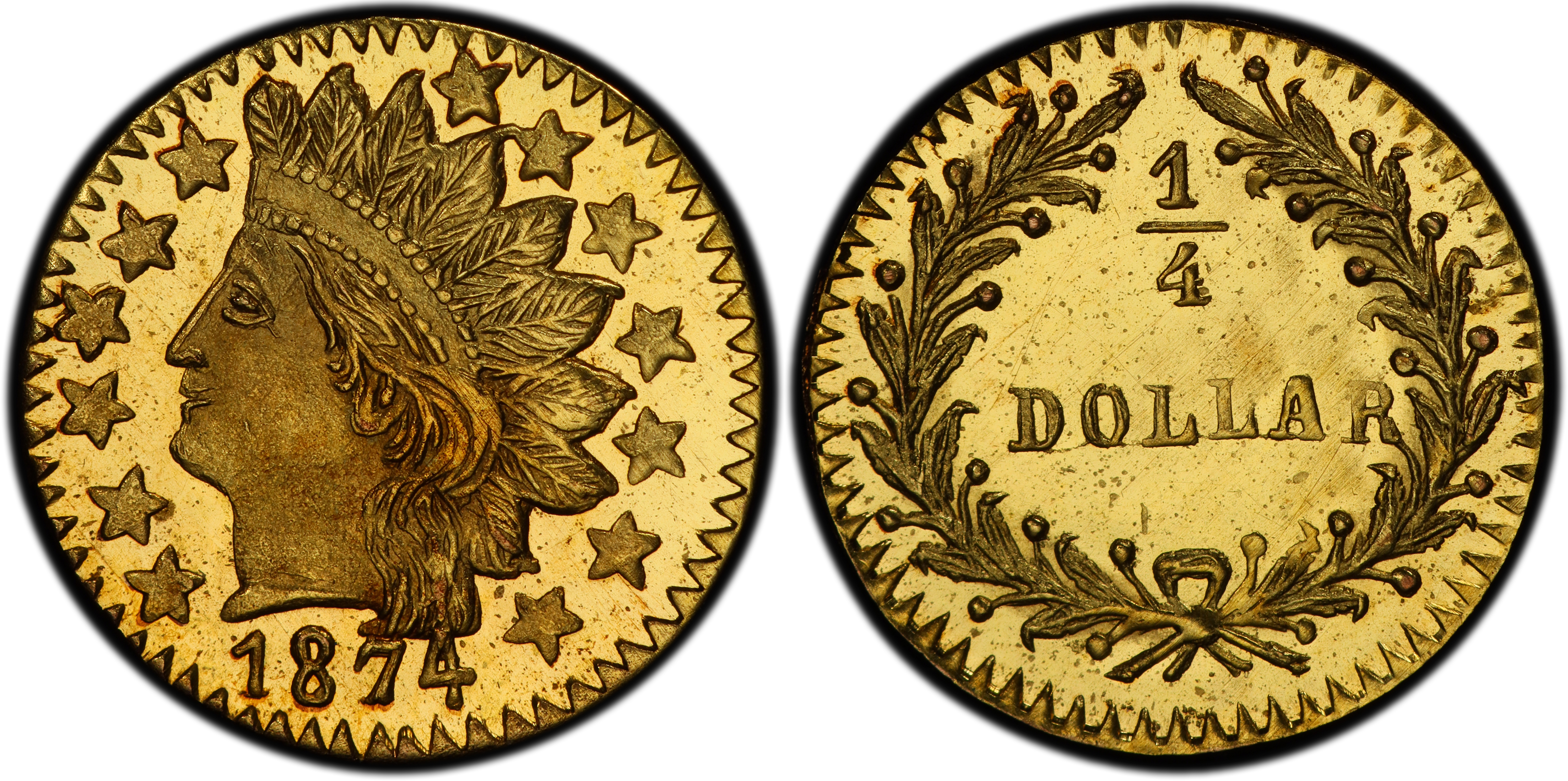
Obverse & Reverse
The 1874 BG-888 25 Cents is a quintessential example of a 'Period Two' California Fractional Gold piece. The story of this diminutive coin begins decades after the initial frenzy of the 1849 Gold Rush. By the 1870s, the acute shortage of small denomination coinage that plagued early California had been largely resolved by the output of the official San Francisco Mint, which opened in 1854. The 'Period One' (1852-1858) fractionals, born of necessity, had largely faded from circulation. However, the romance and allure of the Gold Rush had not. Enterprising jewelers and merchants in San Francisco recognized a burgeoning market for souvenirs and keepsakes that captured the spirit of the West. They began striking their own small gold pieces, not primarily for circulation, but for sale to locals, tourists, and businessmen who wanted a novel item to send back East. These 'Period Two' (1859-1882) issues, often called 'jeweler's issues,' were struck under a legally gray cloud. The Coinage Act of 1864 expressly forbade private coinage, but enforcement by the Secret Service was inconsistent until 1883. To circumvent the law, minters often used back-dating or ambiguous designs. The BG-888, however, bears its true date of 1874. These pieces were not intended to meet a specific intrinsic value standard; their gold content was substantially less than their face value, rendering them, in essence, tokens. They were typically produced using the hammer method, where a planchet was placed between two dies and struck with a sledgehammer, a process that accounts for the frequent variability in strike quality. The BG-888 variety, with its classic Indian Head motif, appealed to the popular romanticism of the American frontier. Its existence speaks to a mature California economy where the focus had shifted from the raw extraction of wealth to the creation of commercial goods, including nostalgic mementos of the very rush that built the state.
Associated EventCalifornia Gold Rush (Post-Rush Souvenir Period)
Reason For MintingPrimarily created as souvenirs and keepsakes for the jewelry trade, capitalizing on the nostalgia of the Gold Rush, rather than to alleviate a coin shortage.
Minter HistoryThe specific minter of the BG-888 variety is unknown, which is typical for 'Period Two' issues. These coins were produced by various jewelers and artisans in San Francisco who rarely, if ever, signed their work from this period. Their primary business was jewelry and precious metal work, with the production of these small gold tokens being a profitable sideline. They operated small, private facilities and created their own dies, leading to a wide array of designs and muled varieties.
Historical SignificanceThe BG-888 is significant not as a circulating medium of exchange, but as a tangible artifact of California's economic and cultural transition in the post-Gold Rush era. It represents the commercialization of the Gold Rush narrative and the birth of a tourism and souvenir market. Numismatically, it is part of a complex and widely collected series that showcases the artistry and entrepreneurship of private minters operating on the fringes of federal law.
BG-888
Denomination25 Cents
Minting Period1874
Assayer/MinterUnknown private minter (Jeweler's Issue)
Geographic OriginSan Francisco, California
Obverse DescriptionA large Native American portrait facing left, often described as a 'large head' variety. The portrait is surrounded by 13 six-pointed stars, creating a crowded and compact appearance for the coin's small size. The date '1874' is below the bust.
Obverse Inscription1874
Reverse DescriptionThe denomination '25 CENTS' is displayed on two lines within a wreath. The wreath is composed of two olive branches tied with a bow at the bottom. The central portion of the reverse is often softly struck.
Reverse Inscription25 CENTS
CompositionGold
Stated Fineness Actual FinenessVariable, typically between .500 and .750 fine.
EdgePlain
Unknown
Survival Estimate13-30 known specimens
Rarity ScaleR-6
This variety is highly sought after by specialists in California Fractional Gold for its distinctive 'large head' design and its R-6 rarity. The appeal lies in its connection to the romantic post-Gold Rush era and the challenge of acquiring a high-grade, well-struck example of a scarce die marriage.
Key VarietiesThe BG-888 is itself a specific die variety. No major variations from the original minting period are recorded. Unlike some territorial series, there are no known patterns, trial pieces, or official later-date restrikes associated with this privately-produced jeweler's issue.
Authentication TipsAuthentic pieces must have the correct 'large head' Indian portrait style and the specific wreath design of the BG-888 dies. Period Two fractionals are denominated; this one must read '25 CENTS'. Replicas from the 20th century often feature a bear on the reverse, which is absent on genuine Period Two issues. Look for crisp die characteristics, even if the strike is weak. Counterfeits often have a mushy or cast-like appearance, incorrect letter/numeral fonts, or are made of gold-plated brass. The weight and specific gravity should be consistent with other genuine fractionals of the era.
Shopping ConsiderationsWhen acquiring a BG-888, the strike is paramount. Seek examples with as much detail as possible on the Indian's headdress and the central elements of the reverse wreath, which are notoriously weak. Surface quality is critical; these tiny coins are easily damaged. A premium quality example will possess original, undisturbed luster, often with semi-prooflike or 'PL' fields, and be free of distracting marks, rim bumps, or evidence of having been mounted in jewelry. Certification by PCGS or NGC is highly recommended not only for authentication and grade but also because they attribute the BG- variety. Avoid coins that have been harshly cleaned, polished, or show signs of tooling, as these issues dramatically reduce value.
A coin's grade is its condition, rated on a 1-70 scale. For rare coins, this is the most critical factor in determining value, as a tiny difference in preservation can mean a huge difference in price.
Relevant Grade TypesAll original 1874 BG-888 pieces are business strikes, intended for sale rather than circulation, and are found in both Circulated (AU-58 and below, typically from minor handling or use in jewelry) and Mint State (MS, 60-70) grades. No true Proofs were struck during the original period of issue. The term 'Prooflike' (PL) or 'Deep Prooflike' (DPL) is often applied by grading services to examples struck from highly polished dies, a common characteristic of these jeweler's issues, but they are not a separate striking method.
Mint State CharacteristicsAn uncirculated BG-888 is defined by its luster and lack of wear. Luster is typically bright and satiny, often with reflective, mirror-like fields that earn a PL designation. Strike is a key issue; many are weakly struck in the centers, especially on the reverse wreath. A premium MS example will show unusually sharp detail in these areas. Due to the primitive minting and handling process, small planchet flaws or contact marks are common and must be evaluated for their impact on eye appeal.
Circulated Wear PatternsFor examples that saw minor handling, wear first appears on the high points of the design. On the obverse, this includes the Indian's cheek, brow, and the highest feathers of the headdress. On the reverse, the highest points of the wreath's leaves and the bow will show rubbing and a loss of detail first. In lower grades, the date and stars will begin to lose their sharpness.
Key Factors For ValueThe primary value drivers for an 1874 BG-888 are rarity, grade, and eye appeal. A sharply struck example will command a significant premium over a weakly struck one of the same grade. Coins with original, lustrous surfaces free of cleaning or polishing are most desired. The presence of a Prooflike designation adds value. Attractive, original toning, often a light reddish-gold, enhances eye appeal. A CAC sticker for this issue indicates premium quality for the grade and will result in a substantial price premium.
PCGS Price Guide
| Grade | Price | Population |
|---|---|---|
| 65 | $1,350.00 | N/A |
| 65+ | $1,650.00 | N/A |
| 66 | $2,100.00 | 1 |