1859 G50C BG-1003 (Regular Strike)
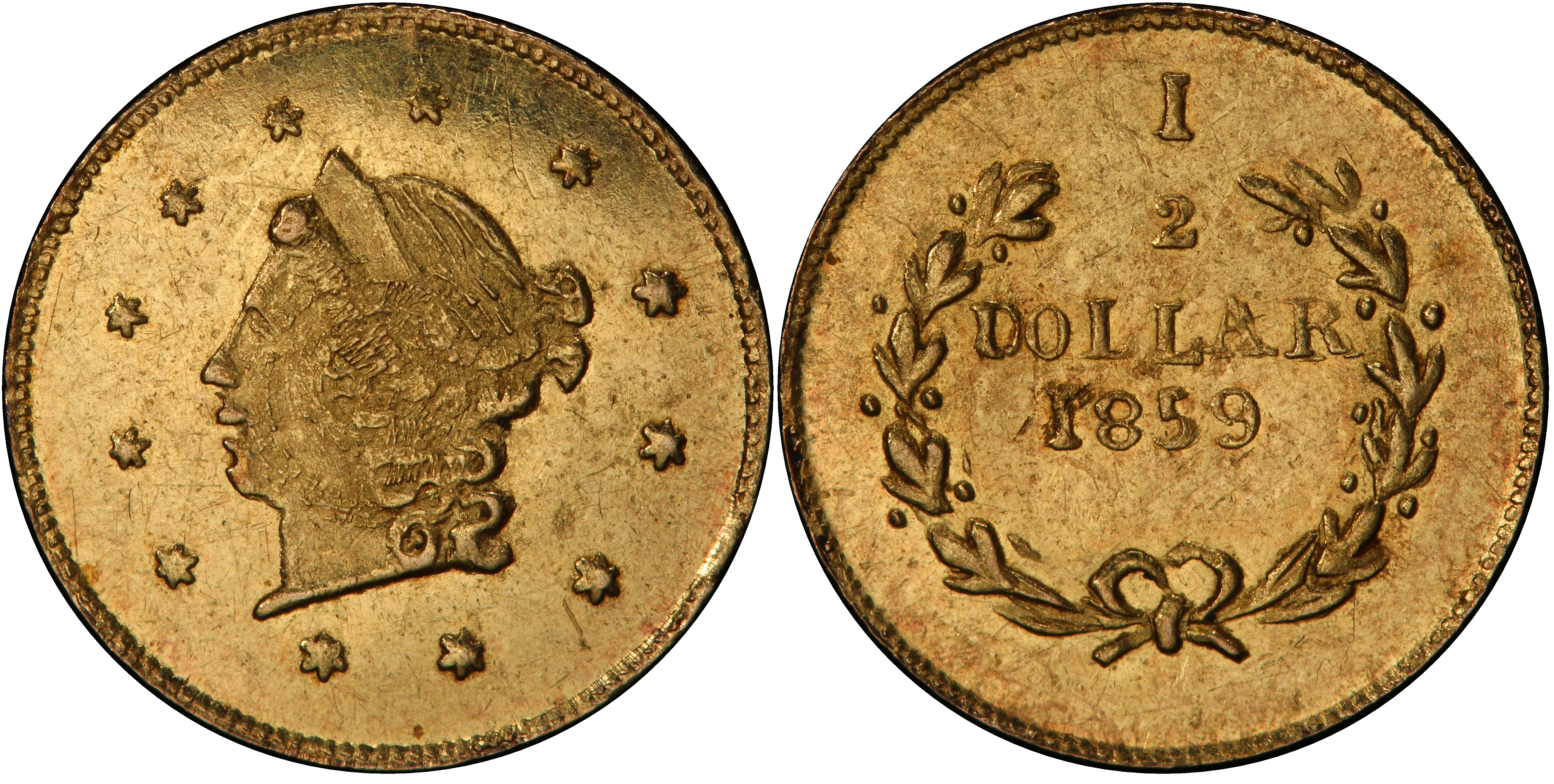
Obverse & Reverse
The 1859 BG-1003 50 Cent piece belongs to what numismatists classify as 'Period Two' (1858-1882) of the California Fractional Gold series. Unlike the earlier 'Period One' issues (1852-1857), which were struck out of genuine commercial necessity to alleviate a severe shortage of small change during the initial Gold Rush, the Period Two pieces were largely produced as souvenirs and curiosities. By 1859, the San Francisco Mint was in full operation, and the acute need for private coinage had subsided. Local jewelers and private minters, such as the firm of Frontier, Deviercy & Co. in San Francisco, recognized a burgeoning market for mementos of the Gold Rush. These tiny gold tokens were popular with locals and tourists alike, often incorporated into jewelry or kept as keepsakes. The production quality of Period Two issues is notably variable; the dies for BG-1003 are described by numismatists as being crudely engraved, a common characteristic of these later souvenir pieces. Despite their non-circulating intent, their connection to the Gold Rush zeitgeist and the allure of California gold made them highly collectible from the moment they were struck. The extreme rarity of the BG-1003 variety today suggests its original mintage was minuscule, even for a souvenir issue. Its absence from major historical collections like that of Virgil Brand underscores its elusiveness. Each surviving specimen is a tangible link to the evolving economy of post-Gold Rush California, where the focus began to shift from pure necessity to the creation of commercial keepsakes and the mythologizing of the frontier experience.
Associated EventCalifornia Gold Rush Aftermath
Reason For MintingPrimarily struck as a souvenir or curio for the tourist and jewelry trade rather than for monetary circulation.
Minter HistoryFrontier, Deviercy & Co. was a San Francisco-based firm of jewelers and engravers active during the mid-19th century. Like many such businesses in the booming city, they leveraged their metallurgical and engraving skills to produce a variety of items, including these small gold tokens. They were one of several firms that transitioned from serving the raw needs of the Gold Rush to catering to a more established populace interested in novelties and souvenirs. Their work is often characterized by a more simplistic or 'crude' engraving style compared to the earlier, circulating issues of Period One.
Historical SignificanceThe BG-1003 is a prime example of a 'Period Two' California Fractional Gold piece, significant for what it represents about the maturation of the California economy. It marks the transition from utilitarian private coinage born of necessity to the commercial production of historical souvenirs. Its high rarity makes it a key variety for specialists seeking to tell the complete story of this fascinating numismatic series.
BG-1003
DenominationG50C
Minting Period1859
Assayer/MinterFrontier, Deviercy & Co.
Geographic OriginSan Francisco, California
Obverse DescriptionA crudely engraved bust of a Liberty Head facing left, her hair tied in a bun at the back. The portrait is surrounded by thirteen stars, representing the original colonies. The date '1859' appears below the bust.
Obverse Inscription1859
Reverse DescriptionA wreath composed of two branches tied with a bow at the bottom. The wreath encircles the denomination '50 CENTS'. The legend 'CALIFORNIA GOLD' is inscribed outside the wreath along the upper periphery.
Reverse InscriptionCALIFORNIA GOLD 50 CENTS
CompositionGold
Stated Fineness Actual Fineness EdgeCrudely Reeded
Extremely low, likely fewer than 100
Survival Estimate4-12 pieces known
Rarity ScaleR-7
The BG-1003 is a highly coveted numismatic rarity, appealing to advanced specialists of California Fractional Gold. Its allure is multi-faceted: it is an issued piece by a known, albeit less common, private minter; it is a key representative of the 'Period Two' souvenir era; and its R-7 rarity ensures that any appearance at auction is a significant event. The crudely engraved details and reeded edge add to its unique character.
Key VarietiesNo major die varieties of BG-1003 are noted in numismatic literature. The primary 'variety' is the authentic original strike itself. No known restrikes, patterns, or trial pieces are recorded. The die state may vary slightly, but given the tiny population, such variations are not systematically cataloged.
Authentication TipsAuthenticity is paramount. Genuine examples will exhibit a crude but distinct strike from known dies. The crudely reeded edge is a key diagnostic. Weight and specific gravity tests are crucial, as many contemporary counterfeits and modern replicas are made of gilded brass. The lettering and stars, while crude, should not be porous or mushy as seen on cast copies. Comparison with high-resolution images of certified examples is essential. Any piece not certified by a top-tier grading service should be regarded with extreme suspicion.
Shopping ConsiderationsFor a coin of this rarity, any example is a major acquisition. A premium quality piece would be one that is well-centered and sharply struck for the issue, showing the reeding and most of the design details clearly. High-grade examples are often described as having prooflike surfaces with frosty devices, and this is a highly desirable characteristic. Avoid specimens that have been harshly cleaned, which would strip the original skin and luster. Damage from jewelry use (e.g., solder marks, edge filing) is a major impairment and should be priced accordingly. Given the small surviving population, any example with problem-free surfaces and a solid strike commands a significant premium.
A coin's grade is its condition, rated on a 1-70 scale. For rare coins, this is the most critical factor in determining value, as a tiny difference in preservation can mean a huge difference in price.
Relevant Grade TypesOriginal examples of BG-1003 were business strikes, although intended as souvenirs rather than for circulation. They are found in both Circulated (1-58) and, more commonly, Mint State (MS, 60-70) grades, as many were preserved as keepsakes. No proofs were struck during the original period of issue, and there are no known later-date collector restrikes.
Mint State CharacteristicsUncirculated examples of this variety are noted for their distinctive surface characteristics. They are often 'largely prooflike' in the fields, with a 'faint frostiness' on the devices. The strike can be inconsistent due to the crude nature of the dies and private minting process; a well-struck coin showing full detail on Liberty's hair and the wreath is rare and desirable. Luster is typically bright and flashy, often with a honey-gold or olive-gold toning. Small planchet flakes or imperfections are not uncommon and are noted by graders but may not significantly detract from the grade if minor.
Circulated Wear PatternsDue to the rarity and non-circulating nature of this coin, circulated examples are almost never encountered. If one were to exist, wear would first appear on the highest points: Liberty's cheek, hair above the eye, and the leaves and bow of the wreath. In lower grades, the delicate reeding would quickly become faint, and the fine details of the stars and lettering would merge with the fields.
Key Factors For ValueRarity is the primary value driver. Beyond that, surface preservation is critical. An example with original, undisturbed prooflike surfaces and frosty devices will command a massive premium. Strike quality is the next factor; a coin that is sharply struck on both sides is far more valuable than one with a weak or uneven strike. Eye appeal, encompassing attractive original toning and a lack of distracting marks or planchet flaws, is also key. For a rarity of this magnitude, a CAC sticker signifying premium quality for the grade would add a substantial percentage to its value.
PCGS Price Guide
| Grade | Price | Population |
|---|---|---|
| 58 | $750.00 | 3 |
| 58+ | $875.00 | N/A |
| 60 | $1,000.00 | 1 |
| 61 | $1,200.00 | N/A |
| 62 | $1,500.00 | 6 |
| 62+ | $1,725.00 | N/A |
| 63 | $2,000.00 | 6 |