1876 G25C BG-854 (Regular Strike)
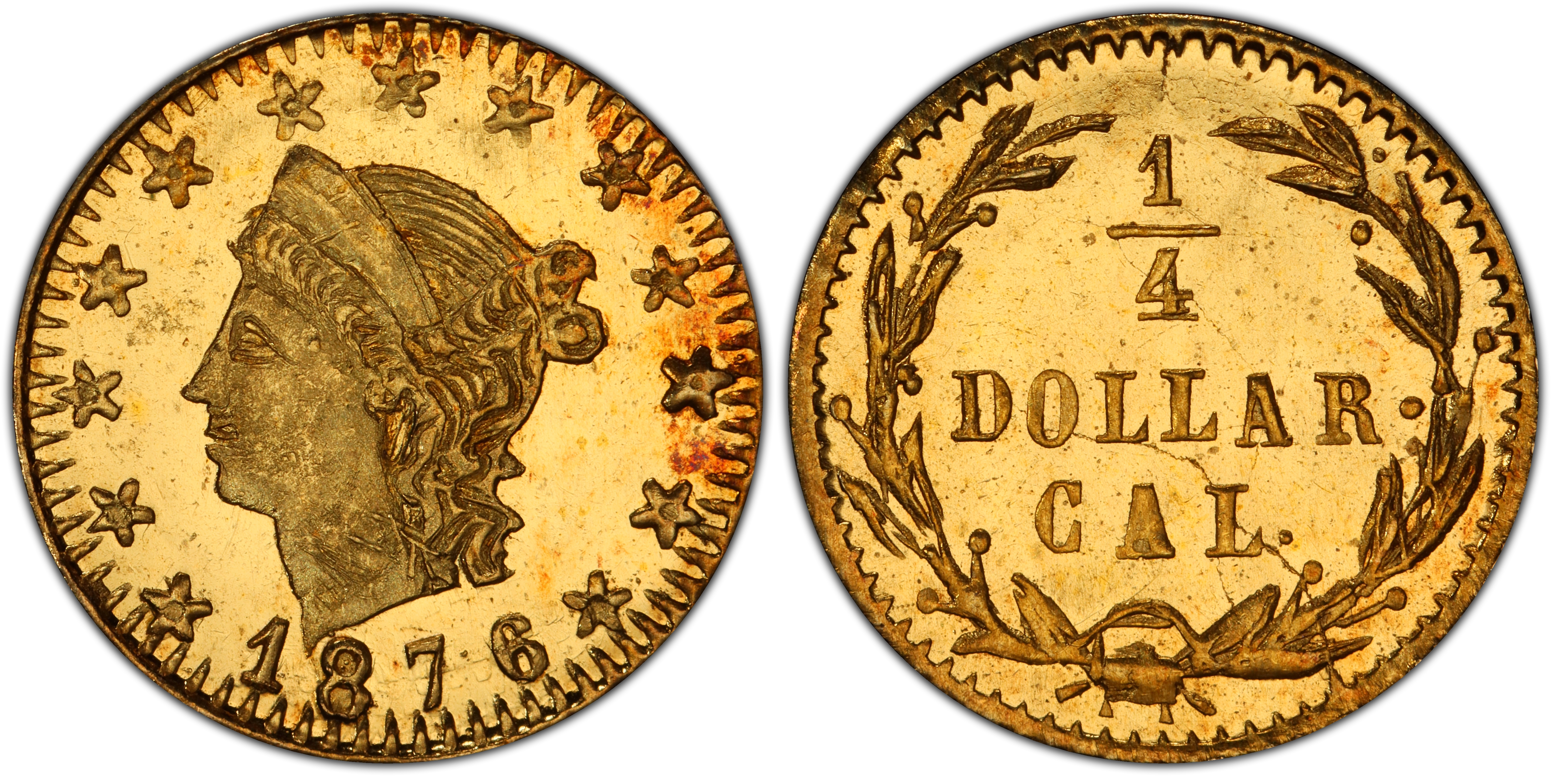
Obverse & Reverse
The 1876 BG-854 25 Cent piece emerges from the second major phase of California Fractional Gold production, often termed 'Period Two' or the 'Jeweler's Era' (1859-1882). By this time, the acute shortage of small change that characterized the initial Gold Rush had largely subsided with the establishment of the San Francisco Mint in 1854. The purpose of these tiny gold pieces had transitioned from fulfilling a crucial monetary need to serving as popular souvenirs and keepsakes for tourists, merchants, and those wishing to send a tangible piece of the 'Golden State' back east. These later issues, often designed and struck by jewelers with varying degrees of skill, were not intended for vigorous circulation and typically contained gold value significantly less than their face value. The year 1876 was particularly significant as it marked the Centennial of American Independence, an event celebrated with great patriotic fervor across the nation, including at the Centennial International Exhibition in Philadelphia. It is highly probable that pieces like the BG-854 were produced to capitalize on this celebratory atmosphere, offering a timely and affordable memento of both California's gold and the nation's centenary. The so-called 'Baby Head' Liberty design is stylistically distinct from the more formal federal motifs, reflecting the artistic license of private minters. Although one authoritative source attributes this variety to San Francisco jeweler Herman J. Brand, other references list the origin as unknown, a common ambiguity for many Period Two issues where production was semi-clandestine and records are nonexistent. The Coinage Act of 1864 had made private coinage illegal, but lax enforcement allowed jewelers to continue striking these denominated 'tokens' until the Secret Service finally cracked down in 1883.
Associated EventCalifornia Gold Rush (Later Souvenir Period)
Reason For MintingPrimarily struck to be sold as souvenirs and keepsakes during the United States Centennial year, rather than to alleviate a currency shortage.
Minter HistoryHerman J. Brand was a German immigrant jeweler and sculptor active in San Francisco during the latter half of the 19th century. While some numismatic catalogs attribute the 'Baby Head' varieties of 1876 to him, documentation for most Period Two minters is scarce. These jewelers operated in a legally grey area, producing souvenir tokens that mimicked coinage but were not intended to meet federal standards for weight or fineness. Their work is characterized by unique, often naive, artistic styles that distinguish them from official U.S. Mint products.
Historical SignificanceThe BG-854 represents the evolution of private California coinage from a necessary medium of exchange to a commercial souvenir product. It is a tangible artifact of the post-Gold Rush California economy, where the romance of gold was packaged and sold to a wider audience, and a memento of the 1876 U.S. Centennial celebration.
BG-854
Denomination25 Cents
Minting Period1876
Assayer/MinterHerman J. Brand (Attributed)
Geographic OriginSan Francisco, California
Obverse DescriptionFeatures a youthful, somewhat primitive depiction of a Liberty Head, facing left. This specific style is known to collectors as the 'Baby Head' due to its rounded, child-like features. The portrait is encircled by thirteen six-pointed stars, with the date '1876' positioned below the truncation of the neck. The digits of the date are characteristically close to the denticled border.
Obverse Inscription1876
Reverse DescriptionA simple wreath composed of two branches tied with a bow at the bottom encircles the denomination. The fraction '1/4' appears in the center, with 'DOLLAR' below it. The abbreviation 'CAL.' for California is located at the top, nestled within the wreath's opening.
Reverse InscriptionCAL. 1/4 DOLLAR
CompositionGold
Stated Fineness Actual FinenessTypically of lower fineness than official U.S. coinage, as was common for Period Two jeweler's issues.
EdgePlain
Unknown
Survival Estimate46 to 75 known examples (per the R-5 rating on the Breen-Gillio Rarity Scale).
Rarity ScaleR-5
The BG-854 is sought after for its distinctive 'Baby Head' design, its connection to the U.S. Centennial year of 1876, and its status as a representative of the popular 'Jeweler's Issue' period of California Fractional Gold. Its defined rarity of R-5 makes it a challenging but achievable acquisition for dedicated collectors.
Key VarietiesThe primary variety associated with this issue is not a regular strike, but a rare 'hybrid' or 'mule.' The obverse die of BG-854 was also used to strike tokens with a dual denomination reverse, showing '1/2' over '1/4'. These pieces are exceptionally rare (rated R-8) and are considered a major prize within the series. No official restrikes or patterns are known.
Authentication TipsA key diagnostic for a genuine BG-854 is a faint, diagonal die crack on the reverse that runs through the letters 'CAL.' at the top of the wreath. Counterfeits are common in this series; they are often soapy in appearance, exhibit incorrect weight and luster, and may be gold-plated base metal. The style of the 'Baby Head' and the specific arrangement of the date and stars should be compared to high-resolution images of certified examples. Struck pieces will have sharp details, unlike cast copies.
Shopping ConsiderationsA premium quality example for its grade will exhibit a sharp strike, particularly on Liberty's hair details and the numerals of the date. Luster can range from satiny to semi-prooflike, with deeply prooflike or cameo-contrast examples commanding significant premiums. Original, uncleaned surfaces with a reddish or orange-gold patina are highly desirable. Check carefully for evidence of past use as jewelry, such as rim bumps, solder marks, or tooling in the fields, which are common problems for this series. The area around the die crack on the reverse should be examined for any signs of weakness or stress.
A coin's grade is its condition, rated on a 1-70 scale. For rare coins, this is the most critical factor in determining value, as a tiny difference in preservation can mean a huge difference in price.
Relevant Grade TypesOriginal 1876 BG-854 coins were business strikes produced for commercial sale as souvenirs, not for circulation. They are found in Circulated grades (AU-50 to AU-58, typically from minor handling) and, more commonly, Mint State (MS, 60-70) grades. No proofs were struck during the original period of issue, and no later-date restrikes are known to exist.
Mint State CharacteristicsUncirculated examples of BG-854 often display a surprisingly sharp strike for a private issue. The highest quality pieces show full detail in the hair strands around Liberty's face and on the leaves of the reverse wreath. Luster is a key value determinant; examples can range from subdued and satiny to bright and prooflike. Due to the small size and the way they were handled in groups, even high-grade specimens may show tiny, scattered contact marks or 'tick' marks. Deeply reflective, cameo-contrast coins are rare and command the highest prices.
Circulated Wear PatternsAlthough not intended for heavy circulation, light wear from handling first appears on the highest points of the design. On the obverse, look for flattening on Liberty's cheek, the top of her hairline, and her ear. On the reverse, the high points of the wreath's leaves and the numerals of the fraction '1/4' will show the first signs of friction. In lower circulated grades (AU), the finer hair details will merge and the overall luster will be subdued.
Key Factors For ValueThe primary drivers of value for an 1876 BG-854 are grade and surface quality. An example with original, uncleaned 'skin' and vibrant luster will always be worth more than a cleaned or polished piece of the same grade. Strike sharpness is critical; a weakly struck coin will be less desirable than a boldly impressed one. Eye appeal, enhanced by attractive original toning or deep prooflike contrast, adds a significant premium. Given the prevalence of counterfeits and cleaned coins in this series, certification by a top-tier grading service (PCGS or NGC) is essential for market acceptance, and a CAC sticker indicates premium quality for the grade.
PCGS Price Guide
| Grade | Price | Population |
|---|---|---|
| 50 | $225.00 | 1 |
| 50+ | $230.00 | N/A |
| 53 | $245.00 | N/A |
| 53+ | $250.00 | N/A |
| 55 | $275.00 | 1 |
| 55+ | $280.00 | N/A |
| 58 | $300.00 | 2 |
| 58+ | $310.00 | N/A |
| 60 | $350.00 | 1 |
| 61 | $375.00 | 1 |
| 62 | $425.00 | 4 |
| 62+ | $465.00 | N/A |
| 63 | $500.00 | 11 |
| 63+ | $575.00 | N/A |
| 64 | $850.00 | 17 |
| 64+ | $950.00 | N/A |
| 65 | $1,150.00 | 7 |
| 65+ | $1,850.00 | N/A |
| 66 | $2,500.00 | 1 |