1868 G50C BG-960A (Regular Strike)
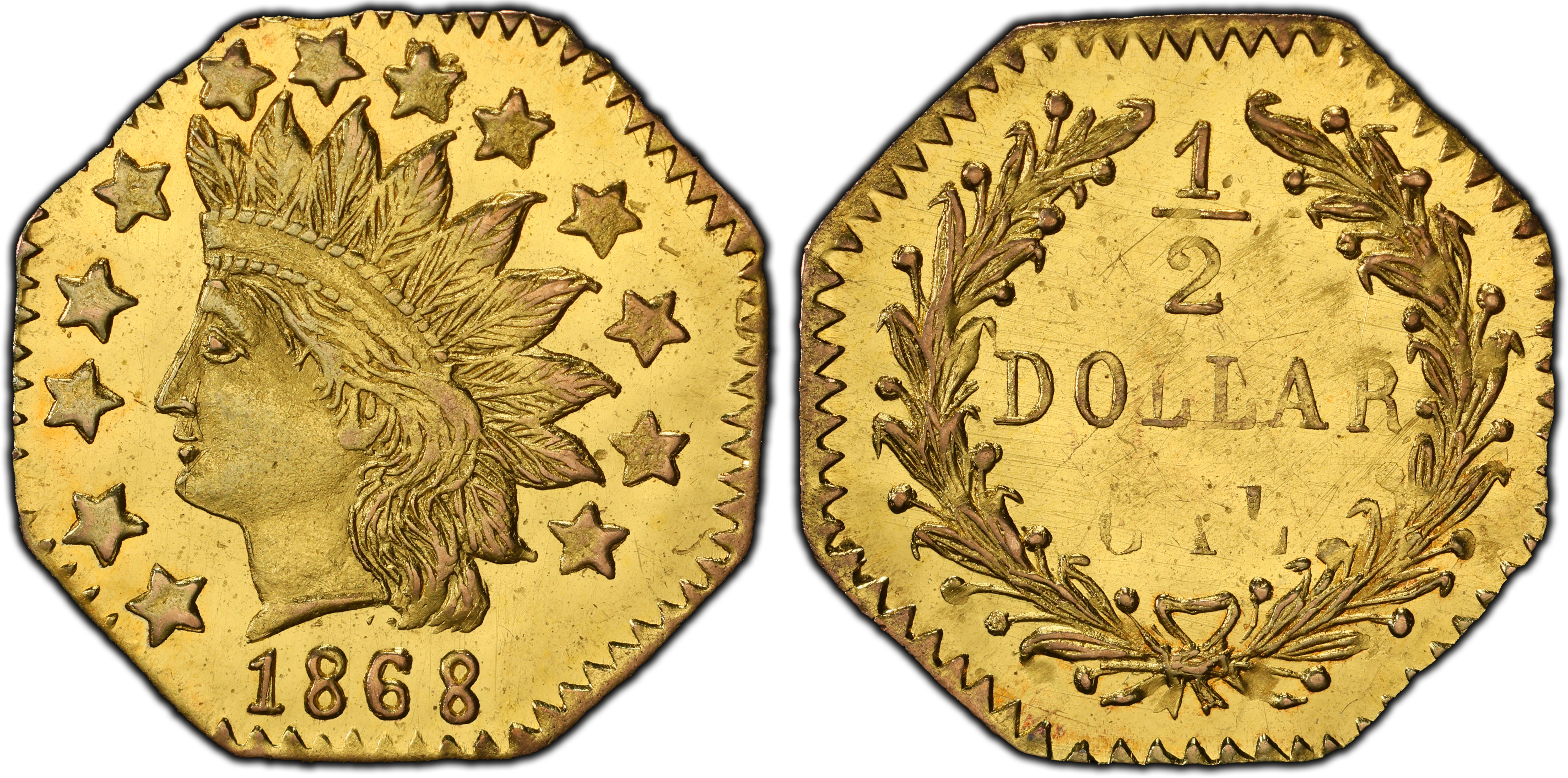
Obverse & Reverse
The 1868 G50C BG-960A is a quintessential example of a 'Period Two' California Fractional Gold piece. By 1868, the acute shortage of small change that had plagued California during the initial Gold Rush years had largely been resolved by the output of the official U.S. Branch Mint in San Francisco, which began operations in 1854. The first wave of fractional gold, now known as 'Period One' (1852-1857), had been struck out of commercial necessity and, while often underweight, was intended to and did circulate. The socio-economic landscape of California had matured; the frenzied chaos of the '49ers was replaced by a more structured economy and a growing sense of regional identity. San Francisco was transforming from a boomtown into a major American city, attracting tourists and settlers alike. It was within this context that jewelers like Robert B. Gray & Co. recognized a new market. They began producing small gold tokens not as a substitute for federal coinage, but as keepsakes and souvenirs of the romanticized Gold Rush era. These 'Period Two' pieces, struck from 1858 to 1882, were consciously designed as novelties. They were typically underweight for their face value, often of a lower gold fineness, and featured more varied and sometimes cruder designs than their 'Period One' predecessors. The Coinage Act of April 22, 1864, had made private coinage illegal, but the law was not strictly enforced by the Secret Service against these small souvenir tokens until 1883. This legal gray area allowed jewelers to continue denominating their pieces, adding to their appeal as 'money-like' objects. The BG-960A was created during this flourishing souvenir trade. It was never intended to buy a loaf of bread or a drink at a saloon; rather, it was purchased by a visitor wanting a memento of California's golden identity or by a local for use in jewelry. This shift in purpose from utility to novelty is the defining characteristic of its era, making it a fascinating artifact not of commercial necessity, but of cultural memory and early tourism.
Associated EventCalifornia Gold Rush (Later Souvenir Period)
Reason For MintingPrimarily minted for sale as a souvenir or jewelry charm for the tourist trade, not for circulation as currency.
Minter HistoryRobert B. Gray & Co. was a prominent San Francisco manufacturing jeweler active during the 'Period Two' era. Around 1859-60, Gray acquired the business of Antoine Louis Nouizillet, another significant producer of fractional gold, including his dies and equipment. Gray continued to produce fractional gold using some of Nouizillet's old dies before creating his own, which are often identifiable by a characteristic 'G' initial. His firm was known for producing some of the heavier and more intrinsically valuable pieces of the souvenir period. In 1871, Robert B. Gray sold his interests to the California Jewelry Company, which itself would later produce fractional gold marked with an 'L' for its Levison Bros. division.
Historical SignificanceThis coin is significant as an artifact of the post-Gold Rush California economy, representing the transition from a currency of necessity to a commercial souvenir trade. It captures the romantic mythology that the Gold Rush had already acquired just two decades after its peak, demonstrating an early form of regional branding and tourism.
BG-960A
Denomination50C
Minting Period1868
Assayer/MinterRobert B. Gray & Co.
Geographic OriginSan Francisco, California
Obverse DescriptionAn Indian Head portrait facing left, surrounded by 13 five-pointed stars. The portrait style is characteristic of Robert B. Gray's work from this period. The date '1868' is below the portrait. The planchet is octagonal.
Obverse Inscription1868
Reverse DescriptionA wreath of two branches tied with a bow at the bottom encircles the denomination. The legend 'CALIFORNIA GOLD' would typically appear outside the wreath, though specific placement can vary by die marriage.
Reverse Inscription1/2 DOLLAR
CompositionGold
Stated Fineness Actual FinenessVariable, but generally lower than the .900 standard of federal coinage, as was typical for Period Two issues.
Weight0.25 grams
Diameter10.00 mm
EdgePlain
Unknown, but certainly very small.
Survival EstimateFewer than 10 known. Based on NGC census data showing 6 examples graded, the total surviving population is likely between 7 and 9 pieces.
Rarity ScaleR-7 (7-9 known)
The 1868 G50C BG-960A is highly sought after due to its extreme rarity as a specific Breen-Gillio variety. Its appeal lies in its connection to the famous California Gold Rush souvenir period, its octagonal shape, and its identifiable maker, Robert B. Gray & Co. It represents a tangible link to the romanticized history of the Old West.
Key VarietiesThe primary variety is the BG-960A Regular Strike. The BG-960 is a separate, though related, variety from the same year and minter. No known proof restrikes, patterns, or trial pieces exist for this specific variety. Collecting fractional gold often focuses on acquiring different BG numbers, which represent distinct die pairings.
Authentication TipsAuthentic Period Two pieces are die-struck, not cast, so look for sharp details, even if crudely engraved. Many genuine fractionals are very thin; modern replicas are often thicker and have a soapy, less-defined appearance. The surfaces should exhibit original luster, not the uniform matte finish of many cast fakes. The Breen-Gillio reference is essential for die-state analysis and identifying the specific markers of the BG-960A dies. Be wary of pieces with incorrect design elements, such as bears on the reverse, which are characteristic of later, non-denominated tokens.
Shopping ConsiderationsFor a premium quality example, a buyer should seek a well-struck coin with minimal contact marks and original, undisturbed surfaces. Luster is a key value determinant; coins with prooflike or semi-prooflike fields command significant premiums. Avoid examples that have been harshly cleaned, which strips the original patina and imparts hairline scratches. Also, check carefully for evidence of having been mounted in jewelry, such as rim damage, solder, or tooling marks, as this was a common fate for these souvenir pieces. Given the rarity, any example, even one with minor impairments, is significant, but price should reflect any damage.
A coin's grade is its condition, rated on a 1-70 scale. For rare coins, this is the most critical factor in determining value, as a tiny difference in preservation can mean a huge difference in price.
Relevant Grade TypesAll original examples of BG-960A were struck as business strikes, but since they were intended as souvenirs and not for commerce, they are most often found in high grades. They exist in Circulated (1-58) grades, though this is uncommon, and are more typically found in Mint State (MS, 60-70) grades. No true Proofs were struck during the original minting period. The term 'Prooflike' (PL) is often applied to high-grade examples with reflective surfaces, which adds to their value, but this is a surface characteristic of a business strike, not a separate striking method.
Mint State CharacteristicsUncirculated examples of this issue often feature a soft, satiny luster, though some can be found with highly reflective, prooflike fields. The strike can be inconsistent due to the manual 'hammered' method of production, with some weakness possible on the high points of the Indian's hair or the details of the wreath. Small planchet flaws or striations are common and generally accepted by collectors. Contact marks, even on high-grade pieces, are expected due to the softness of the gold and rudimentary handling at the time of manufacture.
Circulated Wear PatternsOn the rare occasion a circulated example is found, wear will first appear on the high points of the Indian Head's cheek and feathered headdress. On the reverse, the highest points of the wreath's leaves and the numerals of the fraction will show initial friction and smoothing. In lower grades (VF and below), the stars on the obverse and the lettering on the reverse will begin to lose their sharpness.
Key Factors For ValueThe primary driver of value is rarity, followed closely by grade. For this specific issue, surface quality is paramount. An example with original, uncleaned 'skin' and strong luster will command a substantial premium over a cleaned or abraded piece of the same grade. Eye appeal is critical; coins with attractive, reddish-gold toning and sharp strikes are highly prized. A CAC sticker, indicating premium quality for the grade, would add a significant premium, as it confirms the coin's superior surfaces and strike in the eyes of expert numismatists.
PCGS Price Guide
| Grade | Price | Population |
|---|---|---|
| 60 | $900.00 | N/A |
| 61 | $950.00 | 1 |
| 62 | $1,000.00 | N/A |
| 62+ | $1,025.00 | N/A |
| 63 | $1,050.00 | 1 |
| 63+ | $1,150.00 | N/A |
| 64 | $1,250.00 | 1 |
| 64+ | $1,500.00 | N/A |
| 65 | $2,250.00 | 5 |
| 65+ | $2,500.00 | N/A |
| 66 | $3,000.00 | 1 |
| 67 | N/A | N/A |