1871 G50C BG-926 (Regular Strike)
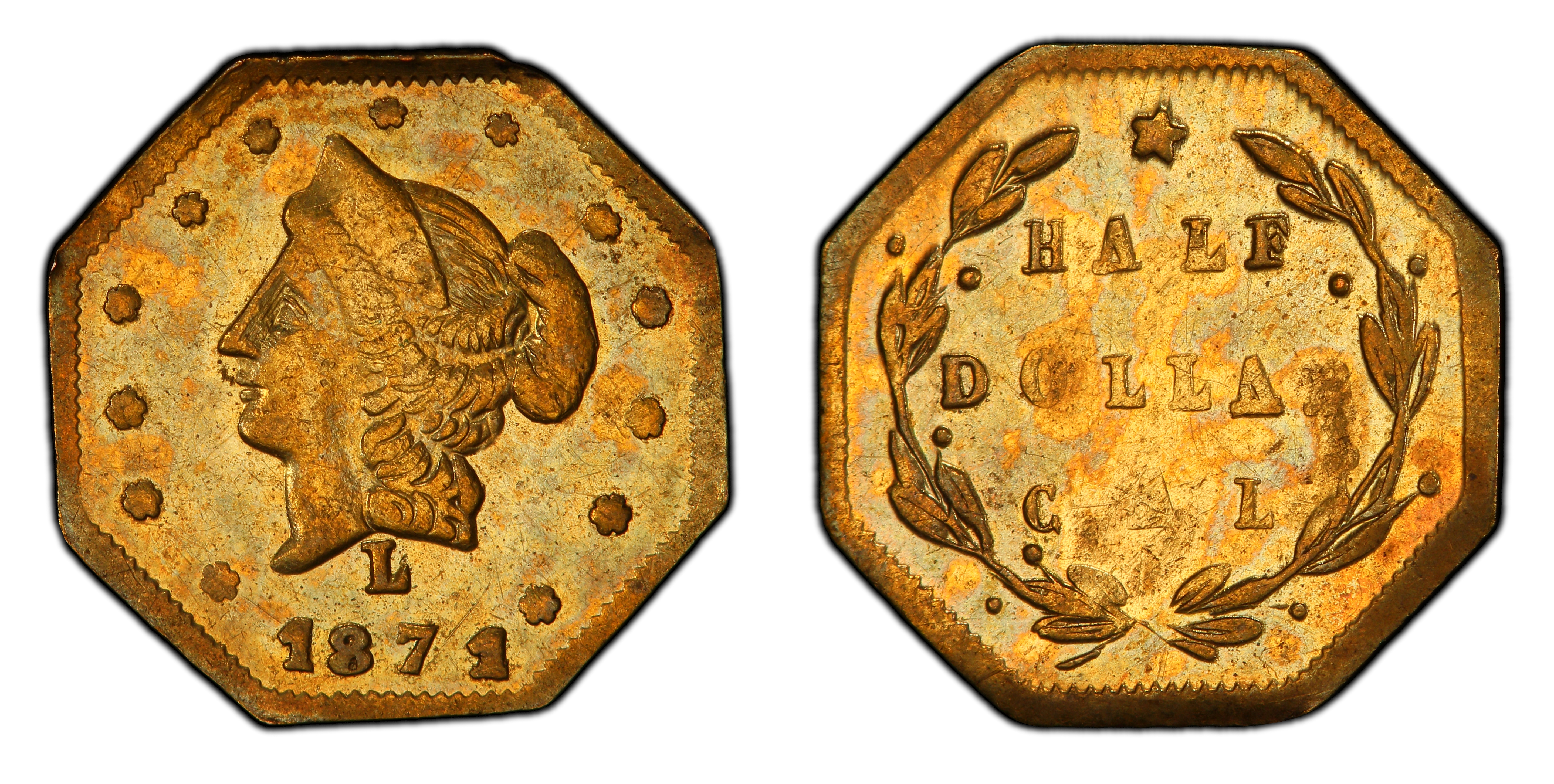
Obverse & Reverse
The 1871 BG-926 fifty-cent piece emerges from the second major phase of California's private gold coinage, a period numismatists designate as 'Period Two' (1859-1882). Unlike the earlier 'Period One' issues, which were struck with the genuine intent of alleviating a chronic shortage of small change during the initial Gold Rush boom, the coins of this later era served a different purpose. By the 1870s, the San Francisco Mint was in full operation, producing ample federal silver coinage that had largely solved the transactional gridlock of the 1850s. The impetus for creating fractional gold had therefore shifted from commercial necessity to commercial novelty. These later pieces, often called 'jeweler's issues,' were primarily manufactured by jewelers and metalsmiths in San Francisco as souvenirs and keepsakes. They catered to a growing tourist trade and a local population still enchanted by the allure of gold. These coins were intentionally lightweight, containing significantly less gold than their stated face value, making them profitable tokens rather than legitimate currency. The production process was rudimentary, often involving hand-operated screw presses or even simple hammer striking, which resulted in coins of varying strike quality. Despite not being intended for widespread circulation, they were widely collected and preserved as mementos of the Gold Rush era, which ironically contributed to their survival, albeit in very small numbers. The passage of the Coinage Act of 1864 had effectively outlawed private coinage, but enforcement was lax for many years, allowing these small, token-like gold pieces to be produced until federal authorities finally cracked down in the early 1880s.
Associated EventPost-Gold Rush California Economy & Tourism
Reason For MintingPrimarily created as souvenirs for tourists and locals, rather than to fill a circulating coinage need which had been met by the San Francisco Mint.
Minter HistoryThe specific minter for the BG-926 variety is unknown, which is common for many 'Period Two' California Fractional Gold pieces. They were typically produced by various San Francisco-based jewelers who struck them as part of their regular business operations. These craftsmen were skilled metallurgists but not official minters, and their identifying marks, if any, were often subtle or nonexistent. This anonymity was also practical, as the legality of their activities was questionable following the Private Coinage Act of 1864.
Historical SignificanceThe BG-926 is significant not as a circulating coin but as a tangible artifact of the evolution of the California economy. It represents the transition from a frontier society scrambling for any medium of exchange to a more established state where gold's primary role shifted from daily currency to a symbol of prosperity and a popular souvenir item. These 'jeweler's issues' are a distinct and fascinating chapter in the history of U.S. private coinage.
N/A
Denomination50 Cents
Minting Period1871
Assayer/MinterUnknown Private Minter
Geographic OriginSan Francisco, California
Obverse DescriptionA stylized Liberty Head facing left, with hair tied in the back. The portrait is surrounded by thirteen stars, representing the original colonies. The date, 1871, appears below the bust.
Obverse Inscription1871
Reverse DescriptionThe denomination '1/2' is enclosed within a beaded circle, which is itself surrounded by the inscription 'CALIFORNIA GOLD'.
Reverse InscriptionCALIFORNIA GOLD 1/2
CompositionGold
Stated Fineness Actual FinenessVaries, but typically between 14 and 22 karats for Period Two issues, containing substantially less gold than their face value would imply.
Weight0.25 grams
Diameter10.50 mm
EdgePlain
Unknown, but presumed to be very small.
Survival Estimate13 to 30 pieces
Rarity ScaleR-6+ (Very Rare)
The BG-926 is highly sought after due to its extreme rarity, its connection to the romanticized California Gold Rush era, and its distinctive octagonal shape. As a 'Period Two' issue, it tells the story of how fractional gold evolved from necessity to novelty. The challenge of acquiring any specimen, let alone a high-grade one, makes it a prize for advanced collectors.
Key VarietiesThe primary reference for this series is 'California Pioneer Fractional Gold' by Walter Breen and Ronald J. Gillio, where this coin is designated BG-926. There are no known major varieties of BG-926 struck during the period of issue. No original Proofs or restrikes are known to exist.
Authentication TipsAuthentication is paramount. Prospective buyers should consult the Breen-Gillio reference, which provides photographs of genuine examples. Characteristics of genuine pieces include specific die markers and a particular strike style. Counterfeits and later replicas abound; many fakes have a soapy or cast-like appearance, incorrect weight, or design details inconsistent with the known dies. A common red flag for replicas is the presence of a bear on the design, which does not appear on genuine 19th-century issues. All uncertified examples should be regarded with extreme skepticism and authenticated by a top-tier grading service.
Shopping ConsiderationsWhen acquiring an 1871 BG-926, the strike quality is a major factor. These were often weakly or unevenly struck by hand; examples with a bold, sharp strike on both Liberty's hair and the reverse wreath are highly desirable and command a significant premium. Surface quality is critical. Look for examples with minimal distracting marks and original, undisturbed luster. Coins with a pleasing, original patina, sometimes described as 'lemon-gold' or having hints of 'steel-blue', are prized. Avoid specimens that have been cleaned, polished, or mounted in jewelry, as this severely impairs their value. Given the coin's rarity, even problem-free circulated examples in grades like AU-58 are considered exceptional.
A coin's grade is its condition, rated on a 1-70 scale. For rare coins, this is the most critical factor in determining value, as a tiny difference in preservation can mean a huge difference in price.
Relevant Grade TypesOriginal examples of BG-926 are business strikes, produced for potential sale as souvenirs rather than for circulation. They are found in Circulated grades (AU-58 and below) and Mint State grades (MS-60 to 70). No Proof (PR/PF) examples were struck during the original period of issue, and there are no known later-date collector restrikes.
Mint State CharacteristicsAn uncirculated BG-926 is defined by its luster and lack of wear. Luster is typically satiny rather than frosty. Strike quality varies significantly; many are softly struck, particularly in the center of the obverse (Liberty's hair) and the reverse (the denomination). A well-struck example is a rarity and commands a premium. Due to the small size and manual production, even Mint State examples may exhibit minor planchet flaws or handling marks from the time of manufacture.
Circulated Wear PatternsWear first appears on the highest points of the design. On the obverse, this includes Liberty's cheek, the highest strands of her hair, and the eyebrow. On the reverse, the high points of the denomination '1/2' and the surrounding beaded circle will show friction first. In lower grades (VF and below), the stars on the obverse and the letters in 'CALIFORNIA GOLD' will begin to lose their sharpness and merge with the fields.
Key Factors For ValueFor the 1871 BG-926, value is driven by three main factors. First and foremost is rarity; with a R-6+ rating, any example is valuable. Second is the grade and surface quality; an example with original, uncleaned surfaces and minimal marks will always be worth multiples of a cleaned or damaged coin. Third is eye appeal, which is heavily influenced by the sharpness of the strike. An MS-62 example that is sharply struck can be more valuable than a weakly struck MS-64. The presence of a CAC sticker, indicating premium quality for the grade, adds a significant premium.
PCGS Price Guide
| Grade | Price | Population |
|---|---|---|
| 50 | $350.00 | 1 |
| 50+ | $375.00 | N/A |
| 53 | $400.00 | 1 |
| 53+ | $425.00 | N/A |
| 55 | $475.00 | 3 |
| 55+ | $500.00 | N/A |
| 58 | $550.00 | 3 |
| 58+ | $575.00 | N/A |
| 60 | $625.00 | 1 |
| 61 | $700.00 | 3 |
| 62 | $950.00 | 2 |
| 62+ | $1,000.00 | N/A |
| 63 | $1,100.00 | N/A |
| 63+ | $1,450.00 | N/A |
| 64 | $2,350.00 | 1 |
| 64+ | $2,750.00 | N/A |
| 65 | $3,750.00 | N/A |