1868 G50C BG-1008 (Regular Strike)
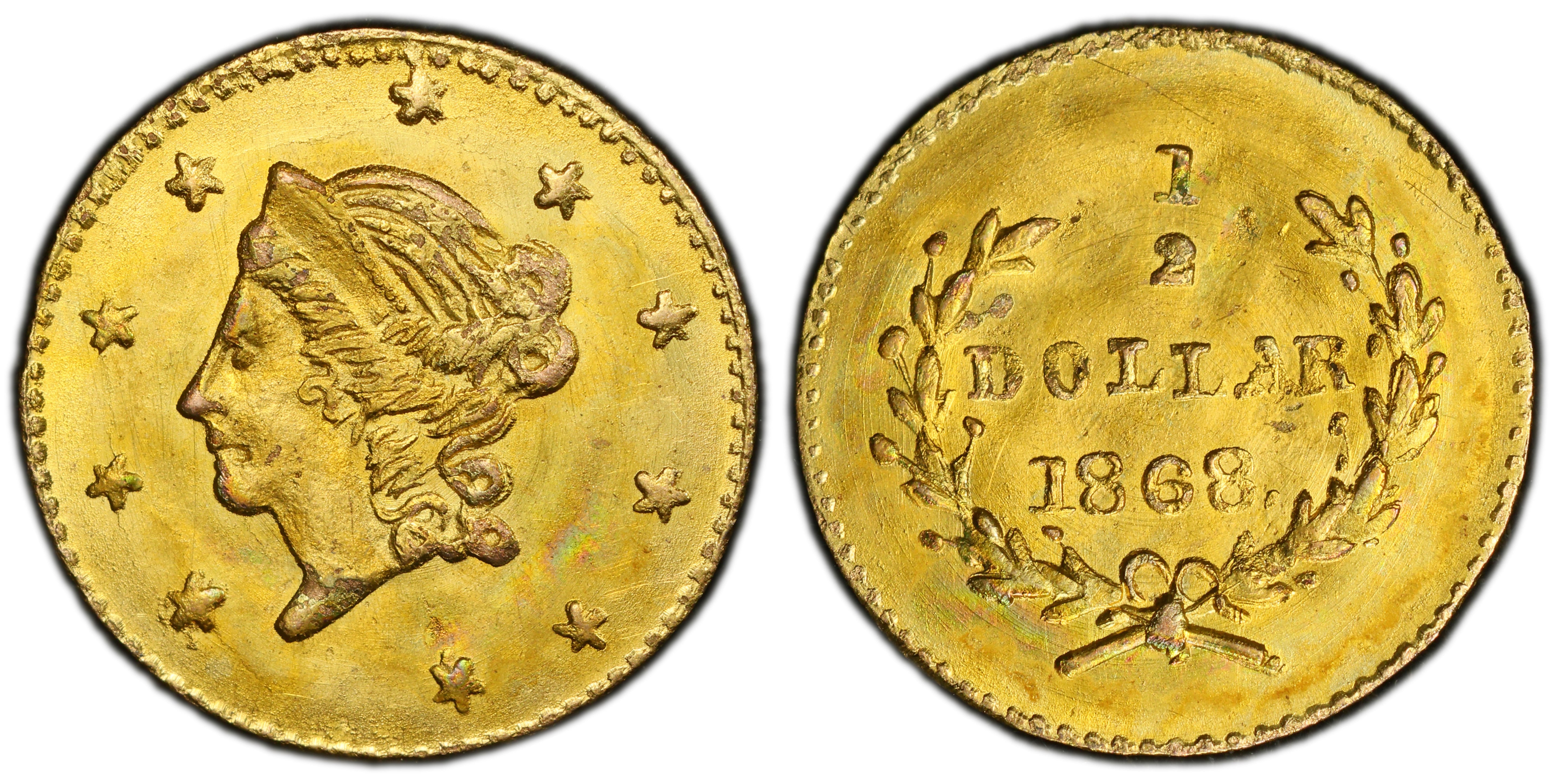
Obverse & Reverse
The 1868 BG-1008 fifty-cent piece emerges from the second period of California Fractional Gold production, a fascinating era that followed the initial frenzy of the Gold Rush. By the late 1860s, the acute shortage of small denomination coinage that had plagued California in the early 1850s had largely subsided with the increased output of the San Francisco Mint. However, the allure of gold and the tradition of private minting persisted, shifting in purpose from necessity to novelty. These later-period 'jeweler's issues' were primarily created not for robust circulation, but as souvenirs, keepsakes, and for use in jewelry. The Coinage Act of 1864 had explicitly outlawed private coinage, but enforcement was lax, allowing a cottage industry of jewelers and metalworkers, predominantly in San Francisco, to continue striking these miniature gold pieces through the early 1880s. The BG-1008 variety is a product of this environment. Struck in 1868, it was created after the Civil War, a time of national healing and continued westward expansion. While larger gold and silver coins were readily available, these tiny gold pieces satisfied a demand for tangible, affordable symbols of California's golden promise. They were popular items for tourists and locals alike, easily sent back east in a letter as a memento of the Golden State. The actual gold content of these later issues was often significantly less than their stated face value, a fact widely understood at the time; their value was in their novelty, not their intrinsic worth. The anonymous minters of these pieces, likely experienced jewelers, used hand-operated presses, which resulted in coins of varying strike quality. Today, the BG-1008 is a tangible link to this unique post-Gold Rush, pre-Federal enforcement era of private minting, representing a transition from utilitarian coinage to commercial souvenir.
Associated EventCalifornia Gold Rush Era (Later Period)
Reason For MintingPrimarily struck to be sold as souvenirs, keepsakes, and for use in jewelry rather than for general circulation.
Minter HistoryThe specific minter for BG-1008 is unknown, which is typical for many 'jeweler's issues' from this period. Production is attributed to one of the many jewelers and private minters operating in San Francisco in the mid-to-late 19th century who capitalized on the souvenir market. These craftsmen often had the skills and equipment to produce small, detailed gold tokens.
Historical SignificanceThis coin is significant as a representative of the 'second period' of California Fractional Gold, where the purpose of issue shifted from filling a commercial need for small change to satisfying a robust market for souvenirs and novelties. It highlights a period of lax federal oversight on private minting and the enduring romanticism of California gold.
Not Applicable
Denomination50 Cents
Minting Period1868
Assayer/MinterUnknown, likely a San Francisco jeweler
Geographic OriginSan Francisco, California
Obverse DescriptionThe obverse features a small Liberty Head facing left, modeled after the contemporary design of James B. Longacre used on federal gold coinage. The portrait is surrounded by thirteen stars, representing the original colonies.
Obverse InscriptionNo textual inscription is present on the obverse beyond the design elements.
Reverse DescriptionThe reverse features the denomination '1/2' and the word 'DOLLAR' within a wreath of leaves. The date '1868' is positioned below the wreath.
Reverse Inscription1/2 DOLLAR 1868
CompositionGold
Stated Fineness Actual FinenessVaries, but generally lower than monetary-issue gold of the period.
Weight0.25 grams
Diameter10.00 mm
EdgePlain
Unknown
Survival Estimate31-75
Rarity ScaleR-6
The BG-1008 is sought after for its classic Liberty Head design, its status as a dated, denominated issue from the later period of California Fractional Gold, and its relative scarcity (R-6). Collectors appreciate it as a tangible piece of Gold Rush-era history that is more accessible than the earlier, circulation-focused issues.
Key VarietiesThe primary reference for this series is 'California Pioneer Fractional Gold' by Walter Breen and Ronald J. Gillio, where this variety is designated BG-1008. There are no major, contemporaneously-issued varieties of BG-1008. No special collector restrikes or patterns are known to exist for this specific die marriage. Collectors should be aware that the broader California Fractional Gold series is rife with modern replicas and fantasy pieces, making attribution to a specific BG number essential.
Authentication TipsAuthentic examples should have a specific die alignment and diagnostic markers consistent with the BG-1008 variety. Look for sharpness of details that match known genuine coins; many counterfeits are soft or have incorrect lettering fonts. The luster should be appropriate for a privately struck gold coin of the era, not the glassy, prooflike fields of many modern fakes. The weight and diameter should be close to the established norms. Third-party certification by PCGS or NGC is highly recommended for this series to ensure authenticity.
Shopping ConsiderationsA premium quality example for its grade will exhibit a sharp, well-centered strike on both the obverse and reverse. For this issue, look for full definition in Liberty's hair details and the individual leaves of the wreath. Original, uncleaned surfaces with a touch of reddish-gold toning are highly desirable. Avoid examples that are described as 'cleaned' or 'ex-jewelry,' as the latter often have evidence of soldering or rim damage. Given their small size, these coins are very susceptible to being lost or damaged, so problem-free examples command a significant premium.
A coin's grade is its condition, rated on a 1-70 scale. For rare coins, this is the most critical factor in determining value, as a tiny difference in preservation can mean a huge difference in price.
Relevant Grade TypesOriginal issues of BG-1008 were business strikes. Though intended more as souvenirs than circulating currency, they are found in both Circulated (1-58) and Mint State (MS, 60-70) grades. No original proofs are known to have been struck. Any piece described as a 'Proof' would be a later-date restrike or fantasy piece and should be treated as a separate numismatic item, distinct from the original 1868 issue.
Mint State CharacteristicsUncirculated examples of BG-1008 often display a soft, satiny luster characteristic of low-pressure, hand-operated press strikes. The overall strike can be inconsistent; some are sharply detailed while others show weakness in the center of either side. Small planchet flaws or adjustment marks are not uncommon and should be evaluated based on their severity. Contact marks, even on high-grade pieces, are common due to the softness of the gold and the way these pieces were handled in bulk by their makers.
Circulated Wear PatternsWear first appears on the highest points of the design. On the obverse, this includes Liberty's cheek, the hair just above the ear, and the tips of the coronet. On the reverse, the high points of the wreath's leaves and the bow at the bottom will show the first signs of friction. In lower grades (VF and below), the smaller letters in 'DOLLAR' and the digits of the date will begin to lose their sharpness.
Key Factors For ValueFor the BG-1008, value is primarily driven by grade and surface quality. A sharply struck coin with minimal distracting marks and original, lustrous surfaces will command a strong premium. Eye appeal is crucial; examples with rich, original reddish-gold coloration are prized over those that are bright, brassy, or have been cleaned or dipped. Given the prevalence of forgeries, certification by a top-tier service like PCGS or NGC is nearly mandatory for market acceptance. A CAC sticker for this issue indicates superior quality for the grade and adds a significant premium.
PCGS Price Guide
| Grade | Price | Population |
|---|---|---|
| 40 | $240.00 | 1 |
| 45 | $250.00 | N/A |
| 45+ | $255.00 | N/A |
| 50 | $265.00 | N/A |
| 50+ | $270.00 | N/A |
| 53 | $275.00 | N/A |
| 53+ | $285.00 | N/A |
| 55 | $290.00 | N/A |
| 55+ | $295.00 | N/A |
| 58 | $325.00 | 2 |
| 58+ | $340.00 | N/A |
| 60 | $350.00 | 2 |
| 61 | $375.00 | 1 |
| 62 | $400.00 | 5 |
| 62+ | $420.00 | N/A |
| 63 | $490.00 | 8 |
| 63+ | $540.00 | N/A |
| 64 | $625.00 | 14 |
| 64+ | $725.00 | N/A |
| 65 | $1,350.00 | 8 |
| 65+ | $1,650.00 | N/A |
| 66 | $2,450.00 | N/A |
| 67 | N/A | N/A |