1875 G25C BG-878 (Regular Strike)
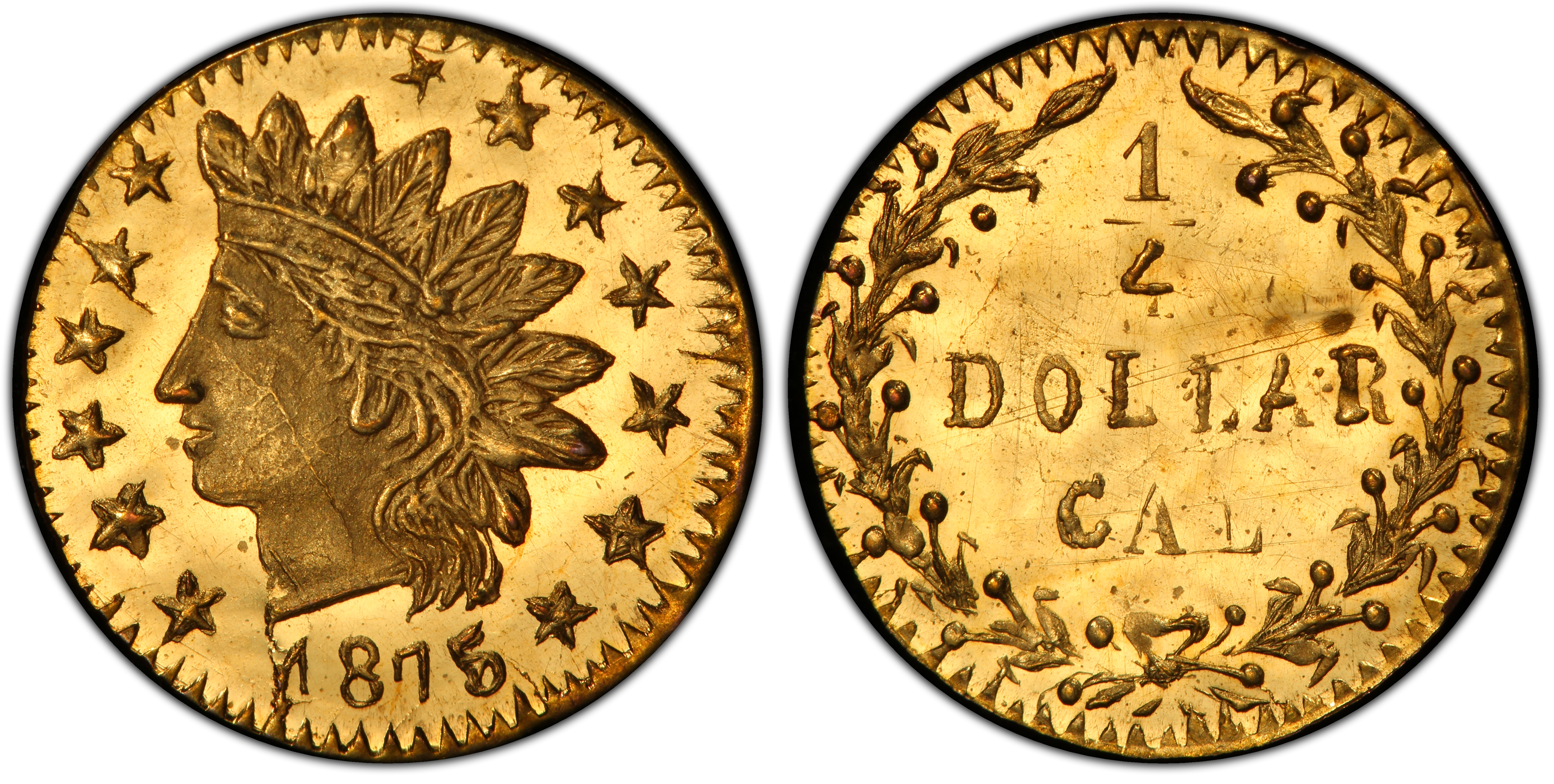
Obverse & Reverse
The 1875 G25C BG-878 is a product of the second period (1859-1882) of California Fractional Gold production, a fascinating chapter in American numismatics born from the crucible of the Gold Rush. While the initial gold discoveries of 1848 created an immediate and severe shortage of small change, leading to the first period of privately issued gold coins, the context for this 1875 piece is different. By the mid-1870s, San Francisco was no longer a chaotic boomtown but a sophisticated, rapidly growing metropolis. The United States Mint had been operating in the city since 1854, and its grand new facility, the 'Granite Lady,' had just opened in 1874, striking millions of dollars in federal coinage. The acute, commerce-crippling coin shortage that necessitated the Period One (1852-1856) fractionals was largely over. Yet, private minters, primarily local jewelers, continued to produce these diminutive gold pieces. Their purpose had evolved; while they may have seen limited circulation, their primary role had shifted to that of souvenirs, keepsakes, and novelties. For a nation fascinated by the 'Wild West' and for the burgeoning tourist trade in San Francisco, these tiny gold coins were the perfect memento of California's mineral wealth. They were tangible, affordable pieces of the Gold Rush legend. The Coinage Act of 1864 had officially prohibited private coinage, but enforcement in the West was lax until the Secret Service cracked down around 1883. This legal gray area allowed jewelers to continue production. These 'jeweler's issues' were typically lighter and often of a lower fineness than their stated face value would imply, a departure from the more functional Period One coins. The BG-878 variety, with its classic Indian Head motif, was a popular design, echoing the federal gold dollar and three-dollar gold pieces and tapping into the romanticized imagery of the American frontier. The anonymous nature of its minter is typical for the period, as these were often small-scale operations without the formal markings of the larger, earlier assay firms. Today, these pieces are not just collected as historical artifacts of the Gold Rush era, but also as marvels of miniature engraving and representatives of a uniquely American form of private enterprise that persisted for decades after its initial, urgent necessity had faded.
Associated EventPost-Gold Rush Economic Expansion in California
Reason For MintingPrimarily created to serve the growing demand for souvenirs and novelty items related to the California Gold Rush, rather than to alleviate a major coin shortage as in earlier years.
Minter HistoryThe specific minter for BG-878 is not definitively known, which is common for Period Two fractional gold. These pieces are often referred to as 'jeweler's issues' because they were typically manufactured by San Francisco jewelers who had the skills and equipment to work with gold on a small scale. While some pieces from this era bear maker's marks (like 'L' for the Levison Brothers), many, including BG-878, are anonymous. Research by numismatists like Walter Breen and Ronald Gillio has attempted to attribute various dies to specific makers, but conclusive evidence is often lacking. The production was decentralized and unregulated, a final echo of the private minting tradition that the Gold Rush had initiated.
Historical SignificanceRepresents the evolution of California Fractional Gold from a necessary medium of exchange in the 1850s to a commercial souvenir industry by the 1870s. It showcases the persistence of private minting in a legal gray area and reflects the enduring national fascination with the California Gold Rush long after the initial frenzy had passed. The BG-878, as a 'common' variety, illustrates the scale of this souvenir trade.
N/A
Denomination25 Cents
Minting Period1875
Assayer/MinterUnknown, likely a San Francisco jeweler. Attributed by some to Robert B. Gray & Co., though this is not definitive.
Geographic OriginSan Francisco, California
Obverse DescriptionA beaded border encircles a right-facing bust of a Native American princess, commonly referred to as an 'Indian Head.' She wears a feathered headdress. Thirteen stars surround the bust, representing the original colonies.
Obverse InscriptionNo inscriptions, only the portrait and stars.
Reverse DescriptionA beaded border contains a wreath of two olive branches tied with a bow at the bottom. The denomination '1/4 DOLLAR' and the date '1875' are inscribed within the wreath. Some sources may refer to the denomination as 25 CENTS.
Reverse Inscription1/4 DOLLAR 1875
CompositionGold
Stated Fineness Actual FinenessVariable, but generally lower than federal coinage of the era, as was typical for Period Two 'jeweler's issues'.
Weight0.25 grams
Diameter9.50 mm
EdgePlain
Unknown, but considered one of the more common Period Two varieties.
Survival Estimate500-1000
Rarity ScaleR-3 (Scarce)
This variety is popular as an affordable and representative example of a Period Two California Fractional Gold piece. Its classic Indian Head design is aesthetically pleasing and connects it thematically to federal gold coinage. For collectors building a type set, the BG-878 is an accessible and attractive entry point.
Key VarietiesThe primary variety is the regular business strike. No original proof strikings are known. Collectors should be aware of numerous modern replicas, counterfeits, and gold-plated tokens that mimic this design. The Breen-Gillio (BG) catalog identifies die states (e.g., Die State III), which are minor variations resulting from die wear or cracking, and are of interest to specialists. No major, contemporaneously produced varieties, patterns, or restrikes are generally recognized for BG-878.
Authentication TipsAuthentic pieces have a distinct, somewhat crude but sharp strike from hand-operated presses. Look for a 'mushy' or soft appearance on counterfeits, often a result of casting. The style of the engraving, particularly the details of the feathers and the numerals in the date, should be compared to known genuine examples. Weight and diameter can be inconsistent, but pieces that are significantly off-spec are suspect. Many modern fakes are made of gilt base metal, not gold. The surfaces of genuine pieces often show planchet striations or adjustment marks characteristic of the era's crude manufacturing process.
Shopping ConsiderationsFor this issue, a 'premium quality' example is defined by a sharp strike, especially on the high points of the Indian's cheek, the details of the headdress, and the numerals of the date. Seek out coins with clean, original surfaces that exhibit some remaining mint luster; prooflike (PL) examples are particularly prized and command a significant premium. Avoid coins that have been harshly cleaned, polished, or show evidence of being mounted in jewelry (solder marks, rim damage). Because these coins are so small, magnification is essential to detect surface problems. A smooth, attractive reddish-gold or yellow-gold toning is considered desirable. An example certified by a major grading service (PCGS or NGC) is highly recommended to guarantee authenticity and grade.
A coin's grade is its condition, rated on a 1-70 scale. For rare coins, this is the most critical factor in determining value, as a tiny difference in preservation can mean a huge difference in price.
Relevant Grade TypesOriginal issues were business strikes intended for potential circulation or sale as souvenirs, and they are found in both Circulated (1-58) and Mint State (MS, 60-70) grades. No proofs were struck during the original minting period. Modern replicas exist, but they are not considered numismatic items in the same category. Some genuine business strikes exhibit highly reflective, prooflike (PL) surfaces due to the use of polished dies, and these are highly sought after by collectors.
Mint State CharacteristicsUncirculated examples of BG-878 often have a soft, satiny luster. The strike can be uneven, with some weakness common on the stars or parts of the wreath. Sharply struck examples are scarce and command premiums. Due to the primitive minting process, it is common to see minor planchet flaws or striations, even on high-grade specimens. Contact marks, while factored into the grade, are often minimal due to the coins' small size and the fact many were kept as souvenirs rather than circulated extensively.
Circulated Wear PatternsWear first appears on the highest points of the design. On the obverse, this is the cheek, the eyebrow, and the feathers of the headdress. On the reverse, the highest points of the bow and the leaves in the wreath will show the first signs of friction and flattening. In lower grades (VF and below), the date and the individual stars will begin to lose their sharpness.
Key Factors For ValueThe primary drivers of value for an 1875 BG-878 are grade and surface quality. A sharply struck coin with pristine, lustrous surfaces will sell for many multiples of a weakly struck or cleaned example in the same grade. Eye appeal is paramount; coins with attractive original color and minimal distracting marks are highly prized. The presence of a prooflike (PL) designation significantly increases value. Certification by a top-tier service (PCGS or NGC) is crucial for market acceptance, and a CAC sticker, indicating premium quality for the grade, adds a further premium.
PCGS Price Guide
| Grade | Price | Population |
|---|---|---|
| 53 | $200.00 | 1 |
| 53+ | $202.00 | N/A |
| 55 | $205.00 | 2 |
| 55+ | $207.00 | N/A |
| 58 | $210.00 | 1 |
| 58+ | $220.00 | N/A |
| 60 | $235.00 | 2 |
| 61 | $265.00 | 8 |
| 62 | $315.00 | 43 |
| 62+ | $340.00 | N/A |
| 63 | $385.00 | 66 |
| 63+ | $425.00 | 1 |
| 64 | $550.00 | 48 |
| 64+ | $675.00 | N/A |
| 65 | $925.00 | 19 |
| 65+ | $1,050.00 | N/A |
| 66 | $1,500.00 | 3 |
| 67 | N/A | N/A |