1876 G25C BG-852, PL (Regular Strike)
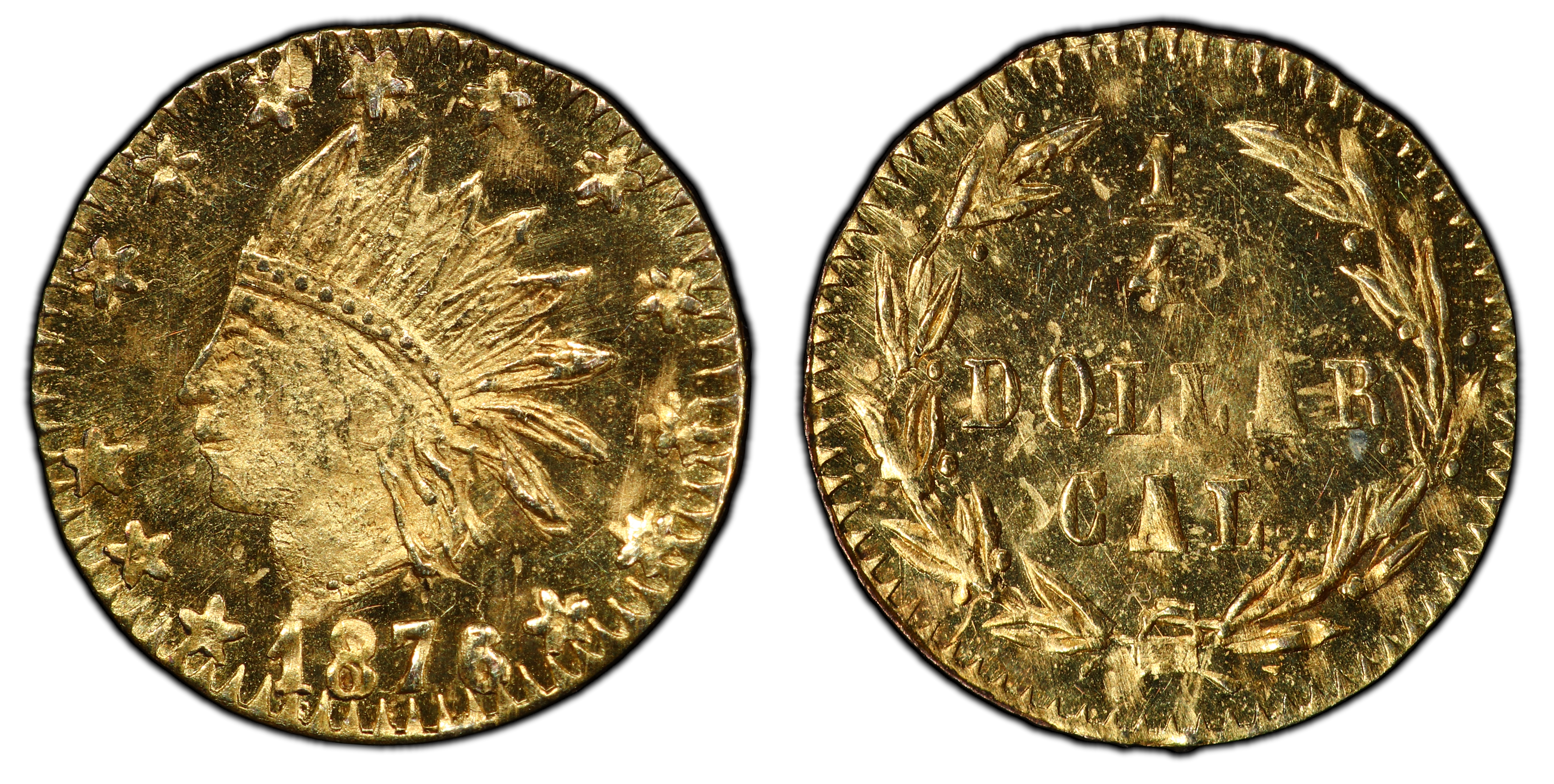
Obverse & Reverse
The 1876 BG-852 25 Cents represents a fascinating and final chapter in the story of private Californian coinage. Struck during 'Period Two' (1858-1882) of the California Fractional Gold series, its existence is owed not to a shortage of currency, but to a burgeoning tourist and souvenir trade. By the mid-1870s, the frantic days of the Gold Rush were a romanticized memory, and the state's economy was maturing. The United States Mint in San Francisco had been in full operation for over two decades, alleviating the initial need for private issues that defined 'Period One' (1852-1857). However, local jewelers and entrepreneurs recognized a persistent market for mementos of the Golden State's famous beginnings. These miniature gold pieces, too small for practical circulation, became popular keepsakes and affordable gifts that could be easily mailed to friends and family back East. The year 1876 was particularly significant, marking the Centennial of the United States. This national celebration likely spurred additional demand for historical souvenirs. Christopher Ferdinand Mohrig, a San Francisco jeweler, was a prolific producer of these fractional gold pieces. He operated during a period of legal ambiguity; the Private Coinage Act of 1864 had outlawed private issues, but federal enforcement was lax. This allowed minters like Mohrig to continue their craft. However, the tide was turning. The U.S. Secret Service, under the direction of Chief James J. Brooks, began to view these private issues as a potential avenue for fraud, regardless of their souvenir status. On August 10, 1876, Mohrig's operations were shut down. He was arrested, and his inventory of coins and coining equipment was confiscated and destroyed. This dramatic end to his enterprise explains the significant rarity of his 1876-dated issues, including the BG-852. Their production was abruptly halted mid-year, resulting in a very small mintage and an even smaller number of survivors.
Associated EventPost-Gold Rush Souvenir Trade & U.S. Centennial
Reason For MintingTo serve the growing market for souvenirs and keepsakes memorializing the California Gold Rush, rather than for monetary circulation.
Minter HistoryChristopher Ferdinand Mohrig was a San Francisco-based jeweler and one of the most significant producers of 'Period Two' California Fractional Gold. He is credited with striking numerous varieties cataloged in the Breen-Gillio reference from BG-790 through BG-799V. His work is characterized by the Indian Head motif popular in the 1870s. Mohrig's minting career came to an abrupt end in August 1876 when he was arrested by the Secret Service for violating the Coinage Act of 1864. The confiscation and destruction of his dies and stock have rendered his 1876-dated issues particularly scarce.
Historical SignificanceThe BG-852 is a tangible artifact of the transition from a frontier economy to one integrated with the rest of the United States. It represents the commercialization of the Gold Rush legacy and is a key issue from the final year of significant private fractional gold production before federal enforcement ended the practice.
BG-852
Denomination25 Cents
Minting Period1876
Assayer/MinterChristopher Ferdinand Mohrig
Geographic OriginSan Francisco, California
Obverse DescriptionA portrait of a Native American princess (Indian Head) facing left, adorned with a feathered headdress. The portrait is surrounded by thirteen stars, representing the original colonies.
Obverse InscriptionNo inscription, only the portrait and stars.
Reverse DescriptionThe denomination '25 CENTS' is enclosed within a wreath of leaves and berries. The date '1876' appears below the wreath.
Reverse Inscription25 CENTS 1876
CompositionGold
Stated Fineness Actual FinenessTypically varied from 14 to 22 karats for Period Two issues, generally less than face value.
Diameter10.00 mm
EdgePlain
Unknown, but very low due to the minter's arrest in August 1876.
Survival Estimate31-75 coins known
Rarity ScaleR-5+
The BG-852 is highly sought after for its specific date, connection to the U.S. Centennial, and the dramatic story of its minter, Christopher Mohrig. Its high rarity (R-5+) and the frequency of Prooflike examples make it a prized possession for specialists in California gold.
Key VarietiesThe primary variety is the regular business strike, which often comes with Prooflike (PL) surfaces from polished dies. There are no known major die varieties, patterns, or official restrikes for BG-852. All known examples are considered 'original period issues' from 1876.
Authentication TipsGenuine BG-852 examples are struck on very thin gold planchets, often no thicker than a business card. Counterfeits and modern replicas are typically much thicker and heavier. Look for a potentially weak or uneven strike, a common characteristic of the hand-hammered or crude press methods used. The luster on original PL specimens should be flashy and reflective, not dull or hazy. Lettering and stars, while small, should be sharply defined and not mushy or rounded as seen on many cast copies. Attribution to the specific Breen-Gillio die characteristics is the ultimate confirmation.
Shopping ConsiderationsFor a 'premium quality' BG-852, look for a sharp strike on the high points of the headdress feathers and the numbers in the date. Many examples, even in high grades, exhibit some central striking weakness. A coin with deep, original Prooflike surfaces commands a significant premium. Check carefully for evidence of past mounting, as these were often used in jewelry; look for solder marks, rim damage, or tooling. Original, uncleaned surfaces with a hint of reddish-gold toning are highly desirable. Avoid specimens that appear overly bright or have hairline scratches from harsh cleaning.
A coin's grade is its condition, rated on a 1-70 scale. For rare coins, this is the most critical factor in determining value, as a tiny difference in preservation can mean a huge difference in price.
Relevant Grade TypesOriginal period issues were business strikes, many struck with polished dies to create a special finish for the souvenir market. They are found in Circulated (1-58) grades, though rarely, and more commonly in Mint State (MS, 60-70). The Prooflike (PL) and Deep Prooflike (DPL) designations are frequently applied to this issue and are highly desirable. No true Proofs were struck in 1876, and no later-date restrikes are known to exist.
Mint State CharacteristicsUncirculated examples are defined by their luster and strike. The BG-852 is known for often having reflective, Prooflike fields. A superior MS example will have sharp details on the Indian's hair and the feathers of the headdress. Weakness is sometimes seen on the stars or the wreath on the reverse due to the challenges of striking such tiny pieces. Small, intrinsic planchet flaws or adjustment marks are not uncommon and should be distinguished from post-strike damage. Bag marks are less common than on larger coins, but small contact marks from handling can still be present.
Circulated Wear PatternsOn circulated examples, wear first appears on the highest points: the cheek and feathers of the Indian princess, and the bow and high leaves of the reverse wreath. As wear progresses, the stars on the obverse will begin to lose their sharp points and blend into the fields. In lower grades (VF and below), the date and the 'CENTS' denomination will become faint.
Key Factors For ValueThe primary value driver for BG-852 is its grade, followed closely by surface quality. A high-grade (MS-63 or better) example with a Prooflike or Deep Prooflike designation will command a substantial premium. Originality is paramount; coins with their natural 'skin' and luster are prized over cleaned or polished examples. Eye appeal, which includes the quality of the strike and the depth of the mirrored fields, is a critical subjective factor. Certification by a top-tier service (PCGS or NGC) is essential for market acceptance, and a CAC sticker will add a further premium, confirming quality for the grade.
PCGS Price Guide
| Grade | Price | Population |
|---|---|---|
| 65 | $1,400.00 | 1 |