1881 G50C BG-964 (Regular Strike)
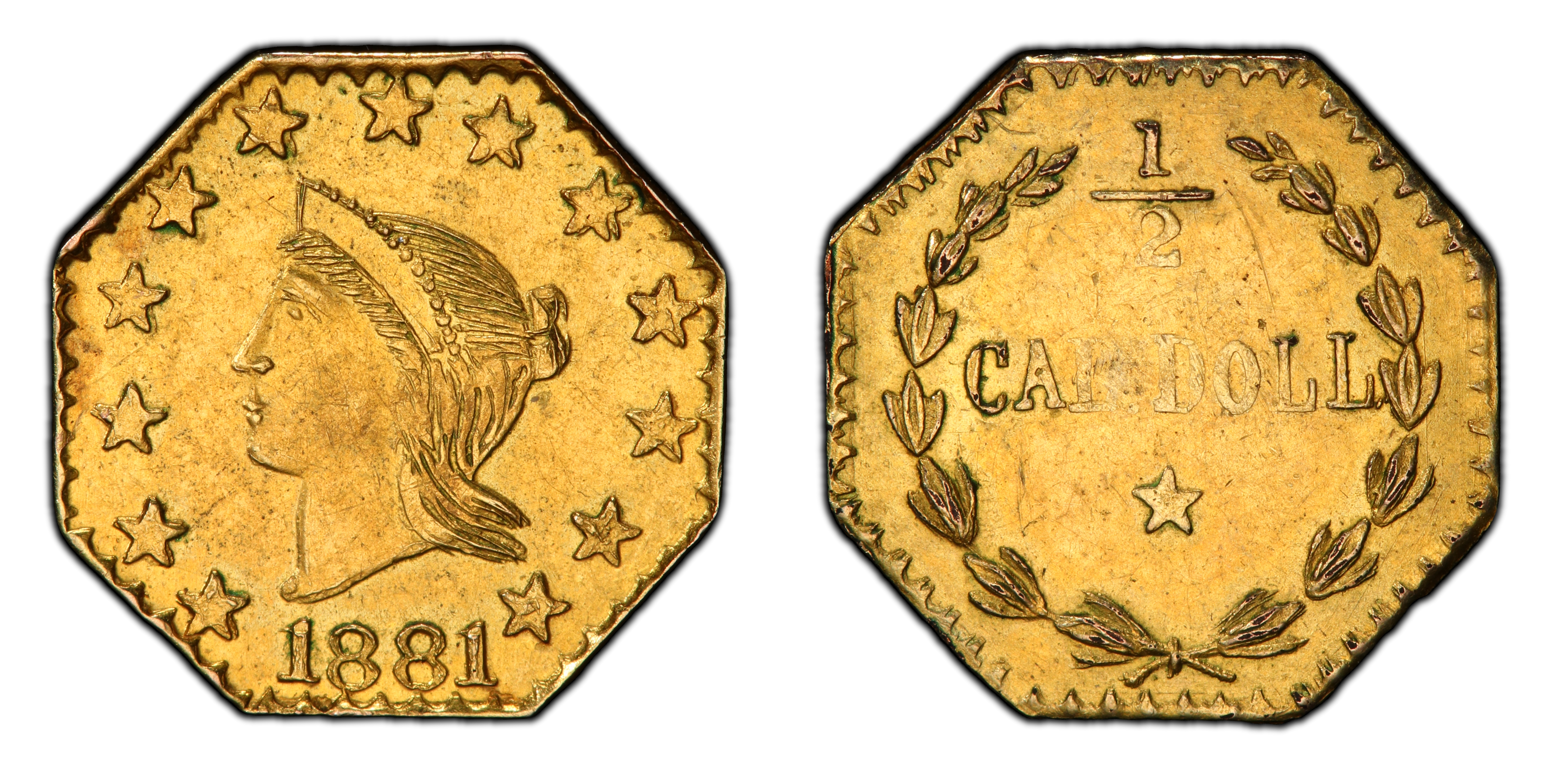
Obverse & Reverse
The 1881 G50C BG-964 is a product of the second great wave of California small-denomination gold production, often termed 'Period Two' (1859-1882) by numismatists. Unlike the 'Period One' issues, which were struck out of genuine commercial necessity to alleviate a chronic shortage of small change during the initial Gold Rush, these later pieces served a different purpose. By the 1880s, the United States Mint in San Francisco was in full operation, and the state was saturated with official federal coinage. The raison d'être for fractional gold had shifted from commerce to curiosity. San Francisco had blossomed from a chaotic boomtown into a major American city and a burgeoning tourist destination. Jewelers and private minters, many of whom were highly skilled but operated on the fringes of legality, recognized a robust market for gold souvenirs. These miniature gold 'coins' were popular keepsakes for visitors and were often incorporated into jewelry, such as stickpins, cufflinks, and watch fobs. The production of these pieces, however, existed in a legal gray area. The Coinage Act of 1864 had explicitly forbidden private coinage, but enforcement was inconsistent. The United States Secret Service, under the determined leadership of James J. Brooks, began to take a more aggressive stance in the early 1880s, viewing these denominated tokens as a direct challenge to federal authority. Minters of this era operated under the constant threat of investigation and seizure of their equipment and stock. It is within this tense environment that the BG-964 was created. Cataloged by Walter Breen and Ronald J. Gillio as the work of 'Unknown Maker D,' this piece is sometimes referred to as a 'suppressed maverick'—a term reflecting its unofficial, somewhat clandestine origins and the pressure its creator faced. The crude yet charming design and the unusual reverse inscription are characteristic of a maker working with limited equipment and a desire to create a distinctive, yet not overtly provocative, product. Its extreme rarity today suggests a very limited original mintage, perhaps the result of a short production run cut off by fear of the authorities, a lack of commercial success, or the simple fact that it was one of many similar competing products in a crowded souvenir market.
Associated EventCalifornia Gold Souvenir & Jewelry Trade
Reason For MintingTo serve the robust tourist and souvenir market in San Francisco by creating an attractive and affordable gold keepsake.
Minter HistoryThe identity of the minter responsible for BG-964 is lost to history. The definitive reference work by Breen and Gillio attributes this piece and a small group of related varieties to 'Unknown Maker D.' This anonymity was likely intentional. By the 1880s, the U.S. Secret Service was actively investigating and shutting down private minters of denominated tokens in California. To avoid prosecution and the seizure of their dies and equipment, many of these artisan-minters, who were often jewelers by trade, kept no records and did not mark their products with their own names or initials. The crude style and unique lettering punches of BG-964 suggest an independent, small-scale operation, consistent with the profile of a jeweler producing items for sale in their own shop.
Historical SignificanceThe BG-964 is a tangible artifact of the post-Gold Rush era in California, representing the transition of fractional gold from a circulating medium of necessity to a commercial souvenir product. It highlights the tension between private enterprise and federal authority over coinage in the late 19th century and is a prime example of the 'suppressed' issues that were produced just before the Secret Service effectively ended the practice in 1883.
BG-964
Denomination50 Cents
Minting Period1881
Assayer/MinterUnknown Maker D
Geographic OriginSan Francisco, California
Obverse DescriptionA crudely rendered bust of Liberty facing left, her hair tied in a bun. She is surrounded by thirteen five-pointed stars, which are often weakly struck and may appear as dots or pellets. The portrait style is simplistic and typical of the later-period jeweler's issues.
Obverse Inscription1881
Reverse DescriptionWithin a wreath of two branches, the denomination is expressed in an unusual and distinctive manner on two lines: 'CAL.' above 'DOLL.' The fraction '1/2' appears above the inscription, and a small decorative element or 'G' (for Gold) is sometimes noted, though this is part of the overall design rather than a mintmark. The wreath itself is crudely engraved.
Reverse Inscription1/2 CAL. DOLL.
CompositionGold
Stated Fineness Actual FinenessTypically low, as with most Period Two issues, often in the 10-14 karat range rather than the .900 standard of federal coinage.
EdgePlain
Extremely Low
Survival Estimate10-12 pieces in all grades.
Rarity ScaleR-7
This is a highly coveted issue for specialists in California fractional gold. Its appeal lies in its extreme rarity (R-7), its attribution to an enigmatic 'Unknown Maker,' its distinctive and somewhat primitive artistry, and its unusual 'CAL. DOLL.' reverse legend, which is not found on other issues.
Key VarietiesThe BG-964 is a single, distinct variety. There are no known major sub-varieties from the original minting period. No special collector issues, patterns, or restrikes are known to exist. The related BG-963 is a similar piece from the same maker with a more conventional '1/2 DOLLAR' reverse.
Authentication TipsGenuine examples exhibit a characteristic crude strike. The stars on the obverse are often malformed or indistinct. The lettering on the reverse, particularly 'CAL.' and 'DOLL.', is from a unique set of punches and should be carefully compared to certified examples. The surfaces should have the texture of genuinely struck gold, not the cast or porous appearance of many counterfeits. Be wary of modern replicas, which are often brassy in color, may have incorrect design details, and typically lack a denomination to avoid legal issues. Any piece that is sharply struck with perfectly formed stars is highly suspect.
Shopping ConsiderationsFor a coin of this rarity, any example is a major acquisition. A 'premium quality' specimen would be one that is well-centered and has as much of the design detail present as possible, especially the date and the reverse lettering. Look for pleasing, original surfaces with some residual luster; many survivors are ex-jewelry and may show signs of mounting, solder, or harsh cleaning, which should be factored into the price. Avoid examples with significant scratches, rim damage, or tooling. Given the typically weak strike, a coin showing an unusually bold rendering of Liberty's hair and the stars would be considered exceptional.
A coin's grade is its condition, rated on a 1-70 scale. For rare coins, this is the most critical factor in determining value, as a tiny difference in preservation can mean a huge difference in price.
Relevant Grade TypesAll original examples of BG-964 were struck as business strikes, intended for sale as souvenirs. They are found in Circulated grades (1-58) and, more frequently, in Mint State (MS, 60-70) grades, as many were kept as keepsakes and never used in transactions. No Proofs (PR/PF) of this issue were struck in the original period, and no later-date restrikes are known.
Mint State CharacteristicsUncirculated examples are defined by the presence of original mint luster. For the BG-964, this luster is typically satiny rather than deeply frosty. The strike is almost universally weak, particularly on the stars and the highest points of Liberty's hair. It is common to see planchet flaws or adjustment marks, which are characteristic of the crude manufacturing process and do not affect the MS grade unless severe. Bag marks are less common than on larger coins, but small, scattered contact marks are typical due to handling over the years.
Circulated Wear PatternsWear first appears on the highest points of the design: the hair above Liberty's eye and ear, her cheekbone, and the leaves in the wreath on the reverse. On moderately worn examples, the stars will begin to merge with the fields, and the fine details of the lettering will soften. In lower grades (Fine and below), the date and legends can become partially obliterated.
Key Factors For ValueRarity is the primary driver of value. Given the minuscule surviving population, any certified, problem-free example is valuable. After that, grade is key. The most significant value factors are the quality of the strike (a sharper-than-normal strike commands a large premium), the originality of the surfaces (uncleaned examples with original skin are highly prized), and overall eye appeal. Problem-free coins will always sell for significantly more than those with details grades (e.g., 'holed,' 'repaired,' 'cleaned'). A CAC sticker on a coin this rare would indicate a premium quality example for the grade and would be highly sought after.
PCGS Price Guide
| Grade | Price | Population |
|---|---|---|
| 50 | $1,200.00 | 1 |
| 50+ | $1,300.00 | N/A |
| 53 | $1,450.00 | N/A |
| 53+ | $1,525.00 | N/A |
| 55 | $1,600.00 | 1 |
| 55+ | $1,750.00 | N/A |
| 58 | $2,000.00 | 2 |
| 58+ | $2,250.00 | N/A |
| 60 | $2,400.00 | N/A |
| 61 | $2,600.00 | N/A |
| 62 | $3,000.00 | 6 |