1874 G25C BG-844 (Regular Strike)
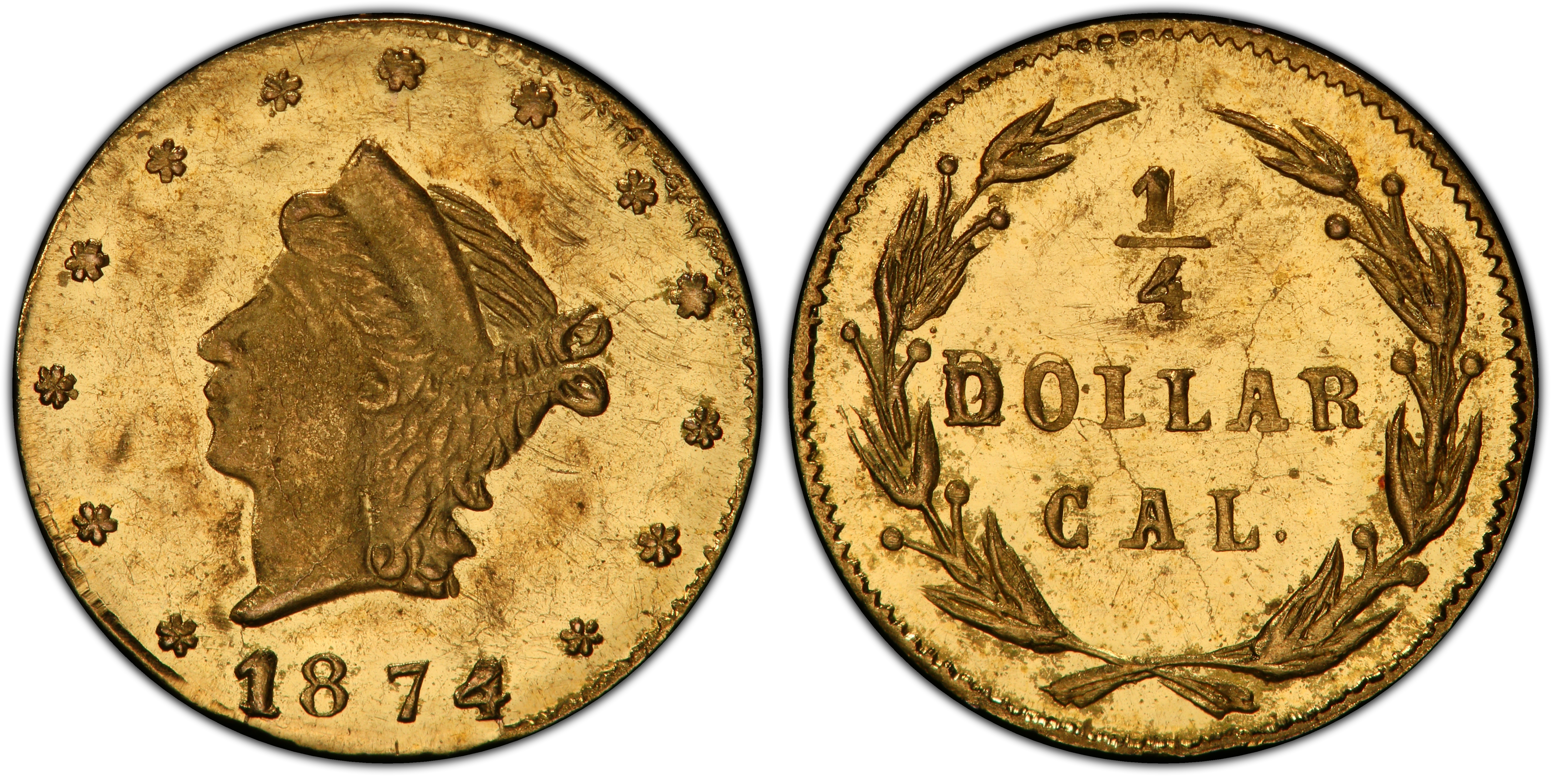
Obverse & Reverse
The 1874 G25C BG-844 is a quintessential example of a 'Period Two' or 'Jeweler's Issue' California Fractional Gold piece. By the mid-1870s, the acute shortage of small change that had plagued California during the initial Gold Rush years had largely been resolved by the output of the United States Mint in San Francisco. The impetus for producing these minuscule gold coins had shifted from commercial necessity to commercial enterprise of a different sort: the burgeoning tourist and souvenir market. San Francisco jewelers, many of whom were of French origin, found a ready market for these charming, diminutive gold pieces among locals and visitors who desired a keepsake of the Golden State's famous rush. Unlike the earlier 'Period One' issues (1852-1857), which were generally of higher weight and fineness and intended to circulate, Period Two pieces were often underweight for their face value and exhibited a wider, more creative variety of designs. They were legal to produce until the Secret Service began enforcing the Coinage Act of 1864 more strictly in the early 1880s, which prohibited private coinage. These pieces were typically struck by hand, using a hammer to impress the die design onto a small gold planchet, resulting in strikes of varying quality. The BG-844, dated 1874, falls squarely into this era of souvenir production. Its existence speaks to a California that had matured beyond the frantic scramble for gold into a place of established commerce and tourism, where the romance of the Gold Rush itself had become a commodity. These tiny gold coins, too small for practical daily use, served as affordable and tangible links to the defining event of California's history, purchased as watch fobs, jewelry, or simple cabinet curiosities.
Associated EventCalifornia Gold Rush (Later Souvenir Period)
Reason For MintingPrimarily struck for sale as souvenirs, jewelry, and curiosities for the tourist trade rather than to alleviate a coin shortage.
Minter HistoryThe specific minter or jeweler responsible for the BG-844 variety is unknown, which is common for many 'Period Two' issues. Production during this era was decentralized among various San Francisco jewelers who often did not apply a distinctive maker's mark. Research by numismatists like Walter Breen, Ronald Gillio, and Robert D. Leonard Jr. has identified some makers from this period, such as Robert B. Gray & Co., but the dies used for BG-844 have not been definitively attributed.
Historical SignificanceThis coin is significant not as a circulating medium of exchange, but as a historical artifact of post-Gold Rush California. It represents the commercialization of the Gold Rush legacy and the demand for souvenirs in a maturing San Francisco economy. Its high rarity today underscores the limited production runs typical of these private-venture 'jeweler's issues'.
BG-844
Denomination25 Cents
Minting Period1874
Assayer/MinterUnknown Private Minter
Geographic OriginSan Francisco, California
Obverse DescriptionA crudely rendered Liberty Head facing left, with hair tied in the back. The portrait is surrounded by 13 five-pointed stars, which are often weakly struck or indistinct. The date '1874' is below the bust.
Obverse Inscription1874
Reverse DescriptionThe reverse features the denomination '1/4 DOLLAR' and 'CAL' enclosed within a simple wreath composed of two branches tied with a bow at the bottom. The wreath is typically open at the top.
Reverse Inscription1/4 DOLLAR CAL
CompositionGold
Stated Fineness Actual FinenessVariable, but typically ranges from .500 to .850 fine for Period Two issues.
Weight0.25 grams
Diameter9.80 mm
EdgePlain
Unknown, but presumed to be very small.
Survival EstimateFewer than 30 believed to exist.
Rarity ScaleHigh R-5 (31-75 known)
The BG-844 is sought by specialists for its rarity and as a representative of the later 'souvenir' period of California Fractional Gold. Completing a set of all known varieties is a significant numismatic challenge, making individual rarities like this highly desirable.
Key VarietiesThe regular business strike of BG-844 is the only variety known for this die pair. No proof strikings, restrikes, or patterns are known to exist from this specific die marriage.
Authentication TipsAuthentic examples often exhibit a crude, somewhat soft strike, characteristic of manual hammer striking. The planchets can be irregular. Look for die markers specific to the BG-844 dies if available through high-resolution images. Beware of modern replicas, which are often brassy in color, have a soapy or cast-like appearance, and may feature incorrect design details or a suspicious, uniform shininess. Genuine pieces are denominated 'DOLLAR', whereas many fakes or tokens will omit this or say 'CALIFORNIA GOLD CHARM'.
Shopping ConsiderationsA premium quality example for this issue would be one with a relatively sharp strike for the type, particularly on the date and the details of the wreath. Many examples are weakly struck in the centers. Original, uncleaned surfaces with some remaining luster command a significant premium. Check carefully for evidence of having been mounted in jewelry, such as rim filing, solder marks, or tooling, as this was a common fate for these souvenir pieces. Avoid examples that appear overly bright or have unnaturally uniform color, as they are likely cleaned or polished. A CAC sticker on a certified example would provide strong confirmation of originality and quality for the grade.
A coin's grade is its condition, rated on a 1-70 scale. For rare coins, this is the most critical factor in determining value, as a tiny difference in preservation can mean a huge difference in price.
Relevant Grade TypesOriginal period issues were business strikes intended for the souvenir market and are found in Circulated (1-58) and Mint State (MS, 60-70) grades. Due to their nature as keepsakes, higher-grade examples are more frequently encountered than on earlier, circulating issues. No Proof (PR/PF) examples were struck during the original period of issue, and no later-date Proof restrikes are known.
Mint State CharacteristicsUncirculated examples of BG-844 are scarce. Quality is defined by the strength of the strike; a sharp strike on Liberty's hair and the leaves of the wreath is highly desirable but rare. Luster is typically subdued and satiny rather than deeply frosty. Due to the hand-hammering process and the softness of the gold, even Mint State examples will often display planchet flaws, minor striking weaknesses, and small contact marks.
Circulated Wear PatternsWear first appears on the high points of Liberty's cheek, hair, and the eyebrow. On the reverse, the highest points of the wreath's leaves and the bow will show the first signs of friction. In lower grades (VF and below), the stars on the obverse will begin to merge with the fields, and the date can become weak or partially obliterated.
Key Factors For ValueRarity is the primary driver of value. For a given grade, an example with a bold, centered strike will be worth more than a weakly struck counterpart. Surface preservation is critical; specimens with original, untouched 'skin' are prized over those that have been cleaned, polished, or previously mounted in jewelry. Eye appeal, including attractive original gold toning, can add a significant premium. For certified coins, a CAC sticker confirming quality for the grade is highly valued by discerning collectors.
PCGS Price Guide
| Grade | Price | Population |
|---|---|---|
| 53 | $360.00 | 2 |
| 53+ | $380.00 | N/A |
| 55 | $400.00 | 2 |
| 55+ | $425.00 | N/A |
| 58 | $450.00 | 5 |
| 58+ | $475.00 | N/A |
| 60 | $500.00 | N/A |
| 61 | $525.00 | 3 |
| 62 | $600.00 | 5 |
| 62+ | $700.00 | N/A |
| 63 | $850.00 | 7 |