1868 G50C BG-961 (Regular Strike)
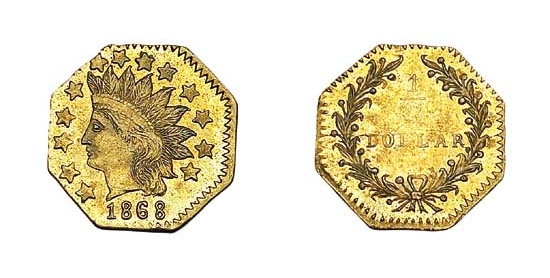
Obverse & Reverse
The 1868 50 Cents, cataloged as Breen-Gillio 961 (BG-961), is a fascinating artifact from the third and final period of California Fractional Gold production (1858-1882). Unlike the emergency issues of the Gold Rush's peak, these later pieces were not primarily intended to alleviate a desperate shortage of small change. By the late 1860s, the U.S. Mint in San Francisco was fully operational, and federal coinage was more readily available. Instead, these miniature gold coins were produced largely as souvenirs and novelty items, catering to tourists, collectors, and those wishing to send a tangible piece of California's gold legacy back east. Produced by jewelers and private minters like Robert B. Gray & Co., these pieces mimicked the appearance of official U.S. gold coinage, featuring a Liberty head and a wreath, but were not legal tender. The federal government took a dim view of these private issues, which they saw as infringing upon the government's sole right to coin money. The Secret Service actively investigated and shut down many of these operations, culminating in the Act of 1883 which officially outlawed their production. BG-961 was struck during this period of legal ambiguity. The coins were often sold in sets or used as keepsakes and jewelry. Their small size made them easy to lose, and their status as novelties meant many were not preserved with care, contributing to their rarity today, especially in high grades. The 'G' in 'G50C' on the reverse was a common, though not universal, design element used by private minters to denote 'Gold', distinguishing them from base metal tokens, although it ironically did little to appease federal authorities.
Associated EventPost-Gold Rush Economic Expansion & Tourism
Reason For MintingPrimarily created as popular souvenirs and novelty items for the tourist trade and local commerce, rather than to address a critical currency shortage.
Minter HistoryRobert B. Gray & Co. was a prominent San Francisco jewelry and watchmaking firm active during the latter half of the 19th century. Like other jewelers of the era, Gray's company leveraged their metalworking skills and access to raw gold to produce these popular fractional gold tokens. These were a profitable sideline, capitalizing on the romantic image of the California Gold Rush that persisted long after its peak. The firm was known for quality workmanship, and their issues are a key component of the California Fractional Gold series. They were one of many such enterprises that were eventually forced to cease production due to increasing pressure and legal action from the U.S. government.
Historical SignificanceThe BG-961 represents a shift in the purpose of private gold coinage from utilitarian necessity to commercial novelty. It stands as a testament to the enduring allure of gold and the entrepreneurial spirit of California's post-Gold Rush period, while also marking the final chapter of private gold minting in the United States before federal laws brought the practice to a definitive end.
N/A
Denomination50 Cents
Minting Period1868
Assayer/MinterRobert B. Gray & Co.
Geographic OriginSan Francisco, California
Obverse DescriptionA beaded border encloses a Liberty Head (Head 11 in Breen-Gillio classification) facing left, adorned with a coronet. Thirteen stars encircle the head.
Obverse Inscription[No Inscription, only stars and Liberty Head]
Reverse DescriptionA wreath composed of two branches tied with a ribbon at the bottom encloses the denomination. The legend 'GOLD' is above the wreath.
Reverse InscriptionGOLD / 50 CENTS
CompositionGold
Stated Fineness Actual FinenessVaries, typically between .500 and .750 fine.
Weight0.25 grams
Diameter11.00 mm
EdgePlain
Unknown
Survival Estimate100-200
Rarity ScaleR-6 (31-75 Known)
BG-961 appeals to collectors due to its direct connection to the California Gold Rush era, its miniature size, and its status as a tangible piece of private minting history. Its relative affordability compared to earlier period issues makes it an accessible entry point into the complex world of California Fractional Gold.
Key VarietiesThe primary issue is the business strike (or 'Regular Strike'). There are no known major die varieties for BG-961 from the original minting period. Unlike some other territorial issues, there are no known patterns, trial pieces, or later-date Proof restrikes associated with this specific variety.
Authentication TipsGenuine examples have a sharp, well-defined strike, especially on the stars and letters. The 'G' in 'GOLD' on the reverse is often a key diagnostic point; it should match the punch style known for Robert B. Gray & Co. Counterfeits are common and often have a soapy, indistinct appearance, incorrect weight, or a brassy color. Many fakes are cast rather than struck, leaving behind pitting or a granular surface. Authentication by a third-party grading service is highly recommended.
Shopping ConsiderationsA premium quality example for its grade will possess sharp details, particularly on Liberty's hair and the leaves of the wreath. Seek out coins with smooth, lustrous surfaces and minimal distracting contact marks—a challenge given their small size and tendency to be handled. Avoid examples that have been cleaned, which will show hairlines or have a dull, lifeless surface. Also, be wary of ex-jewelry pieces, which may show signs of solder, rim damage, or polishing. Original, attractive toning is a significant plus.
A coin's grade is its condition, rated on a 1-70 scale. For rare coins, this is the most critical factor in determining value, as a tiny difference in preservation can mean a huge difference in price.
Relevant Grade TypesOriginal period issues were business strikes intended for circulation or sale as souvenirs, and are found in Circulated (1-58) and Mint State (MS, 60-70) grades. No Proof (PR/PF) examples were struck by Robert B. Gray & Co. during the original period of issue for this variety, nor are there any known later-date Proof restrikes.
Mint State CharacteristicsUncirculated examples of BG-961 are scarce. Quality is determined by the sharpness of the strike, the quality of the luster, and the presence of contact marks. Strikes can be variable, but high-end examples will show full detail in Liberty's hair curls and the individual leaves in the wreath. Luster is typically satiny. Due to the small size and handling, even MS examples can have tiny ticks or marks, so finding a 'clean' piece is a major challenge.
Circulated Wear PatternsWear first appears on the highest points: Liberty's cheek, the hair above her eye, and the coronet on the obverse. On the reverse, the high points of the wreath's leaves and the bow of the ribbon will show the first signs of friction and metal loss. In lower grades (VG and below), the stars will begin to merge with the field and the letters in the legend become faint.
Key Factors For ValueThe primary drivers of value are grade and surface quality. An example with original, uncleaned surfaces and minimal marks will command a significant premium over a cleaned or damaged piece of the same numerical grade. Strike sharpness is also key; a weakly struck coin will be less desirable than a boldly struck one. Finally, certification by a top-tier grading service (PCGS or NGC) is virtually essential for marketability, and a CAC sticker indicating premium quality for the grade adds another significant layer of value.
PCGS Price Guide
| Grade | Price | Population |
|---|---|---|
| 60 | $950.00 | N/A |
| 61 | $1,000.00 | 1 |
| 62 | $1,150.00 | 2 |
| 62+ | $1,300.00 | N/A |
| 63 | $1,500.00 | 2 |
| 63+ | $1,575.00 | N/A |
| 64 | $1,750.00 | 1 |
| 64+ | $2,750.00 | N/A |
| 65 | $4,500.00 | 1 |