1871 G25C BG-838 (Regular Strike)
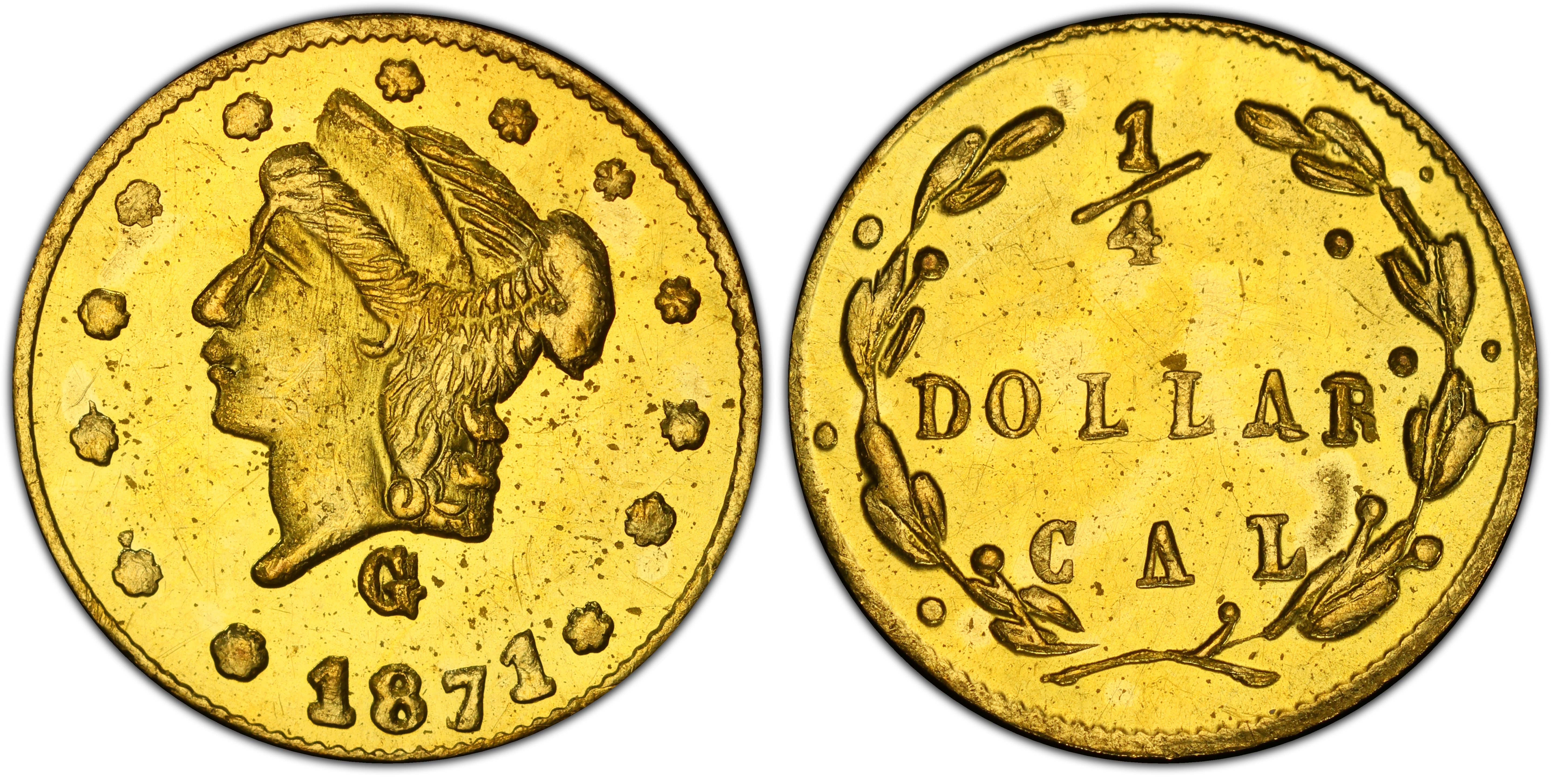
Obverse & Reverse
The 1871 G25C BG-838 represents a fascinating chapter in the evolution of California's privately issued coinage, belonging to what numismatists classify as 'Period Two' (1859-1882) of fractional gold production. Unlike the 'Period One' issues, which were struck out of genuine commercial necessity to alleviate a severe shortage of small-denomination coinage during the initial Gold Rush boom, the Period Two pieces emerged in a different economic landscape. By 1871, San Francisco was a maturing metropolis. The completion of the Transcontinental Railroad in 1869 had ended the city's isolation, connecting it to eastern manufacturing hubs and labor markets. While the U.S. Branch Mint in San Francisco was producing ample federal coinage, the memory of the Gold Rush and the romanticism of private gold lingered. This created a robust market for gold souvenirs, trinkets, and jewelry items. San Francisco jewelers, leveraging their skills and access to raw gold, stepped in to meet this demand. Robert B. Gray & Co., who had acquired the business of earlier minter Antoine Nouizillet, was a prominent producer during this era. These 'jeweler's issues' were not intended to function as the lifeblood of commerce like their predecessors. Instead, they were created as keepsakes and novelties for tourists and locals alike, tangible mementos of California's golden identity. The Private Coinage Act of 1864 had technically forbidden such private issues, but enforcement in California was lax until the 1880s, allowing firms like Gray's to continue production. The BG-838 pieces were typically struck with less intrinsic gold value than their stated denomination, a common feature of Period Two coins, underscoring their primary role as souvenirs rather than true circulating money. Their existence speaks to a California transitioning from a raw frontier economy to a more established society that was already beginning to commercialize and mythologize its own recent past.
Associated EventPost-Gold Rush Economic Maturation
Reason For MintingPrimarily struck to be sold as souvenirs and keepsakes to tourists and residents in a prospering San Francisco.
Minter HistoryRobert B. Gray & Co. was a San Francisco-based jeweler and one of the more prolific producers of 'Period Two' California fractional gold. Around 1859-60, the firm acquired the business of Antoine Louis Nouizillet, another established minter, including his dies and punches. Gray continued to use some of Nouizillet's old equipment while also creating new dies marked with his own hallmark, the characteristic 'G' found on the obverse of coins like the BG-838. The firm was an active participant in the city's jewelry trade, producing these small gold pieces as part of a broader business catering to the demand for gold novelties. In 1871, the same year this coin was struck, Gray sold his interests to the California Jewelry Co., which was operated by the Levison Brothers. Gray's issues are noted by researchers like Breen and Gillio for being generally heavier and of higher intrinsic value than many other contemporary jeweler's issues.
Historical SignificanceThe BG-838 is significant not as a coin that filled a crucial monetary void, but as a socio-economic artifact representing the commercialization of the Gold Rush legacy and the souvenir trade in 19th-century San Francisco.
N/A
Denomination25 Cents
Minting Period1871
Assayer/MinterRobert B. Gray & Co.
Geographic OriginSan Francisco, California
Obverse DescriptionA small head of Liberty facing left, her hair tied in a bun at the back. She is surrounded by 13 six-pointed stars. The date '1871' is positioned below the bust of Liberty, crowded between the lower stars. A small letter 'G', the hallmark for Robert B. Gray & Co., is located below the truncation of the neck.
Obverse Inscription1871 G
Reverse DescriptionThe denomination '25 CENTS' is displayed on two lines within a simple wreath composed of two branches tied together with a bow at the bottom. The word 'CENTS' is located within a curved depression or 'scoop' in the die.
Reverse Inscription25 CENTS
CompositionGold
Stated Fineness0.9
Actual Fineness Weight0.24 grams
Diameter11.00 mm
EdgePlain
Unknown
Survival Estimate500-1000
Rarity ScaleR-2
This variety is popular as a representative 'Period Two' fractional gold piece from a known and respected maker. Its affordability, clear date and minter's mark, and the distinctiveness of its die characteristics make it an appealing entry point into the complex world of California small-denomination gold.
Key VarietiesThe primary variety is the regular business strike as described. A key diagnostic for BG-838 is the small, often boldly repunched 'G' for Gray below Liberty's bust. No proof strikings or official later-date restrikes are known to exist for this specific variety. All genuine examples are considered business strikes, though many were produced with prooflike surfaces as was common for jeweler's issues intended for the souvenir market.
Authentication TipsGenuine BG-838 examples will exhibit a sharp, albeit small, 'G' below the bust. Look for the characteristic widely spaced letters in 'CAL' on some related Gray issues, although this is less pronounced on the 'CENTS' reverse of the BG-838. Counterfeits are rampant in this series. Be wary of pieces with a 'soft' or mushy appearance, incorrect weight, or a soapy luster. Many fakes lack the denomination and instead show a bear on the reverse; these are fantasy pieces with no numismatic value. Genuine pieces are very thin; modern replicas are often thicker and feel heavier than their small size would suggest. Weak strikes are a common characteristic of genuine pieces, not necessarily an indicator of a fake.
Shopping ConsiderationsA premium quality example for its grade will display sharp details, especially on Liberty's hair and the stars. Given that these were jeweler's issues, many survivors are found in high grades (MS60 and above) and often exhibit prooflike or semi-prooflike fields; this reflectivity is highly desirable and commands a premium. Look for coins with clean, original surfaces and avoid examples that have been harshly cleaned, polished, or used in jewelry, as evidenced by solder marks or excessive rim damage. While a weak strike on the wreath is not uncommon, a coin with a strong strike on both the obverse and reverse is considered superior.
A coin's grade is its condition, rated on a 1-70 scale. For rare coins, this is the most critical factor in determining value, as a tiny difference in preservation can mean a huge difference in price.
Relevant Grade TypesAll original 1871 G25C BG-838 coins were struck as business strikes, intended for sale as souvenirs rather than for circulation. They are found in Circulated grades (AU-58 and below), though this is less common, and more frequently in Mint State (MS, 60-70) grades. No true Proofs were struck during the original period of issue. The term 'Prooflike' (PL) is often used to describe high-grade Mint State examples that have mirror-like surfaces, a desirable trait stemming from their production as jewelry and souvenir items.
Mint State CharacteristicsAn uncirculated (MS) BG-838 typically exhibits a bright, satiny to semi-prooflike luster. The quality of the strike can vary, but high-end examples will show clear definition in Liberty's hair curls and the individual leaves of the wreath. Due to the small size and production methods, perfectly struck specimens are rare. Minor planchet flaws or strike-through imperfections are not uncommon and should be evaluated on a case-by-case basis. Contact marks, even small ones, can be very distracting on such a tiny coin and will significantly impact the grade and eye appeal.
Circulated Wear PatternsOn circulated examples, wear will first appear on the highest points of the design. For the obverse, this includes Liberty's cheek, the hair just above her eye, and the earlobe. On the reverse, the highest points of the wreath's leaves and the bow will show the first signs of friction and flattening. In lower grades (VF and below), the stars will begin to lose their points and the finer details of the hair and wreath will merge.
Key Factors For ValueThe primary drivers of value for this coin are grade and surface quality. A high-grade Mint State coin (MS-63 or better) with clean, original surfaces and strong prooflike reflectivity will command a significant premium. Eye appeal is paramount; coins with attractive, unimpaired luster and a sharp strike are highly sought after. Examples that have been cleaned, spotted, or damaged from being mounted in jewelry are worth considerably less. A CAC sticker for this issue is highly valued, as it confirms both the grade and the quality of the coin's surfaces for the assigned grade.
PCGS Price Guide
| Grade | Price | Population |
|---|---|---|
| 30 | $180.00 | 1 |
| 35 | $185.00 | N/A |
| 40 | $190.00 | 4 |
| 45 | $192.00 | 4 |
| 45+ | $194.00 | N/A |
| 50 | $195.00 | 10 |
| 50+ | $197.00 | N/A |
| 53 | $200.00 | 17 |
| 53+ | $205.00 | N/A |
| 55 | $220.00 | 48 |
| 55+ | $240.00 | N/A |
| 58 | $260.00 | 86 |
| 58+ | $280.00 | N/A |
| 60 | $300.00 | 13 |
| 61 | $320.00 | 67 |
| 62 | $350.00 | 168 |
| 62+ | $375.00 | N/A |
| 63 | $400.00 | 60 |
| 63+ | $425.00 | N/A |
| 64 | $450.00 | 30 |
| 64+ | $600.00 | N/A |
| 65 | $1,050.00 | 1 |