1868 G50C BG-960A, PL (Regular Strike)
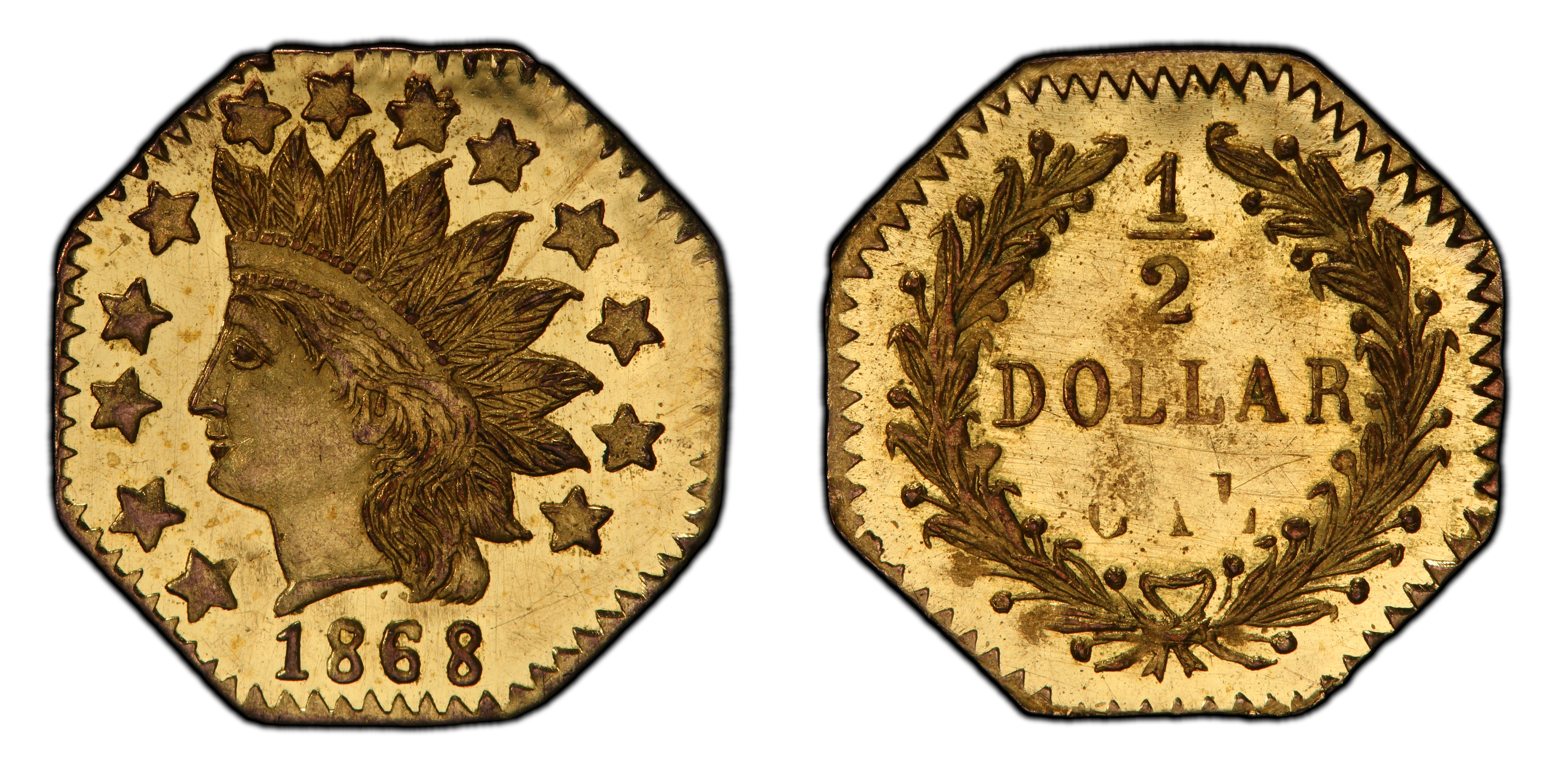
Obverse & Reverse
The 1868 BG-960A 50 Cent piece emerges from the second major phase of California's private gold coinage, a period numismatists designate as 'Period Two' (1859-1882). By the late 1860s, the initial, desperate need for small denomination coinage that characterized the Gold Rush's peak ('Period One,' 1852-1857) had largely subsided. The establishment of the San Francisco Mint in 1854 and its increasing output of federal silver and gold coinage had stabilized the region's money supply. However, the allure of California gold remained potent, transforming these small gold pieces from utilitarian currency into popular souvenirs and jewelry items. San Francisco's manufacturing jewelers, such as Robert B. Gray & Co. and the successors to Antoine Nouizillet, recognized this new market. They continued to produce fractional gold, often using older dies or creating new, more fanciful designs. These 'jeweler's issues' were typically lighter and of a lower fineness than their Period One predecessors, as their purpose was no longer to pass as full-value currency but to serve as keepsakes of the Golden State. The production of these pieces existed in a legal gray area. The Private Coinage Act of 1864 expressly forbade private minting, but enforcement by the Secret Service was lax in California until the early 1880s. This permissive environment allowed for the creation of hundreds of varieties like the BG-960A. Struck in 1868, a year before the completion of the Transcontinental Railroad would further integrate California's economy with the East, this coin represents a local industry in transition. It was produced by the 'hammer method,' where a planchet was placed on an anvil die and struck with a hand-held upper die and a sledgehammer, a process accounting for the frequently uneven strikes seen on these pieces. The BG-960A is a specific late-die-state variety of the BG-960, notable for the progressive wearing of the reverse die, which caused the word 'CAL.' to become almost completely effaced. This detail provides a fascinating glimpse into the working life of a private minter's die set, illustrating how dies were used until they failed, maximizing output for the souvenir trade.
Associated EventPost-Gold Rush Economic Expansion
Reason For MintingPrimarily produced as a popular souvenir or jewelry item for tourists and locals, rather than to alleviate a coinage shortage.
Minter HistoryWhile the specific minter of the BG-960/960A die pair is unknown, the style is characteristic of San Francisco's 'jeweler's issues' of the era. The dominant figure in this period was Robert B. Gray, who had purchased the business of Antoine Louis Nouizillet in the late 1850s. Gray and other manufacturing jewelers produced a vast number of varieties, often unsigned, for a market that valued novelty over intrinsic worth. These operations were typically small, combining jewelry manufacturing with the production of these popular gold tokens.
Historical SignificanceThis coin is a tangible artifact of California's post-Gold Rush economic maturity, reflecting the shift of fractional gold from essential currency to commercial keepsake. As a late-die-state variety, it also offers a valuable technical case study in the production methods and lifecycle of privately produced dies in the 19th century.
N/A
Denomination50 Cents
Minting Period1868
Assayer/MinterUnknown San Francisco Jeweler (Possibly Robert B. Gray & Co. or successor)
Geographic OriginSan Francisco, California
Obverse DescriptionAn Indian Head motif facing left, adorned with a feathered headdress. The portrait is encircled by thirteen stars, representing the original colonies. The date '1868' is positioned below the bust.
Obverse Inscription1868
Reverse DescriptionThe denomination '1/2' and the word 'DOLLAR' are enclosed within a wreath of leaves. The word 'CAL.' (for California) is intended to be at the top, outside the wreath, but is mostly or completely effaced on the BG-960A variety due to late die state.
Reverse Inscription1/2 DOLLAR CAL.
CompositionGold
Stated Fineness Actual FinenessVariable, often between .500 and .800 fine; lower than Period One issues.
EdgePlain
Unknown
Survival Estimate13-18 coins
Rarity ScaleHigh R-6
The BG-960A is highly sought after for its significant rarity (High R-6), its status as a distinct die state variety, and its octagonal shape and classic Indian Head design. It appeals to specialists in California fractionals, die state collectors, and those fascinated by the 'jeweler's issue' period.
Key VarietiesBG-960A is itself a key variety of BG-960. The primary distinction is the die state: BG-960 exhibits a clear 'CAL.' on the reverse, while BG-960A is characterized by 'CAL.' being mostly or entirely missing due to die wear and failure. No later-date restrikes or special collector issues are known to exist for this specific variety.
Authentication TipsAuthentic Period Two fractionals must have a denomination (e.g., 'DOLLAR' or 'CENTS'). Pieces with a bear motif are almost always later, non-contemporary tokens. For BG-960A specifically, the key diagnostic is the nearly obliterated 'CAL.' on the reverse, which should appear as a natural result of die erosion, not tooling or damage. The overall fabric should be consistent with a hammered strike, with potential weakness in the center and a slightly irregular shape. Replicas often have a soapy, cast look or unnaturally sharp, uniform details.
Shopping ConsiderationsA premium quality example of BG-960A will exhibit lustrous, prooflike or semi-prooflike fields, as is characteristic of this variety. Look for a strong strike on the peripheral details like the stars and wreath, though weakness on the very central elements of the reverse is common and acceptable for the issue. Original, reddish-gold toning adds to the eye appeal. Avoid examples that have been harshly cleaned, which strips the original skin and luster. Given their use in jewelry, carefully check the edges and surfaces under magnification for signs of mounting, removal, or tooling to repair damage.
A coin's grade is its condition, rated on a 1-70 scale. For rare coins, this is the most critical factor in determining value, as a tiny difference in preservation can mean a huge difference in price.
Relevant Grade TypesOriginal examples of this coin were business strikes, although produced with souvenir intent, and are found in Circulated (1-58) and Mint State (MS, 60-70) grades. No true Proofs were struck during the original period of issue. The 'PL' (Prooflike) designation is a modifier for a business strike (MS) that has reflective, mirror-like surfaces from polished dies, a characteristic often seen on this variety.
Mint State CharacteristicsUncirculated examples of BG-960A are known for moderately prooflike fields. The quality of the strike is paramount; top-tier examples will have sharp details on the Indian's headdress and the individual leaves of the wreath. However, a defining characteristic of this die pair is a lack of an absolute strike in the central reverse, meaning the '1/2' may appear somewhat soft. Luster should be bright and flashy. Contact marks, even small ones, can be distracting on the mirrored surfaces and will impact the grade.
Circulated Wear PatternsWear first appears on the high points of the design: the cheek and feathers of the Indian Head on the obverse, and the bow and high points of the leaves on the reverse wreath. On moderately circulated examples (VF-XF), the finer details of the feathers will merge and the legends will begin to soften. In lower grades, the date and stars will show significant flattening.
Key Factors For ValueFor the BG-960A, rarity is the primary driver of value. After that, surface quality is critical. Examples with clean, unabraded, prooflike surfaces command significant premiums. A sharp strike on the peripheral elements, despite the known central weakness, is highly desirable. Eye appeal, defined by attractive original color and minimal distracting marks, is a key factor. A CAC sticker for this issue provides a strong third-party endorsement of quality for the grade and will result in a substantial premium.
PCGS Price Guide
| Grade | Price | Population |
|---|---|---|
| 63 | N/A | N/A |
| 64 | $1,500.00 | 1 |
| 67 | N/A | N/A |