1871 G25C BG-809 (Regular Strike)
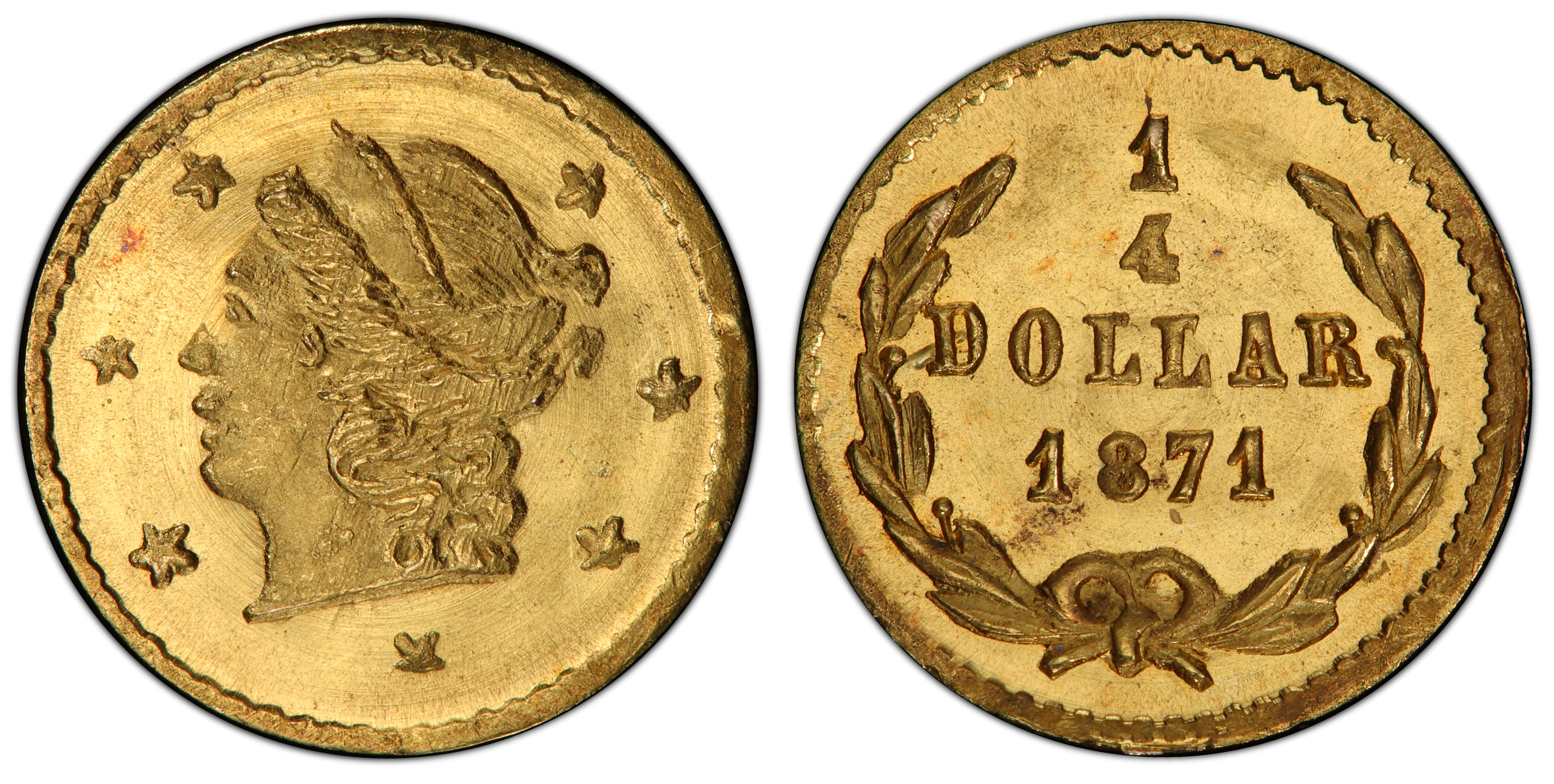
Obverse & Reverse
The 1871 25 Cents, cataloged as Breen-Gillio 809, is a quintessential example of 'Period Two' California Fractional Gold. These small-denomination coins arose from the unique economic landscape of post-Gold Rush California. While the initial deluge of '49ers had subsided, California remained a region awash in gold dust but critically short of small circulating coinage for daily transactions. The U.S. Mint in San Francisco, established in 1854, primarily focused on larger denominations, leaving a void that private minters, often jewelers, eagerly filled. The first period of these fractionals (1852-1857) were often crudely made and intended to genuinely alleviate this change shortage. By the time the BG-809 was struck in 1871, the context had shifted. While still serving a marginal transactional purpose, these 'jeweler's issues' were increasingly produced as souvenirs and keepsakes for a growing tourist trade and for locals who cherished them as mementos of the Gold Rush era. This piece is attributed to Pierre Frontier, a French jeweler who had established himself in San Francisco circa 1853. The coins he and his contemporaries produced were often lighter than their stated face value in gold would suggest, a common characteristic of Period Two issues that solidified their status as privately issued tokens rather than true coinage. The Coinage Act of 1864 had officially forbidden private coinage, but enforcement by the Secret Service was lax until the early 1880s, allowing this vibrant and historically significant series to persist. The BG-809, with its crude but charming Liberty Head, is a tangible link to this era of private enterprise and the enduring legacy of the California Gold Rush, representing a time when jewelers' workshops served as de facto mints for the public's needs.
Associated EventCalifornia Gold Rush Aftermath
Reason For MintingTo satisfy a continued, albeit diminished, need for small denomination coinage and to serve the growing market for Gold Rush souvenirs.
Minter HistoryPierre Frontier was a jeweler who emigrated to San Francisco around 1853. Like many jewelers of the period, he became involved in the lucrative business of producing small denomination gold pieces to meet public demand. His work is characterized by a somewhat crude but distinctive style, particularly in the rendering of the Liberty Head motif, as seen on the BG-809. These 'jeweler's issues' were a significant part of the Period Two (1859-1882) output of California Fractional Gold.
Historical SignificanceThe BG-809 is significant as a representative of the later period of California Fractional Gold, illustrating the transition from quasi-circulating coinage to souvenir pieces. It showcases the persistence of private minting in the face of federal law and highlights the unique economic conditions of 19th-century California. The series as a whole represents the only privately issued gold coins tolerated for an extended period in U.S. history.
N/A
Denomination25 Cents
Minting Period1871
Assayer/MinterAttributed to Pierre Frontier
Geographic OriginSan Francisco, California
Obverse DescriptionA crudely rendered Liberty Head facing left, with thirteen stars surrounding the portrait. The date 1871 is below the bust. The execution is typical of many jeweler's issues, with less refined detail than contemporary federal coinage.
Obverse Inscription1871
Reverse DescriptionA wreath of two olive branches, tied with a ribbon at the bottom, encircles the denomination. In the center, the fraction '1/4' is displayed above the word 'DOLLAR'.
Reverse Inscription1/4 DOLLAR
CompositionGold
Stated Fineness Actual FinenessTypically around 90% Gold for assay purposes, though the intrinsic value was often less than the face value.
Weight0.40 grams
Diameter9.20 mm
EdgePlain
Unknown, but considered scarce.
Survival Estimate75-125
Rarity ScaleR-4 (Low R-4)
This variety is popular due to its affordability relative to earlier Period One issues and its clear connection to the romantic era of the California Gold Rush. As a dated, denominated piece from a known period of private production, it holds significant historical appeal. High-grade examples with sharp strikes are particularly sought after by specialists.
Key VarietiesThe BG-809 is a specific die marriage and does not have major varieties from its original minting. The broader series of California Fractional Gold contains over 500 distinct varieties cataloged by Breen and Gillio, differing by date, denomination, shape (round or octagonal), and design. No later-date restrikes or special collector issues are known for this specific variety.
Authentication TipsGenuine pieces must be denominated with 'DOLLAR' or an abbreviation; modern replicas often say 'CALIFORNIA GOLD' or feature a bear on the reverse, which is not found on authentic 19th-century issues. The fabric of genuine pieces is often slightly uneven due to the crude hammer-striking process, and the gold is soft. Be wary of pieces with sharp, uniform rims or a brassy, unnatural color. The BG-809 has a specific, somewhat crude Liberty Head style; compare any potential purchase to high-resolution images of certified examples. Unlisted varieties should be treated with extreme caution.
Shopping ConsiderationsWhen purchasing an 1871 BG-809, prioritize a sharp strike, especially on the Liberty Head and the numerals of the date. Due to the manufacturing process, many examples are weakly struck in areas. Luster is also key; a premium quality example will have satiny, original mint luster, often with attractive caramel or reddish-gold toning. Avoid coins that appear cleaned, polished, or have been used in jewelry, as evidenced by solder marks or excessive rim damage. Minor planchet flaws or small retained laminations are sometimes seen and can be acceptable if not distracting. Third-party certification from PCGS or NGC is highly recommended for this series to ensure authenticity and accurate grading.
A coin's grade is its condition, rated on a 1-70 scale. For rare coins, this is the most critical factor in determining value, as a tiny difference in preservation can mean a huge difference in price.
Relevant Grade TypesOriginal examples of BG-809 were struck as business strikes intended for limited circulation or sale as souvenirs and are found in Circulated (1-58) and Mint State (MS, 60-70) grades. No Proofs were struck during the original period of issue, and no later-date Proof restrikes are known to exist for this variety.
Mint State CharacteristicsAn uncirculated BG-809 is defined by the absence of wear. Quality is determined by the sharpness of the strike, the quality of the luster, and the presence of marks. The strike can be variable, with weakness often seen on the high points of Liberty's hair and the wreath. Luster is typically satiny rather than deeply prooflike, though semi-prooflike surfaces are sometimes encountered. Due to the softness of the gold and the way these pieces were handled, small contact marks are common, even on high-grade specimens. A truly choice example will have a bold strike, vibrant luster, and minimal, well-hidden marks.
Circulated Wear PatternsWear first appears on the highest points of the design. On the obverse, this includes Liberty's hair, cheek, and the stars. On the reverse, the highest points of the wreath leaves and the numerals of the fraction will show the first signs of friction. On lower grade examples, the legends and date will begin to soften and merge with the fields.
Key Factors For ValueThe primary drivers of value for an 1871 BG-809 are grade and eye appeal. A sharply struck coin with clean, lustrous surfaces will command a significant premium over a weakly struck or heavily marked example of the same grade. Original, uncleaned surfaces are paramount; coins that have been polished or harshly cleaned are worth substantially less. Attractive toning, often in shades of orange or rose-gold, can enhance eye appeal and value. For this series, a CAC sticker, indicating a premium quality coin for the grade, adds a notable premium.
PCGS Price Guide
| Grade | Price | Population |
|---|---|---|
| 55 | $275.00 | 1 |
| 55+ | $285.00 | N/A |
| 58 | $300.00 | 8 |
| 58+ | $310.00 | N/A |
| 60 | $325.00 | 2 |
| 61 | $375.00 | 4 |
| 62 | $450.00 | 17 |
| 62+ | $500.00 | N/A |
| 63 | $525.00 | 23 |
| 63+ | $550.00 | N/A |
| 64 | $575.00 | 30 |
| 64+ | $625.00 | N/A |
| 65 | $775.00 | 24 |
| 65+ | $1,025.00 | N/A |
| 66 | $1,500.00 | 9 |
| 66+ | $2,250.00 | 1 |
| 67 | $3,500.00 | 1 |
| 68 | N/A | N/A |