1875 G50C BG-930A (Regular Strike)
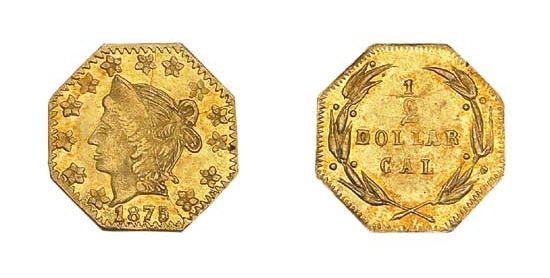
Obverse & Reverse
The 1874 octagonal 50-cent piece, cataloged as Breen-Gillio 930, is a quintessential example of a 'Period Two' California Fractional Gold coin. Unlike their 'Period One' predecessors (1852-1857), which were struck to alleviate a severe shortage of small change during the initial chaos of the Gold Rush, Period Two issues were created in a different economic climate. By the 1870s, the San Francisco Mint was in full operation, and an adequate supply of federal coinage had rendered the tiny private gold pieces obsolete for commerce. Instead, they found a new purpose as popular souvenirs and jewelry items. San Francisco's jewelers, many of them of French or Italian origin, recognized a robust market among tourists, eastern visitors, and locals who wanted a tangible memento of the romanticized Gold Rush era. These 'jewelers' issues' were often deliberately underweight and struck with less care than the earlier circulating issues, as their intrinsic value was secondary to their novelty. The production of these pieces existed in a legal gray area. The Coinage Act of 1864 had made private coinage illegal, but the law was not aggressively enforced against these small souvenir pieces until the early 1880s, when the Secret Service, under the direction of Chief James J. Brooks, finally cracked down on their manufacture, bringing the era to a close. The BG-930, attributed to Gaetano F. Lodi, exemplifies the manufacturing techniques of the time. Struck with hand-cut dies and often using a simple screw press or even a hammer, the quality could be inconsistent. Pieces are frequently found with areas of weak striking, particularly on the high points of Liberty's portrait, a characteristic that defines the issue. Despite their non-monetary function, they remain a direct link to the post-Gold Rush culture of California and are avidly collected for their history and vast variety.
Associated EventCalifornia Gold Rush (Later Souvenir Period)
Reason For MintingPrimarily created for sale as souvenirs, jewelry charms, and keepsakes of the California Gold Rush era.
Minter HistoryGaetano Francesco Lodi is the attributed maker of several California Fractional Gold varieties, including BG-930. While detailed biographical information placing him as a San Francisco jeweler is scarce, the style and workmanship of the dies are consistent with other known private minters of the period. Like many of his contemporaries, Lodi was likely a professional jeweler and engraver who produced these small gold pieces as a profitable sideline to his main business, catering to the significant tourist and souvenir trade in the city. The attribution is based on the extensive research compiled by numismatists Walter Breen and Ronald J. Gillio.
Historical SignificanceThis coin represents the transition of fractional gold from a necessary medium of exchange to a commercial souvenir product. It is a tangible artifact of California's burgeoning tourism industry in the 1870s and the romantic mythology that had already grown around the Gold Rush, less than three decades after its start. Its existence also highlights the federal government's initially lax enforcement of private coinage laws, which allowed a vibrant and diverse series of private issues to flourish for nearly 30 years.
BG-930
Denomination50C
Minting Period1874
Assayer/MinterGaetano Francesco Lodi
Geographic OriginSan Francisco, California
Obverse DescriptionAn octagonal planchet featuring a crude, right-facing bust of Liberty. Her hair is tied in the back, and she wears a coronet. The portrait is surrounded by thirteen stars, representing the original colonies. The date, 1874, appears below the bust. The rendering is typical of jewelers' issues, often lacking the fine detail of federal coinage.
Obverse Inscription1874
Reverse DescriptionA simple wreath composed of two branches tied with a bow at the bottom. The denomination '1/2' is located in the center. The legend CALIFORNIA GOLD surrounds the wreath along the upper border.
Reverse InscriptionCALIFORNIA GOLD 1/2
CompositionGold
Stated Fineness Actual FinenessVaries, typically 14 to 22 karats (.585 to .917 fine)
Weight0.25 grams
Diameter10.50 mm
EdgePlain
Unknown
Survival Estimate75-125
Rarity ScaleR-5
The BG-930 is sought after as a representative of the later 'jewelers' issues' of California Fractional Gold. Its octagonal shape, crude but charming engraving style, and specific Breen-Gillio attribution appeal to series specialists. It is more affordable than many of the Period One issues, making it an accessible entry point for collecting attributed varieties.
Key VarietiesThe primary variety is the regular strike BG-930. The user's input of 'BG-930A' appears to be an error, as there is no widely recognized 'A' variety for this issue in numismatic literature. No proof or special presentation strikings are known to exist.
Authentication TipsAuthentic examples often exhibit a crude, somewhat soft strike, especially on Liberty's cheek and hair. The surfaces may have a slightly grainy or uneven texture from the planchet preparation and striking process. The style of the numerals in the date and the letters in the inscriptions should be carefully compared to known genuine examples. Modern counterfeits are common; they are often brassy in color, have sharper, more 'perfect' details than originals, and frequently feature incorrect design elements. A common red flag for replicas in this series is the presence of a bear on the reverse, which is not found on genuine 19th-century issues.
Shopping ConsiderationsA premium quality example for its grade will show minimal contact marks and retain some original mint luster, often appearing as prooflike or semi-prooflike fields around the devices. Given the typically weak strike, any example showing unusual sharpness on the central portrait of Liberty should be prized. Avoid pieces that have been harshly cleaned, which strips the original patina and imparts a flat, lifeless look. Also, inspect carefully for evidence of having been mounted in jewelry, such as rim damage, solder, or tooling marks where a clasp was removed. The natural golden-russet toning that sometimes frames the borders is considered attractive and adds to the eye appeal.
A coin's grade is its condition, rated on a 1-70 scale. For rare coins, this is the most critical factor in determining value, as a tiny difference in preservation can mean a huge difference in price.
Relevant Grade TypesAll original BG-930 pieces were struck as business strikes, intended for sale as souvenirs rather than circulation. They are found in Circulated grades (AU-50 to AU-58, from minor handling) and, more commonly, Mint State (MS, 60-70) grades. No proofs were struck during the original period of issue, and no later-date restrikes are known.
Mint State CharacteristicsUncirculated examples of BG-930 are defined by their luster, which is often bright and flashy, sometimes with deep, mirror-like fields. However, the strike is a key issue; most examples are weakly struck, particularly on the high points of Liberty's head and hair. This is characteristic of the variety and not necessarily a flaw. Small planchet flaws or striations are common and do not always detract from the grade if they are not distracting. Contact marks, even on high-grade pieces, are to be expected due to the softness of the gold.
Circulated Wear PatternsAlthough not intended for circulation, some pieces saw handling as pocket pieces or jewelry. Wear first appears on the highest points: Liberty's cheek, the hair above her ear, and the tips of the leaves in the wreath. On lower-grade circulated examples, the stars and legends will show softness and begin to merge with the fields.
Key Factors For ValueThe primary value drivers for a BG-930 are grade and surface quality. An example with a sharp strike for the issue commands a significant premium. Original, uncleaned surfaces with attractive luster and minimal distracting marks are paramount. Eye appeal is crucial; coins with prooflike fields or attractive, subtle toning are highly prized by specialists. Certification by PCGS or NGC is standard for this series, and a CAC sticker, indicating premium quality for the grade, adds a notable premium.
PCGS Price Guide
| Grade | Price | Population |
|---|---|---|
| 62 | $11,500.00 | N/A |