1872/1 G25C BG-868 (Regular Strike)
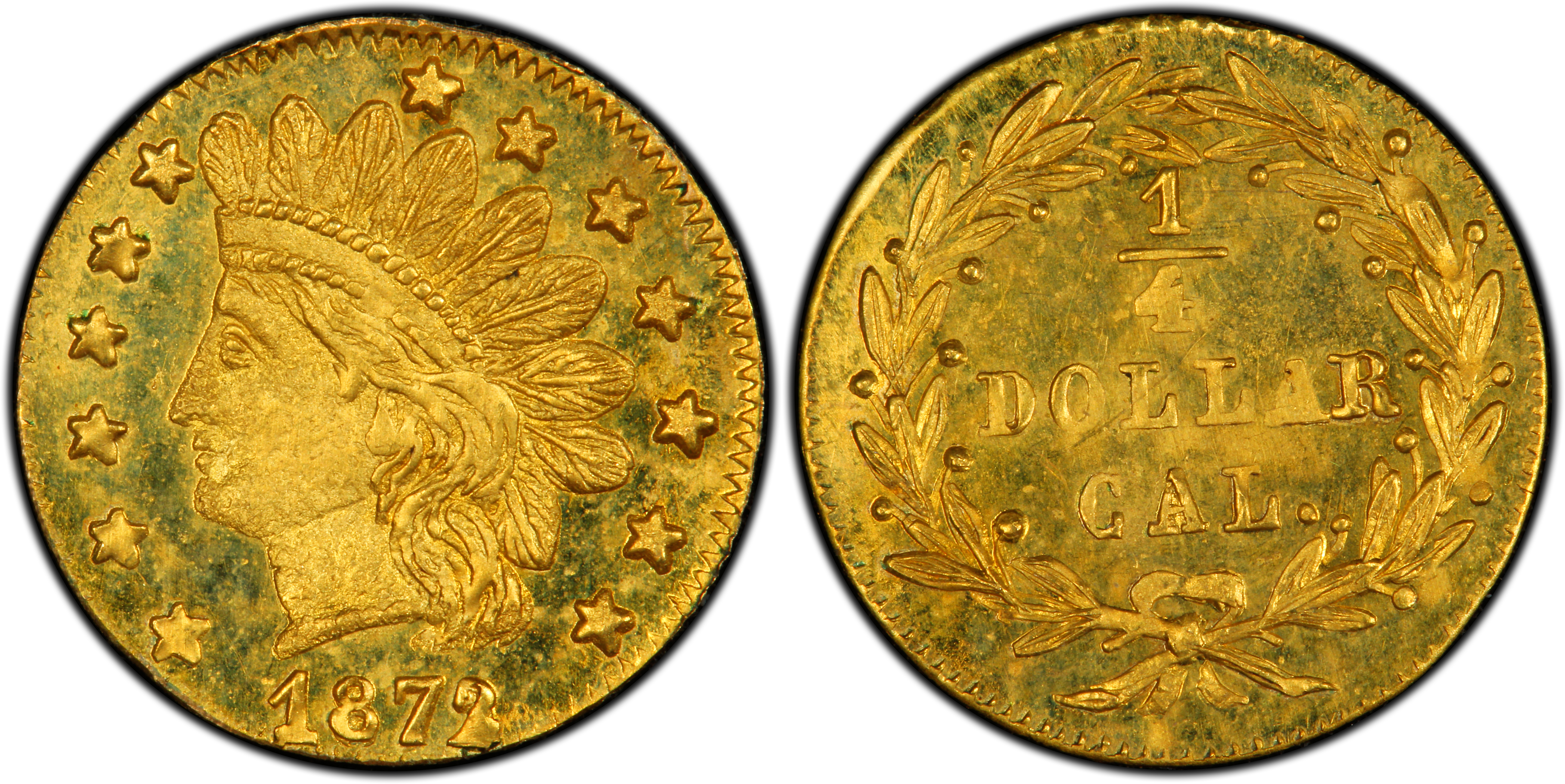
Obverse & Reverse
The 1872/1 G25C BG-868 is a fascinating product of the second period (1859-1882) of California Fractional Gold production. By the 1870s, the initial, desperate need for small change that characterized the Gold Rush had subsided with the establishment of a Federal branch mint in San Francisco. The pieces from this later era were primarily produced by jewelers and served a different purpose. They were not struck to alleviate a coin shortage but were sold as souvenirs, keepsakes, and novelties to tourists and locals captivated by the romance of the Gold Rush. Despite the Coinage Act of 1864, which made private coinage illegal, federal enforcement in the West was lax, allowing this cottage industry to persist until the early 1880s. These 'jeweler's issues' were often deliberately backdated or muled with older dies to circumvent the law and enhance their appeal as relics of an earlier time. The BG-868 is a prime example of this practice, featuring a prominent 1872/1 overdate. This was not an accidental die-cutting error but a deliberate modification, likely made to create an interesting variety for collectors or to reuse an older die. These pieces were struck with less gold than their stated face value would imply, a common characteristic of Period Two fractionals, confirming their status as tokens rather than true circulating coinage. Their small size and intricate designs were a testament to the skill of the jewelers who crafted them, often using hand-operated presses which resulted in variable strike quality. Today, the BG-868 is highly prized not as a coin that facilitated commerce, but as a tangible link to the post-Gold Rush culture of California, representing the commercialization of its founding myth.
Associated EventPost-California Gold Rush Era
Reason For MintingPrimarily created as a souvenir or collectible item for the tourist and novelty trade, not for general circulation.
Minter HistoryThe specific minter for the BG-868 variety is unknown, a common trait for many Period Two California Fractional Gold pieces. Production is attributed to the community of San Francisco jewelers who engaged in this trade. Numismatic scholarship, particularly the work of Breen and Gillio, has attempted to link stylistic elements and die characteristics to specific makers, with some attributing this and related varieties to Robert B. Gray. These jewelers operated small-scale minting operations, using hand-engraved dies and screw presses to produce their wares, which were sold directly from their shops.
Historical SignificanceThis coin's significance lies in its representation of the shift from utilitarian private coinage to commercial souvenir tokens. It highlights a period when the memory and allure of the Gold Rush were being packaged and sold. The 1872/1 overdate is a key feature, illustrating the production methods and marketing savvy of the private minters who created interesting varieties to attract collectors and tourists, operating in a legally gray area for nearly two decades after private coinage was officially outlawed.
N/A
Denomination25 Cents
Minting Period1872
Assayer/MinterUnknown private minter, likely a San Francisco jeweler. Attributed by some specialists to Robert B. Gray.
Geographic OriginSan Francisco, California
Obverse DescriptionAn Indian Head or 'Indian Princess' design facing left, reminiscent of the contemporary U.S. Indian Head cent. The portrait is surrounded by thirteen five-pointed stars.
Obverse Inscription[None, design only]
Reverse DescriptionThe denomination '1/4' is at the center, surrounded by a decorative wreath of leaves and berries. The word 'DOLLAR' is below the wreath, and the date '1872' (with a clear '2' punched over a '1') is at the very bottom. The letters 'CAL.' for California are sometimes noted as appearing on related varieties but are not a feature of the BG-868 reverse die.
Reverse Inscription1/4 DOLLAR 1872/1
CompositionGold
Stated Fineness Actual FinenessVariable, but generally lower than official U.S. coinage of the era.
Weight0.25 grams
Diameter9.80 mm
EdgePlain
Unknown
Survival EstimateFewer than 100 known
Rarity ScaleHigh R-4 / Low R-5
The 1872/1 BG-868 is highly sought after due to its status as a dramatic and clear overdate. It appeals to collectors of California Fractional Gold, overdate specialists, and those interested in the fascinating history of private mints in the American West. Its scarcity and attractive Indian Head design add to its desirability.
Key VarietiesThe primary variety is the 1872/1 overdate itself, which is the defining characteristic of BG-868. No major sub-varieties from the original minting period are known. Unlike official U.S. coinage, there are no known patterns, trial pieces, or later-date restrikes associated with this specific privately-issued token.
Authentication TipsAuthentic examples show a clear underlying '1' beneath the final '2' in the date. The die characteristics, including the specific shape and placement of the stars, wreath elements, and numerals, should be compared to known genuine examples. Weight and specific gravity tests can be useful, as many contemporary counterfeits and modern replicas are made of brass or have incorrect gold content. Look for the sharp, albeit sometimes uneven, strike quality typical of a screw press, rather than the soft, mushy details of cast copies.
Shopping ConsiderationsA premium quality example for this issue is defined by a sharp strike, particularly on the high points of the Indian's headdress and the details of the reverse wreath. Many examples exhibit some softness in the centers. Look for specimens with vibrant, proof-like or deep mirror proof-like (DMPL) surfaces, which are highly prized and indicate an early strike from the dies. Original, undisturbed luster with a pleasing greenish-gold or reddish-gold patina is paramount. Avoid examples that have been harshly cleaned, polished, or exhibit scratches, as surface quality is critical to value. The clarity and boldness of the overdate itself can also command a premium.
A coin's grade is its condition, rated on a 1-70 scale. For rare coins, this is the most critical factor in determining value, as a tiny difference in preservation can mean a huge difference in price.
Relevant Grade TypesOriginal issues were business strikes, but as Period Two 'jeweler's issues,' they were not intended for widespread circulation. They are found in both Circulated (1-58) and, more commonly, Mint State (MS, 60-70) grades. No true Proofs were struck during the original period of issue. The finest examples are often described with designations like 'Proof-Like' (PL) or 'Deep Mirror Proof-Like' (DMPL) due to the highly polished dies used by the jewelers, but they are not a separate striking type like official U.S. Proof coinage.
Mint State CharacteristicsUncirculated examples are characterized by their luster, which can range from satiny to deeply reflective. High-grade specimens often display a dramatic cameo effect, with frosty devices contrasting with mirror-like fields. Due to the manual striking process, weakness on the central reverse (the '1/4' and wreath) is common and should not be overly penalized. Small planchet flaws or adjustment marks are occasionally seen and are part of the coin's character. Contact marks, while present on most examples, should be minimal and not in focal areas to command the highest grades.
Circulated Wear PatternsFor the few examples that saw handling or circulation, wear first appears on the highest points: the cheek and the feathers of the Indian's headdress on the obverse, and the bow and highest leaves of the wreath on the reverse. In lower grades (VF and below), the fine details of the feathers will merge, and the stars will begin to lose their sharpness.
Key Factors For ValueThe primary value drivers are grade and surface quality. An example with original, vibrant proof-like surfaces will command a significant premium over a hazy or cleaned piece of the same numerical grade. The sharpness and visibility of the 1872/1 overdate are crucial; a bold overdate is more desirable than a faint one. Eye appeal is paramount for this series, with collectors paying more for coins with attractive color and a strong visual contrast. Certification by a major grading service (PCGS or NGC) is standard, and a CAC sticker indicating premium quality for the grade adds a further layer of value.
PCGS Price Guide
| Grade | Price | Population |
|---|---|---|
| 55 | $250.00 | 1 |
| 55+ | $275.00 | N/A |
| 58 | $300.00 | N/A |
| 58+ | $325.00 | N/A |
| 60 | $350.00 | N/A |
| 61 | $425.00 | N/A |
| 62 | $500.00 | 5 |
| 62+ | $525.00 | N/A |
| 63 | $575.00 | 12 |
| 63+ | $625.00 | N/A |
| 64 | $675.00 | 16 |
| 64+ | $800.00 | N/A |
| 65 | $1,550.00 | 15 |
| 65+ | $1,700.00 | 1 |
| 66 | $2,500.00 | 2 |
| 67 | N/A | N/A |