1880 G50C BG-954 (Regular Strike)
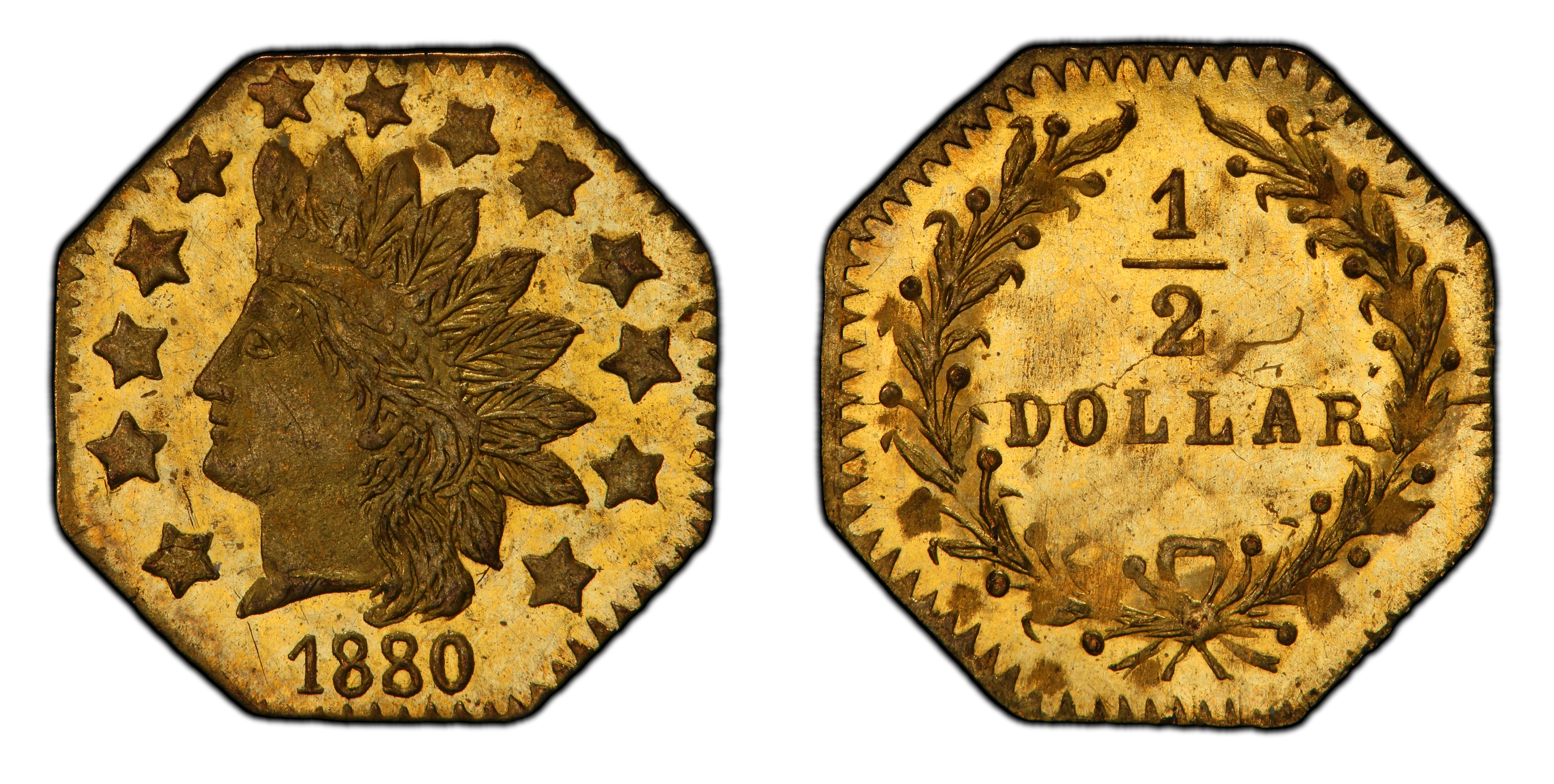
Obverse & Reverse
The 1880 Octagonal 50 Cents, cataloged as Breen-Gillio 954, is a quintessential example of a 'Period Two' California Fractional Gold piece. By 1880, the frantic necessity for small denomination coinage that characterized the California Gold Rush of the early 1850s had long subsided. The establishment and prolific output of the official United States Mint in San Francisco, which began operations in 1854, had effectively saturated the region with federal coinage, obviating the need for private issues to facilitate daily commerce. Consequently, the motivation behind producing fractional gold pieces shifted dramatically. The BG-954 was not created to alleviate a coin shortage but to capitalize on a burgeoning tourism industry and a national fascination with the 'Wild West.' These later issues, often termed 'jeweler's pieces' or 'souvenir tokens,' were manufactured by various San Francisco jewelers, including the presumed maker of this variety, Herman J. Brand. They were sold as keepsakes, charms for bracelets, and mementos of a visit to the romanticized gold fields. Despite carrying a denomination, their gold content was intentionally less than their face value, making them a form of profitable tokenage rather than true circulating currency. The Coinage Act of 1864 had technically made such private issues illegal, but enforcement by the Secret Service was lax until 1883. Jewelers operated in this gray area, producing denominated pieces that mimicked coinage but were understood to be novelties. The BG-954, with its popular Indian Head motif—a design choice likely influenced by the contemporary U.S. Indian Head cent—would have been an attractive and affordable souvenir. Their production continued until stricter enforcement began, after which makers typically removed the denomination to avoid prosecution, labeling them as charms or tokens.
Associated EventPost-Gold Rush California Tourism
Reason For MintingTo be sold as a souvenir or jewelry item to tourists and collectors, capitalizing on the romanticism of the California Gold Rush.
Minter HistoryHerman J. Brand was a San Francisco-based jeweler and die sinker active during the latter part of the 19th century. He was one of several craftsmen who produced a variety of California Fractional Gold pieces during the 'Period Two' (1859-1882) era. Unlike the 'Period One' minters who were filling a critical economic need for circulating small change, Brand's business was focused on the lucrative souvenir and jewelry market. His operations involved creating dies and striking these small, denominated gold tokens that appealed to visitors and locals as novelties. When the U.S. Secret Service began to crack down on private issues bearing denominations in 1883, Brand adapted his business. To avoid prosecution for counterfeiting, he ceased producing denominated pieces and shifted to creating non-denominated tokens, famously moving to a 'Miner' design and later the 'Arms of California' motif. His work, including the BG-954, is characteristic of the later jeweler's issues: competently executed but lacking the monetary legitimacy of their Period One predecessors.
Historical SignificanceThe BG-954 is historically significant not as a coin used in commerce, but as a tangible artifact of how the California Gold Rush was memorialized and commercialized. It represents the transition of fractional gold from a necessary form of currency to a nostalgic souvenir, reflecting a mature California economy and the popular romanticism of its pioneering past. These pieces document a period of lax federal oversight on private coinage and the enterprising spirit of jewelers who catered to a new tourist market.
K-Unlisted (Breen-Gillio BG-954)
Denomination50 Cents
Minting Period1880
Assayer/MinterHerman J. Brand
Geographic OriginSan Francisco, California
Obverse DescriptionFeatures a stylized bust of a Native American princess facing left, wearing a feathered headdress. The portrait is encircled by 13 six-pointed stars, representing the original colonies. The date '1880' appears below the bust.
Obverse Inscription1880
Reverse DescriptionA wreath composed of two branches tied with a ribbon at the bottom encircles the denomination. The legend 'CALIFORNIA GOLD' is inscribed around the periphery, outside the wreath.
Reverse Inscription1/2 DOLLAR CALIFORNIA GOLD
CompositionGold
Stated Fineness Actual FinenessVariable, typically of a lower fineness than official U.S. coinage and intentionally underweight for its face value.
EdgePlain
Unknown
Survival Estimate46-60 known (per R-5 rating)
Rarity ScaleR-5
The BG-954 is sought after for its classic Indian Head design, octagonal shape, and its status as a late-date, denominated souvenir from the historic California Gold Rush era. It is an accessible representative of the 'Period Two' issues and is popular with type collectors. Its defined rarity of R-5 makes it challenging to acquire but not prohibitively rare, offering a pleasing balance for collectors.
Key VarietiesThe primary variety is the regular business strike. No proof strikings from the original period of manufacture are known or expected for this issue, as they were commercial novelties. There are no known major die varieties for BG-954 itself, nor are there any known special collector restrikes from a later period. The key distinction for collectors is between this and other similar Indian Head octagonal 50-cent pieces from different years or by different makers.
Authentication TipsAuthentic BG-954 pieces must have the denomination '1/2 DOLLAR' clearly on the reverse; many contemporary fakes and later souvenir tokens lack a denomination and often feature a bear, which is a definitive sign of a replica or fantasy piece. Genuine examples often have a slightly crude, handmade quality. They may exhibit uneven strikes or planchet imperfections. Weight and specific gravity can be inconsistent due to variable gold content but will not match modern gold-plated brass fakes which are typically much lighter or have a different feel. Comparison with high-resolution images from major grading services is the best authentication method.
Shopping ConsiderationsA premium quality example for its grade will exhibit a sharp strike, particularly on the details of the headdress feathers, the stars, and the letters in the legends. Many surviving examples are in high grades (Mint State) because they were purchased as souvenirs and never circulated. Look for specimens with clean, prooflike or semi-prooflike surfaces, which are common for this issue and highly desirable. Avoid examples that have been harshly cleaned, which will show hairline scratches and impaired luster. Also, watch for pieces that have been used as jewelry, looking for evidence of mounting, solder, or excessive rim damage. A coin with original, undisturbed surfaces and attractive eye appeal will command a significant premium.
A coin's grade is its condition, rated on a 1-70 scale. For rare coins, this is the most critical factor in determining value, as a tiny difference in preservation can mean a huge difference in price.
Relevant Grade TypesOriginal issues of BG-954 were business strikes, although not intended for circulation. They are found in both Circulated (1-58) and, more commonly, Mint State (MS, 60-70) grades. Because they were sold as souvenirs, a high proportion of the surviving population is uncirculated. No true Proof (PR/PF) examples were struck during the original period of issue, and no later-date Proof restrikes are known to exist.
Mint State CharacteristicsUncirculated examples of BG-954 are characterized by their luster, which is often bright and flashy with prooflike or semi-prooflike fields, a result of being struck on polished planchets to enhance their appeal as novelties. The strike can be variable; some are sharply detailed, while others may show slight weakness on the high points of the design. Contact marks, even on high-grade pieces, can be present due to the softness of the gold and loose handling over the years. A superior MS example will combine strong luster with a sharp strike and minimal, non-distracting marks.
Circulated Wear PatternsOn circulated examples, wear first appears on the highest points of the design. For the obverse, this includes the cheek and brow of the Indian princess and the tips of the feathers in her headdress. On the reverse, the highest points of the wreath's leaves and the letters in the denomination will show the first signs of friction and flattening. In lower grades (VF and below), the finer details of the feathers will merge and the legends will become soft.
Key Factors For ValueBeyond the numerical grade, value is driven by surface quality and eye appeal. A sharp, well-centered strike is paramount. Specimens with reflective, prooflike surfaces command significant premiums over those with more subdued, satiny luster. The presence of original, attractive reddish-gold or orange-peel toning can also add to the value. Conversely, coins that have been cleaned, polished, or show evidence of being mounted in jewelry will trade at a substantial discount. A CAC sticker for this issue is highly valued, as it confirms both the accuracy of the grade and the superior quality and eye appeal for that grade.
PCGS Price Guide
| Grade | Price | Population |
|---|---|---|
| 58 | $250.00 | 1 |
| 58+ | $260.00 | N/A |
| 60 | $290.00 | 3 |
| 61 | $325.00 | 4 |
| 62 | $350.00 | 26 |
| 62+ | $375.00 | N/A |
| 63 | $400.00 | 31 |
| 63+ | $450.00 | N/A |
| 64 | $600.00 | 39 |
| 64+ | $675.00 | N/A |
| 65 | $950.00 | 14 |
| 65+ | $1,250.00 | N/A |
| 66 | $2,150.00 | 2 |