1854 G$1 BG-508, PL (Regular Strike)
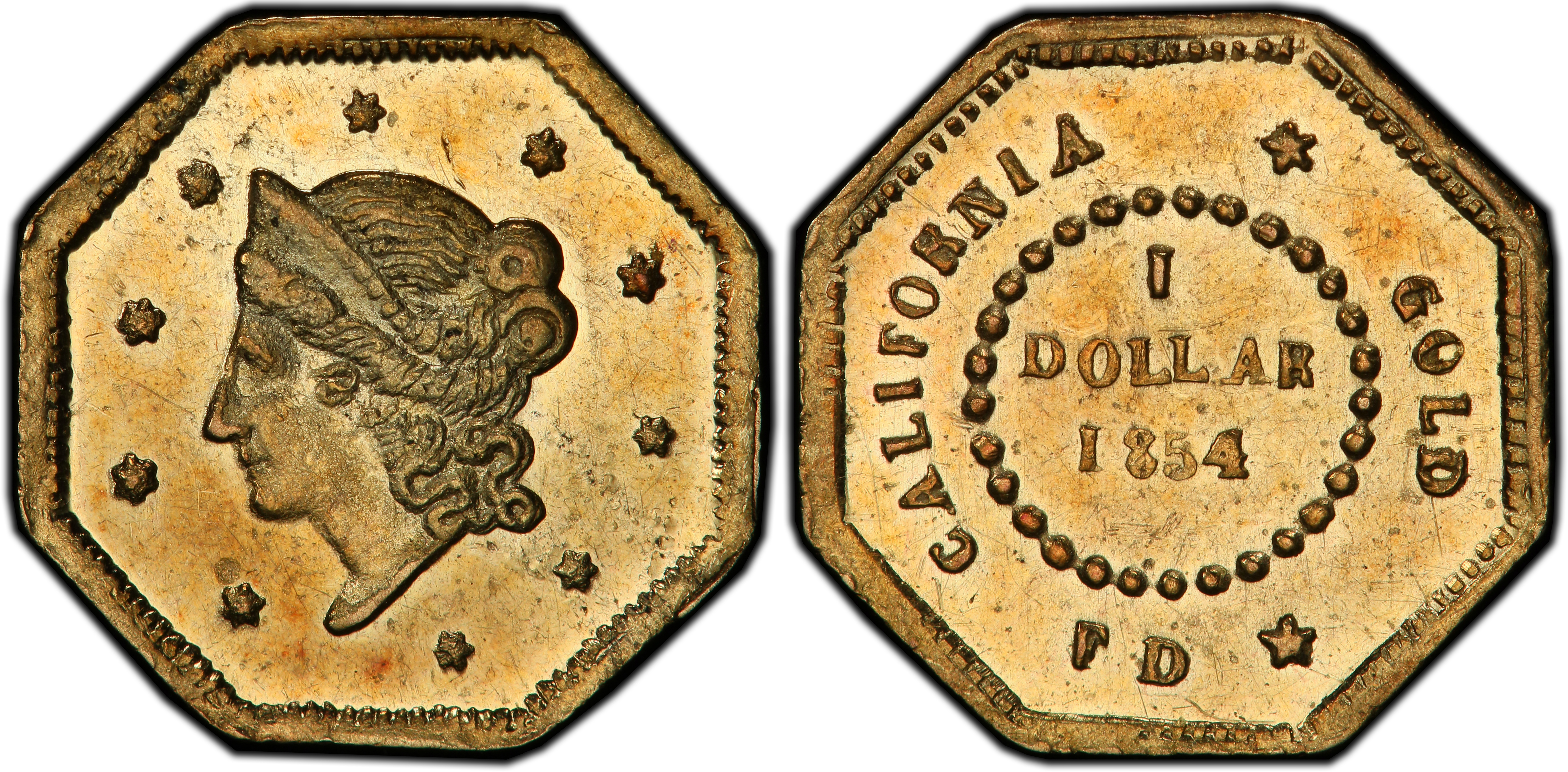
Obverse & Reverse
The California Gold Rush, ignited by James Marshall's discovery at Sutter's Mill in 1848, precipitated one of the most significant demographic and economic shifts in American history. Over 300,000 'forty-niners' descended upon California, creating bustling boomtowns overnight. This massive influx of people, combined with California's geographic isolation, created a peculiar economic environment: an abundance of raw gold dust but a severe scarcity of circulating coinage for everyday transactions. Simple acts like buying a drink, which might be crudely paid for with a 'pinch' of gold dust, highlighted the desperate need for a standardized medium of exchange for small purchases. While several private firms began striking larger denomination gold coins ($5, $10, $20), these were impractical for minor daily commerce, leaving a critical void. Into this gap stepped various jewelers and metallurgists who, beginning in 1852, began privately minting small-denomination gold pieces in quarter-dollar, half-dollar, and one-dollar sizes. These 'California Fractional Gold' pieces were not official government coinage but were a pragmatic, market-driven solution to a chronic problem. The 1854 BG-508 Octagonal Gold Dollar emerged during this initial phase, now known to numismatists as 'Period One' (1852-1857). Coins from this period are believed to have been genuinely intended for circulation to alleviate the small change shortage. Struck by the firm Frontier, Deviercy & Co. in San Francisco, the BG-508 was created before the newly opened San Francisco Mint could produce enough federal coinage to satisfy local demand. The production method for most of these early pieces was crude, often involving a sledgehammer to strike the dies, resulting in inconsistent strike quality. Though initially utilitarian, these tiny gold coins quickly became popular as lightweight, affordable souvenirs that miners and settlers could mail back east. This secondary market may have encouraged producers to continue minting them even as their necessity in commerce waned. The Coinage Act of 1864 eventually made all private coinage illegal, though enforcement was lax until the early 1880s, bringing an end to this fascinating and uniquely American series of private coinage.
Associated EventCalifornia Gold Rush
Reason For MintingTo alleviate a severe shortage of small-denomination coinage for daily commercial transactions in Gold Rush-era California.
Minter HistoryFrontier, Deviercy & Co. was a San Francisco-based firm of jewelers and watchmakers active during the Gold Rush. Like many jewelers of the era, they possessed the metallurgical skills and equipment necessary to strike coins. Their mark, 'FD', is found at the bottom of the reverse on the BG-508. They were one of several private enterprises that stepped in to fill the coinage void, producing a number of octagonal and round dollar and half-dollar varieties between 1853 and 1855. The same obverse die was often used for multiple varieties, as is the case with BG-505 through BG-510, indicating a systematic, albeit small-scale, production.
Historical SignificanceThe BG-508, and California Fractional Gold as a whole, represents a crucial chapter in American monetary history, demonstrating a private, market-based response to a failure in the supply of official government money. These pieces are tangible relics of the socio-economic realities of the California Gold Rush, illustrating the ingenuity and ad-hoc solutions required to build a functioning economy on the frontier. They are among the only privately issued gold coins intended for circulation in U.S. history and serve as a direct link to the daily lives of the 'forty-niners'.
N/A
Denomination$1
Minting Period1854
Assayer/MinterFrontier, Deviercy & Co.
Geographic OriginSan Francisco, California
Obverse DescriptionA head of Liberty, often described as a 'Large Head' variety for this issue, facing left. She wears a coronet inscribed with the word LIBERTY. Thirteen stars encircle the portrait along the octagonal border.
Obverse InscriptionLIBERTY
Reverse DescriptionThe reverse features the denomination '1 DOLLAR' and the date '1854' enclosed within a wreath of leaves and berries. The minter's initials 'FD' for Frontier & Deviercy are located at the bottom of the wreath.
Reverse Inscription1 DOLLAR 1854 FD
CompositionGold
Stated Fineness Actual FinenessVariable, but Period One issues generally had a higher gold content than later souvenir pieces, though often still below their face value equivalent in federal coinage.
EdgePlain
Unknown
Survival EstimateFewer than 75
Rarity ScaleR-6
The BG-508 is highly sought after as a representative of the scarce and historically rich 'Period One' California Fractional Gold series. Its appeal lies in its direct connection to the Gold Rush, its unusual octagonal shape, and its status as a tangible piece of Old West history. The 'PL' (Prooflike) designation indicates unusually reflective, mirror-like surfaces, making such examples particularly desirable to collectors who prize exceptional eye appeal.
Key VarietiesThe primary variety is the regular business strike. No original proof strikings from 1854 are known. While many later California Fractional Gold pieces were restruck or created as souvenirs in the late 19th and early 20th centuries (often backdated), the BG-508 is a 'Period One' issue considered to be originally intended for commerce. Collectors should be aware of the broader category of 'jeweler's issues' and outright modern replicas which are not contemporary to the Gold Rush.
Authentication TipsAuthentic Period One pieces like BG-508 are always denominated, typically with 'DOLLAR' or an abbreviation. Replicas and later souvenir tokens often lack a denomination or feature anachronistic designs, such as a bear on the reverse, which never appeared on genuine 19th-century issues. Genuine examples often exhibit a crude, uneven strike due to being hand-hammered. The fabric of the gold should be consistent with mid-19th-century planchets. Look for the correct 'FD' mintmark placement. Any unlisted variety not documented in the Breen-Gillio reference should be viewed with extreme suspicion. Third-party grading and authentication by PCGS or NGC is highly recommended for any potential purchase.
Shopping ConsiderationsFor a premium quality BG-508, a buyer should prioritize sharpness of strike, particularly on Liberty's hair details, the stars, and the wreath on the reverse. Given the crude minting process, finding a well-struck example is a challenge and commands a significant premium. The 'PL' designation for this issue is rare and desirable, so look for deep, clear reflectivity in the fields. Original, uncleaned surfaces with a hint of reddish-gold or greenish-gold toning are prized. Avoid examples that are holed, bent, heavily scratched, or exhibit signs of harsh cleaning or polishing, which severely detract from the value. Due to their small size, these coins are prone to damage and loss, so problem-free examples are scarce.
A coin's grade is its condition, rated on a 1-70 scale. For rare coins, this is the most critical factor in determining value, as a tiny difference in preservation can mean a huge difference in price.
Relevant Grade TypesOriginal BG-508 issues were business strikes intended for circulation and are found in Circulated (1-58) and Mint State (MS, 60-70) grades. No Proofs were struck during the original minting period. The 'PL' or Prooflike designation is a modifier applied to business strikes that exhibit exceptionally mirrored fields from polished dies, and it is not a separate grade type. These are not Proof coins but are highly desirable business strikes.
Mint State CharacteristicsAn uncirculated BG-508 is defined by the absence of wear. Quality is determined by the strength of the strike; many examples are weakly struck in the center of the obverse and reverse. Luster is typically satiny and can be vibrant; prooflike (PL) examples will have flashy, mirror-like fields. Due to the softness of the gold and crude handling at the time of minting, even high-grade Mint State examples will typically show some scattered contact marks or planchet imperfections. A premium MS example would display a sharp strike, good luster, and minimal, well-hidden marks.
Circulated Wear PatternsWear first appears on the highest points of the design. On the obverse, this includes Liberty's cheek, hair above the eye, and the coronet. On the reverse, the highest points of the wreath's leaves and the numerals of the date will show the first signs of friction. In lower grades (VF and below), the word LIBERTY on the coronet will become indistinct and the stars will begin to merge with the fields.
Key Factors For ValueThe primary driver of value for an 1854 BG-508 is its certified grade. Beyond the numerical grade, surface quality is paramount; an example with original, uncleaned 'skin' is far more valuable than one that has been harshly cleaned, even if it has less wear. The sharpness of the strike is a critical factor, with well-defined examples fetching strong premiums. Eye appeal, enhanced by attractive original toning or prooflike surfaces, significantly increases value. A CAC sticker, indicating premium quality for the grade, will add a substantial premium for this and other Territorial gold issues.
PCGS Price Guide
| Grade | Price | Population |
|---|---|---|
| 62 | $1,800.00 | 2 |
| 62+ | $2,150.00 | N/A |
| 63 | $2,750.00 | N/A |
| 63+ | $3,250.00 | N/A |
| 64 | $5,250.00 | N/A |
| 64+ | $6,500.00 | N/A |
| 65 | $8,000.00 | N/A |