1876 G50C BG-951 (Regular Strike)
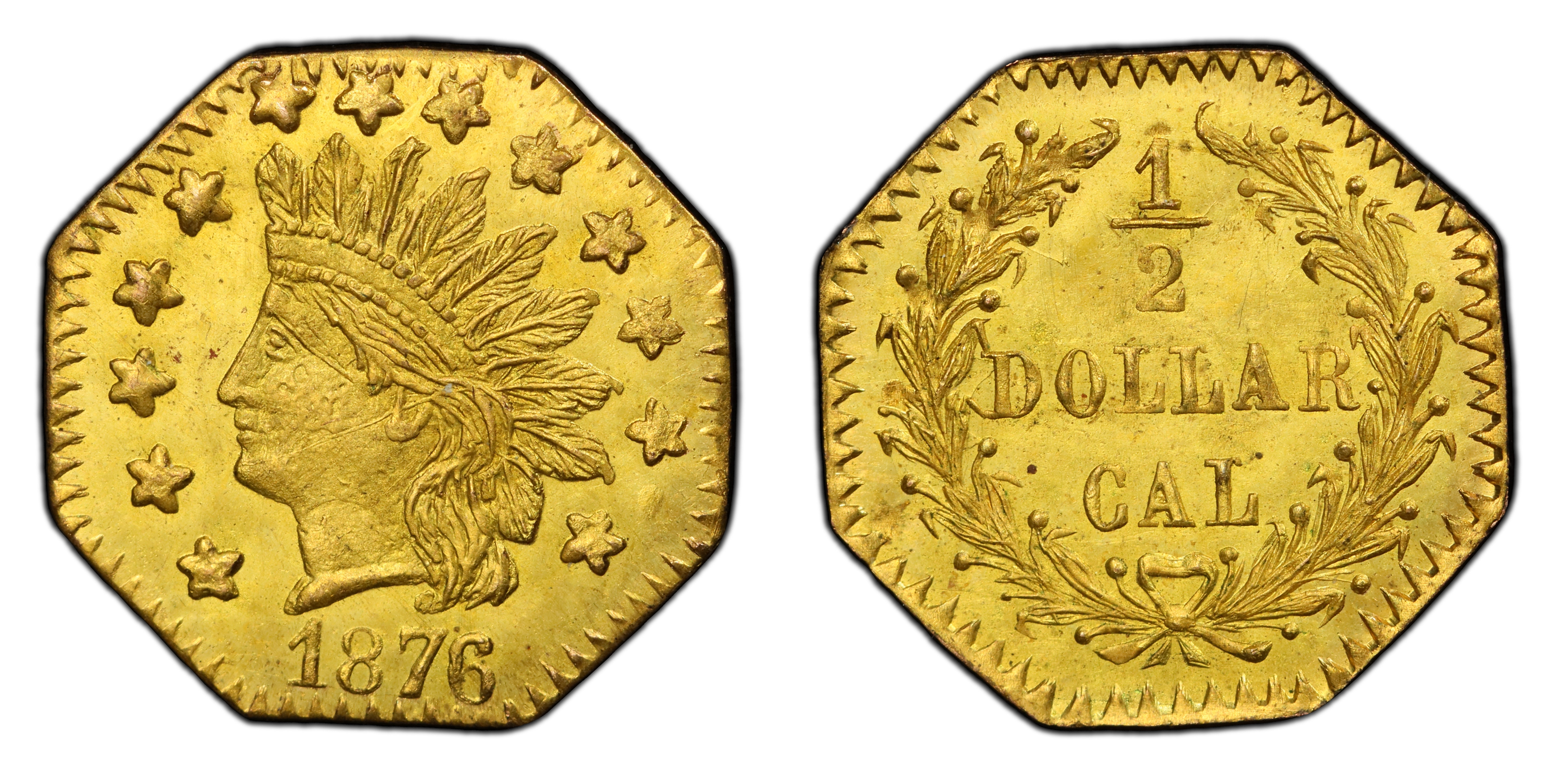
Obverse & Reverse
The 1876 BG-951 50 Cents is a fascinating artifact from the third and final period of California Fractional Gold production (1872-1882). Unlike their predecessors from Period One (1852-1857), which were struck out of genuine commercial necessity to alleviate a severe shortage of small denomination coinage in the Gold Rush economy, the pieces from this later era served a different purpose. By 1876, the United States Mint in San Francisco was in full operation, and the acute need for private coinage had long since passed. Furthermore, the Private Coinage Act of 1864 had explicitly outlawed the production of private gold coins intended for circulation. The BG-951 and its contemporaries were therefore created not as money, but as souvenirs and collectibles. Jewelers and novelty makers in San Francisco, capitalizing on the romantic allure of the Gold Rush, produced these small gold tokens for tourists and collectors. The date 1876 is particularly significant as it coincided with the Centennial Exposition in Philadelphia, a nationwide celebration that sparked immense interest in American history and memorabilia. These Period Three pieces were often backdated or bore contemporary dates, and were designed with popular motifs like the Indian Head, appealing to the Victorian fascination with the 'Wild West.' While not true circulating currency, they are an integral part of the territorial gold story, representing the commercial adaptation of a numismatic tradition. Their production continued until 1883 when the Secret Service finally cracked down on their manufacture, ending the era of private gold minting in California.
Associated EventPost-Gold Rush California / Centennial Year Interest
Reason For MintingPrimarily produced as souvenirs and collector's items capitalizing on the legacy of the California Gold Rush.
Minter HistoryThe specific minters of most Period Three California Fractional Gold pieces, including BG-951, are unknown. They were generally produced by various jewelers and metalworkers in San Francisco who had the skills and equipment for striking small gold pieces. These craftsmen operated on a small scale, and unlike the famous assayers of the 1850s, they did not typically mark their products with their names. Their business model shifted from filling a currency void to satisfying a burgeoning collectors' market.
Historical SignificanceThe BG-951 represents the final phase of the California Fractional Gold series, marking the transition from utilitarian private currency to commercial souvenir coinage. It is a tangible link to the romantic, post-Gold Rush perception of California and the nationwide historical interest sparked by the 1876 Centennial. These pieces are crucial for understanding the complete lifecycle of private gold coinage in the United States.
BG-951
Denomination50 Cents
Minting Period1876
Assayer/MinterUnknown Private Minter (likely a San Francisco jeweler)
Geographic OriginSan Francisco, California
Obverse DescriptionA stylized head of Liberty facing left, wearing a feathered headdress. The portrait is often referred to as an 'Indian Head'. Thirteen stars encircle the portrait within the octagonal border.
Obverse Inscription(No lettering, only stars)
Reverse DescriptionThe denomination '1/2' is enclosed within a wreath of leaves and berries. The date '1876' is positioned below the wreath.
Reverse Inscription1/2
CompositionGold
Stated Fineness Actual FinenessVaries, but generally around .500 to .800 fine gold, often less than the earlier period issues.
Weight0.25 grams
Diameter10.00 mm
EdgePlain
Unknown, but very small.
Survival EstimateFewer than 75 known
Rarity ScaleR-5+
This variety is popular for its classic Indian Head design, octagonal shape, and the historically significant 1876 date. As a Period Three issue, it is more affordable than many of the earlier, circulating fractionals, making it an accessible entry point into this fascinating field. The distinct design elements and defined rarity make it a desirable target for variety collectors.
Key VarietiesThe primary variety is the BG-951 regular business strike. No original proof strikings are known. While some Period Three pieces are found with prooflike surfaces, these are the result of polished dies and are not true proofs. There are no known major die varieties for BG-951, nor are there any sanctioned restrikes. Collectors should focus on acquiring a single high-quality example of the original issue.
Authentication TipsGenuine examples have a characteristic 'soft' look to the strike, even on high-grade pieces, that is different from modern replicas which are often sharply detailed but sterile. The stars on the obverse should be individually discernible, not blurry clumps. The numbers in the date should have the correct font and spacing for the period. Many underweight, gold-plated counterfeits exist; weight and specific gravity tests are crucial. Look for die polish lines and a natural, slightly worn look to the dies, which is inconsistent with modern fakes.
Shopping ConsiderationsA premium quality example for its grade will exhibit a sharp, well-centered strike, particularly on the details of the headdress and the wreath on the reverse. Seek out coins with bright, original luster and minimal distracting contact marks. The flat surfaces are susceptible to friction and hairlines, so a clean, unrubbed appearance commands a significant premium. Avoid examples that have been harshly cleaned, which strips the original patina and imparts a dull or unnaturally bright look. Problems like previous mounting for jewelry (tool marks on the edge or rim) or bending are sometimes seen and should be avoided unless the coin is extremely rare.
A coin's grade is its condition, rated on a 1-70 scale. For rare coins, this is the most critical factor in determining value, as a tiny difference in preservation can mean a huge difference in price.
Relevant Grade TypesOriginal issues were business strikes intended for the collector and souvenir market, not for heavy circulation. They are found in Circulated (1-58) grades, though this is less common, and more frequently in Mint State (MS, 60-70) grades. No true Proof (PR/PF) examples were struck during the original period of issue. Some Mint State examples are designated 'Prooflike' (PL) by grading services if the fields are particularly mirrored, a result of being struck from freshly polished dies, but these are a subset of business strikes and not a separate striking method.
Mint State CharacteristicsUncirculated examples of BG-951 often exhibit a vibrant, satiny luster. The strike can be inconsistent; many show some weakness on the high points of the feathers and the stars. A fully struck specimen is rare and highly desirable. Due to the small size and production methods, minor planchet flaws or die polish lines are common and should not be considered major detractors unless they are severe. High-grade examples often display a pleasing reddish or greenish-gold toning over lustrous surfaces.
Circulated Wear PatternsWear first appears on the highest points of the design: the cheek and the feathers of the headdress on the obverse. On the reverse, the bow and the high points of the leaves in the wreath will show the first signs of friction. On lower grade circulated examples (VF and below), the stars on the obverse will begin to merge and the finer details of the wreath will be lost.
Key Factors For ValueFor the BG-951, the key value drivers are surface preservation and strike quality. An example with clean, lustrous, and mark-free surfaces will always command a premium. A sharp strike that renders the details of the feathers and wreath clearly is highly prized. Eye appeal is paramount; coins with original, attractive coloration are preferred over those that are dull or have been cleaned. A CAC sticker for this issue is a significant value-add, confirming both the accuracy of the grade and the quality of the coin's surfaces and strike.
PCGS Price Guide
| Grade | Price | Population |
|---|---|---|
| 62 | $375.00 | 2 |
| 62+ | $450.00 | N/A |
| 63 | $550.00 | 12 |
| 63+ | $600.00 | N/A |
| 64 | $675.00 | 15 |
| 64+ | $800.00 | N/A |
| 65 | $1,250.00 | 8 |
| 65+ | $1,450.00 | N/A |
| 66 | $1,750.00 | N/A |