1869 G25C BG-828 (Regular Strike)
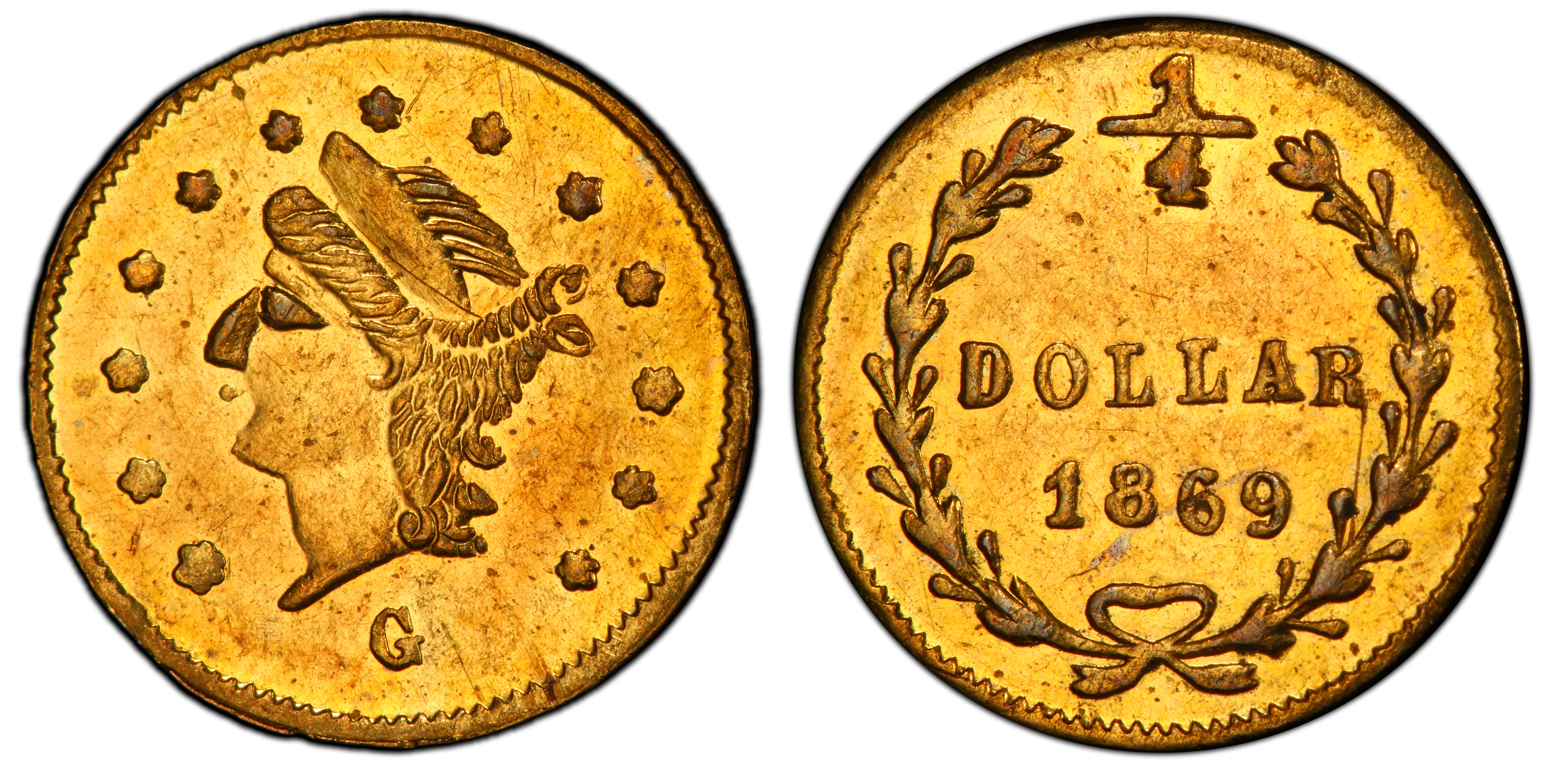
Obverse & Reverse
The 1869 BG-828 25 Cents is a quintessential example of a 'Period Two' California Fractional Gold piece. The story of these fascinating miniature gold coins begins with the California Gold Rush of 1848. The massive influx of population created an acute shortage of small denomination coinage for daily transactions; gold dust and nuggets were impractical for minor purchases. To fill this void, private jewelers and metallurgists began striking their own small gold coins in 25-cent, 50-cent, and one-dollar denominations starting in 1852. These initial 'Period One' (1852-1857) issues were often crude but served a genuine commercial need. By the time the San Francisco Mint was fully operational and producing sufficient federal coinage, the practical necessity for these private issues waned. However, a new market emerged. The tiny gold pieces had become popular as souvenirs and keepsakes, easily sent back East in a letter as a memento of the Golden State. This gave rise to the 'Period Two' issues (1859-1882), to which the BG-828 belongs. These coins were produced primarily for the souvenir trade rather than for circulation. Many were made by French jewelers in San Francisco, leading to the nickname 'jeweler's issues.' Artistically, they were often more refined than their Period One predecessors. The legal status of these pieces was complicated by the Coinage Act of 1864, which prohibited private coinage. However, the law was not strictly enforced against these small souvenir pieces until 1883. This particular piece, dated 1869, was struck during this era of lax enforcement. While they contained gold, their intrinsic value was typically less than their face value, a common trait for tokens not intended for serious monetary circulation. Today, the BG-828 and its contemporaries are not just numismatic curiosities but tangible links to the entrepreneurial spirit and cultural landscape of post-Gold Rush California.
Associated EventCalifornia Gold Rush Aftermath
Reason For MintingPrimarily created to satisfy the demand for souvenirs and keepsakes from California during a period of growing tourism and nostalgia for the Gold Rush.
Minter HistoryThe BG-828 variety is not attributed to a specific, known assayer or minter. It falls into the broad category of 'jeweler's issues' believed to have been produced by various, often anonymous, jewelers and artisans in San Francisco during the latter half of the 19th century. These minters operated outside of federal authority, creating dies and striking coins with rudimentary equipment, likely hand-operated screw presses or even the hammer method, which accounts for the variability in strike quality.
Historical SignificanceThe coin is significant as an artifact of 'Period Two' California Fractional Gold production, illustrating the transition of these pieces from necessity-based coinage to commercial souvenirs. It represents the persistent private production of gold tokens in a legal gray area and serves as a historical marker of California's unique economic and cultural identity in the decades following the initial Gold Rush.
BG-828
Denomination25 Cents
Minting Period1869
Assayer/MinterUnknown Private Minter
Geographic OriginSan Francisco, California
Obverse DescriptionA Liberty Head facing left, her hair tied in a bun. She is surrounded by 13 six-pointed stars, representing the original colonies. The date, 1869, is below the bust.
Obverse Inscription1869
Reverse DescriptionThe denomination '1/4' is enclosed within a wreath of leaves and berries, which is open at the top. The legend 'CALIFORNIA GOLD' appears above the wreath along the upper periphery. A small letter 'G' is sometimes noted below the wreath on coins from this period, though its presence and meaning can vary by die marriage.
Reverse InscriptionCALIFORNIA GOLD 1/4
CompositionGold
Stated Fineness Actual Fineness EdgePlain
Unknown
Survival Estimate76-200
Rarity ScaleR-4+
The 1869 BG-828 is sought after for its connection to the romanticized Gold Rush era and its status as an affordable entry point into the complex series of California Fractional Gold. Its classic Liberty Head design, miniature size, and tangible gold content make it a historically rich and visually appealing collectible.
Key VarietiesThe BG-828 itself is a specific die marriage cataloged in the Breen-Gillio reference. Within the broader California Fractional Gold series, key varieties include different shapes (round vs. octagonal) and designs (Liberty vs. Indian Head). No original Proofs of this issue were struck for collectors. However, some examples were struck with polished dies on polished planchets, resulting in deeply mirrored surfaces. These are designated as Prooflike (PL) or Deep Prooflike (DPL) by grading services and command significant premiums as they represent the highest level of minting quality for the issue.
Authentication TipsGenuine pieces are very small and thin. Counterfeits are often thicker, have a soapy or cast-like appearance, and may exhibit incorrect design details, such as mushy stars or lettering. A key diagnostic for genuine Period Two issues is the presence of a stated denomination (e.g., '1/4 DOLLAR' or '1/4'). Many modern replicas will say 'CALIFORNIA GOLD' but omit a denomination to circumvent counterfeiting laws, sometimes replacing it with 'CHARM'. Weak strikes are common on genuine examples, whereas modern fakes are often sharply and uniformly struck. Authentication by a reputable third-party grading service is highly recommended.
Shopping ConsiderationsWhen acquiring an 1869 BG-828, look for a sharp, well-centered strike, especially on Liberty's hair details and the numerals of the date. Surface quality is paramount; a premium quality example for its grade will possess clean, original surfaces free from distracting marks, cleaning, or evidence of having been mounted in jewelry. Luster is a key value driver; specimens with frosty mint luster or, ideally, Prooflike (PL/DPL) surfaces are highly desirable and scarce. Avoid examples with harsh cleanings, scratches, or tooling, which are common problems in this series. A coin with attractive, original reddish-gold toning is often preferred over a brightly dipped specimen.
A coin's grade is its condition, rated on a 1-70 scale. For rare coins, this is the most critical factor in determining value, as a tiny difference in preservation can mean a huge difference in price.
Relevant Grade TypesOriginal issues were business strikes intended for the souvenir market, and they are found in Circulated (1-58) and Mint State (MS, 60-70) grades. No true Proof (PR/PF) examples were struck during the original period of issue. However, as these were often made by jewelers, special care was sometimes taken, resulting in specimens with mirrored surfaces. These are designated 'Prooflike' (PL) or 'Deep Prooflike' (DPL) and are considered a special category of business strike, not separate Proof issues. These PL and DPL examples are highly sought after by specialists.
Mint State CharacteristicsAn uncirculated BG-828 is defined by the presence of original mint luster. Typical strike quality can be inconsistent; some examples are sharply detailed while others may show weakness on the high points of Liberty's hair or the leaves in the wreath. Due to the softness of the gold and rudimentary production methods, even high-grade Mint State examples will often exhibit minor planchet flaws or small, scattered contact marks. The quality of luster is a primary determinant of grade, ranging from soft and satiny to bright and reflective in prized Prooflike examples.
Circulated Wear PatternsWear first appears on the highest points of the design. On the obverse, this includes Liberty's cheek, the hair above the ear, and the eyebrow. On the reverse, the highest parts of the wreath's leaves and the numerals '1/4' will show the first signs of friction. In lower grades (VF and below), the individual hair strands will merge, the stars will become faint, and the finer details of the wreath will be worn smooth.
Key Factors For ValueThe primary drivers of value for an 1869 BG-828 are grade and surface quality. An uncirculated example is worth many times more than a circulated one. Within Mint State grades, the presence of a Prooflike (PL) or Deep Prooflike (DPL) designation commands a substantial premium. Original, uncleaned surfaces with attractive eye appeal are critical; specimens with a warm, reddish-gold patina are highly prized. A sharp strike that brings out the full detail of the dies adds to the value. Finally, certification by a top-tier grading service (PCGS or NGC) is essential for market acceptance, and a CAC sticker indicating premium quality for the grade will add a further premium.
PCGS Price Guide
| Grade | Price | Population |
|---|---|---|
| 45 | $185.00 | 1 |
| 45+ | $187.00 | N/A |
| 50 | $190.00 | N/A |
| 50+ | $192.00 | N/A |
| 53 | $195.00 | N/A |
| 53+ | $197.00 | N/A |
| 55 | $200.00 | 7 |
| 55+ | $205.00 | N/A |
| 58 | $210.00 | 9 |
| 58+ | $215.00 | N/A |
| 60 | $225.00 | 6 |
| 61 | $250.00 | 9 |
| 62 | $300.00 | 22 |
| 62+ | $325.00 | N/A |
| 63 | $475.00 | 13 |
| 63+ | $525.00 | N/A |
| 64 | $750.00 | 2 |
| 64+ | $900.00 | N/A |
| 65 | $1,500.00 | 1 |