1881 G25C BG-799O, PL (Regular Strike)
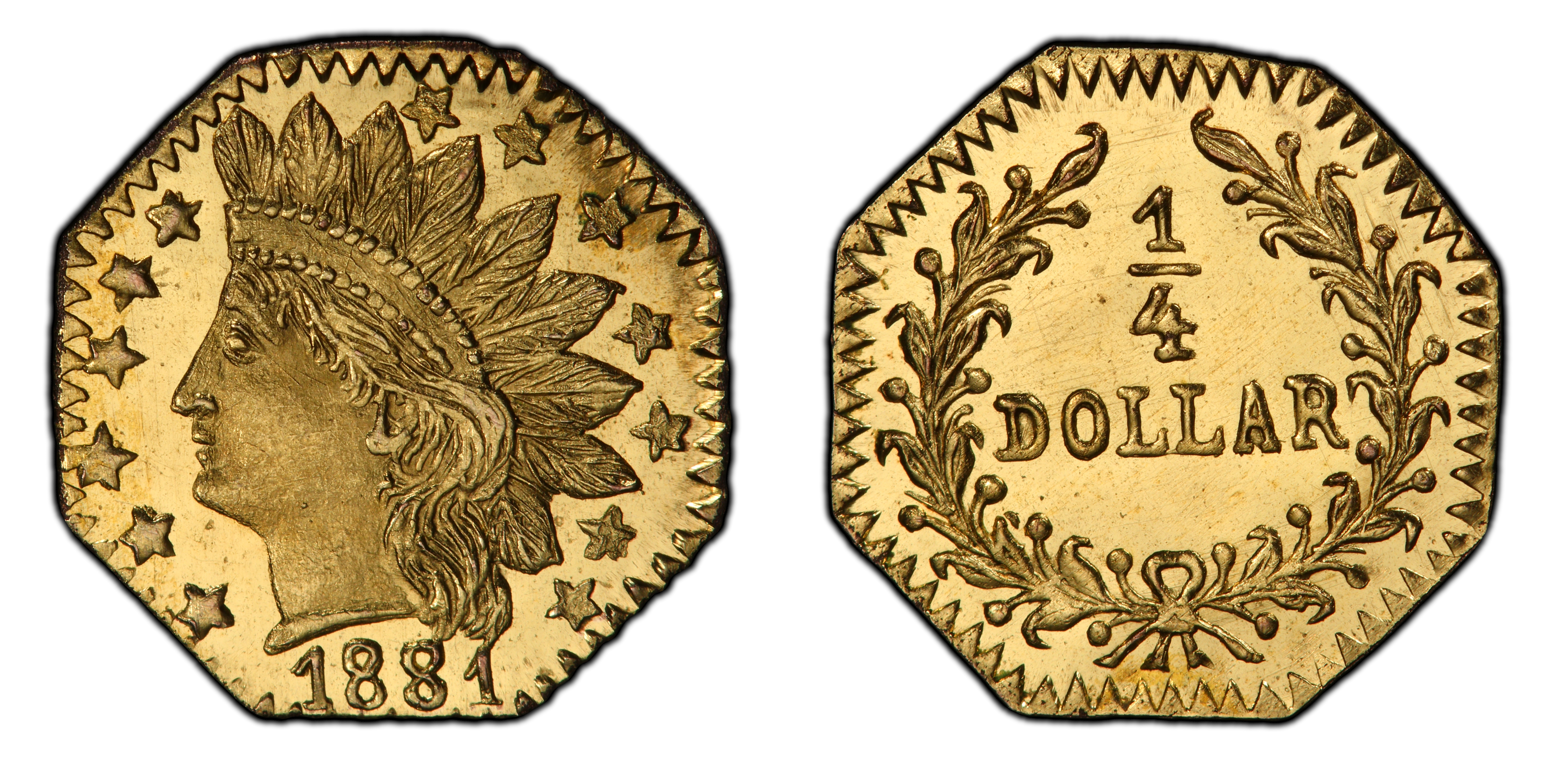
Obverse & Reverse
The 1881 G25C BG-799O represents the twilight era of a fascinating and uniquely American series of private coinage: California Fractional Gold. By the early 1880s, the initial, desperate need for small-denomination coinage that had characterized the Gold Rush was a distant memory. The United States Mint in San Francisco, operating since 1854, adequately supplied the region with federal silver and minor coinage. The continued production of these tiny, privately issued gold 'charms' or 'tokens' was therefore not driven by a circulating medium of exchange necessity, but by a burgeoning market for souvenirs and keepsakes. These pieces catered to tourists, locals, and merchants who desired a memento of the California Gold Rush, which by then had entered the realm of legend. The period from 1872 to 1882 is often termed the 'Souvenir Period' by numismatists. Assayers and jewelers, primarily in San Francisco, recognized the commercial potential in manufacturing these miniature gold coins. They were sold in sets, incorporated into jewelry, and marketed as novelties. The legal status of these pieces was perpetually ambiguous. While the U.S. government had cracked down on private coinage that appeared to imitate federal designs in the 1860s, the souvenir pieces of the 1870s and 1880s often used distinct motifs like the Indian Head or Washington portraits to avoid direct conflict. However, the Act of February 16, 1883, effectively ended the production of all such private issues by making it illegal to mint coins from gold or silver. The BG-799O, struck just two years before this prohibition, is a direct product of this souvenir trade. Its existence speaks to the romanticism that had already enveloped the Gold Rush era and the clever entrepreneurship of jewelers who capitalized on this sentiment. These later-date fractionals are often found in higher grades than their predecessors from the 1850s, as they were purchased as keepsakes and not subjected to the rigors of daily commerce.
Associated EventCalifornia Gold Rush (Souvenir Period)
Reason For MintingPrimarily created to be sold as souvenirs and keepsakes for the tourist and jewelry trade, not for general circulation.
Minter HistoryWhile not definitively signed, coins of this style and period are widely attributed to Herman J. Brand of San Francisco. Brand was a prominent jeweler and one of the most prolific manufacturers of California fractional gold during the 'souvenir period' (1872-1882). He, along with other contemporaries like Robert B. Gray, created a wide variety of these small-denomination pieces, often using standardized dies for different denominations. Their business was focused on the novelty and jewelry market, capitalizing on the romantic allure of the Gold Rush era long after the initial need for such coinage had passed.
Historical SignificanceRepresents the final phase of private gold coining in California, illustrating the transition from a functional medium of exchange to a commercial souvenir industry. It is a tangible link to the romanticized memory of the Gold Rush and a product of the legal gray area that existed for private minters before federal laws definitively prohibited their activities in 1883.
N/A
Denomination25 Cents
Minting Period1881
Assayer/MinterHerman J. Brand (attributable)
Geographic OriginSan Francisco, California
Obverse DescriptionA female head facing left, often described as an 'Indian Princess' or a representation of Liberty, wearing a feathered headdress. The headdress is adorned with the word 'CALIFORNIA'. The portrait is surrounded by 13 stars, representing the original colonies.
Obverse InscriptionCALIFORNIA
Reverse DescriptionThe denomination '1/4' is positioned in the center, encircled by a wreath of leaves and berries. The date '1881' is located below the wreath. The words 'GOLD' and 'CHARM' are typically found on these souvenir pieces, though their presence and placement can vary. For BG-799O, the denomination is central.
Reverse Inscription1/4
CompositionGold
Stated Fineness Actual FinenessVaries, typically between .500 and .750 fine (12 to 18 karats).
Weight0.25 grams
Diameter9.50 mm
EdgePlain
Unknown
Survival Estimate250-400
Rarity ScaleR-4
This coin appeals to collectors for its connection to the final chapter of the California Fractional Gold story, its attractive Indian Head design, and its status as a late-date, high-grade souvenir piece. The octagonal shape is also a classic and desirable feature of the series. The 'PL' (Prooflike) designation indicates a specimen with reflective fields, adding to its visual appeal.
Key VarietiesThe Breen-Gillio (BG) catalog is the definitive reference for this series. BG-799O is a specific die marriage of the 1881 octagonal 25 Cents. Within the broader category, varieties exist based on die states, positioning of the date and legends, and specific design elements. The 'O' in BG-799O signifies its octagonal shape. No official restrikes or patterns are known for this specific variety, as it was part of a commercial, not governmental, venture.
Authentication TipsAuthenticity is a major concern with California Fractional Gold. Genuine pieces like BG-799O have sharp, well-defined details, especially in the feathers and stars. The numerals of the date should match known genuine examples. Counterfeits are often soapy, have incorrect weights and diameters, or are made of gold-plated brass. A dull or incorrect color can also be an indicator. Comparison with high-resolution images of certified examples is crucial.
Shopping ConsiderationsA premium quality example of BG-799O will exhibit sharp striking details, particularly on the word 'CALIFORNIA' in the headdress and the fine lines of the wreath. For a 'PL' specimen, look for deeply mirrored fields that contrast with frosted devices (the portrait and wreath). The surfaces should be clean and free of distracting marks, although tiny planchet flaws are common for the series. Avoid examples that have been harshly cleaned, which will show as hairlines and impaired luster, or those that show evidence of being mounted in jewelry, such as solder marks or rim damage.
A coin's grade is its condition, rated on a 1-70 scale. For rare coins, this is the most critical factor in determining value, as a tiny difference in preservation can mean a huge difference in price.
Relevant Grade TypesOriginal issues were business strikes, though intended for the souvenir trade rather than circulation. They are found in both Circulated (1-58) and, more commonly, Mint State (MS, 60-70) grades. The 'PL' (Prooflike) designation is a modifier for a business strike (MS) coin that exhibits mirror-like fields, similar to a Proof coin, but was struck as a regular issue. True Proof (PR/PF) strikings are not known for this issue; the PL designation is the highest level of manufacturing quality for this variety.
Mint State CharacteristicsA Mint State BG-799O is defined by the quality of its luster. A typical MS example will have satiny luster, while a Prooflike (PL) example will have reflective, mirror-like fields. The strike can be variable; look for sharpness in the feathers of the headdress and the bow of the wreath. Due to the manufacturing process, it is common to see minor planchet irregularities or die polish lines, which should not be confused with post-strike damage. Bag marks, while possible, are less common than on circulating coinage as these were often handled more carefully.
Circulated Wear PatternsAlthough most examples are uncirculated, any wear would first appear on the highest points: the cheek and the upper feathers of the headdress on the obverse, and the bow and high points of the leaves on the reverse. In lower grades, the stars and the word 'CALIFORNIA' would begin to lose their definition.
Key Factors For ValueThe primary value driver for this coin is its grade and surface quality. A high-grade (e.g., MS-64 or higher) specimen will command a significant premium. The Prooflike (PL) designation adds another substantial premium due to its rarity and enhanced eye appeal. Original, uncleaned surfaces with deep reflectivity are highly prized. Strike completeness is also key; a coin with a full, sharp strike on all design elements is more desirable than a softly struck example. Certification by a major grading service (PCGS or NGC) is essential for authenticity and grade verification.
PCGS Price Guide
| Grade | Price | Population |
|---|---|---|
| 64 | $575.00 | 1 |
| 64+ | $725.00 | N/A |
| 65 | $1,000.00 | 1 |
| 65+ | $1,250.00 | N/A |
| 66 | $1,750.00 | 2 |
| 66+ | $2,000.00 | N/A |
| 67 | $3,250.00 | 2 |