1871 G25C BG-770, PL (Regular Strike)
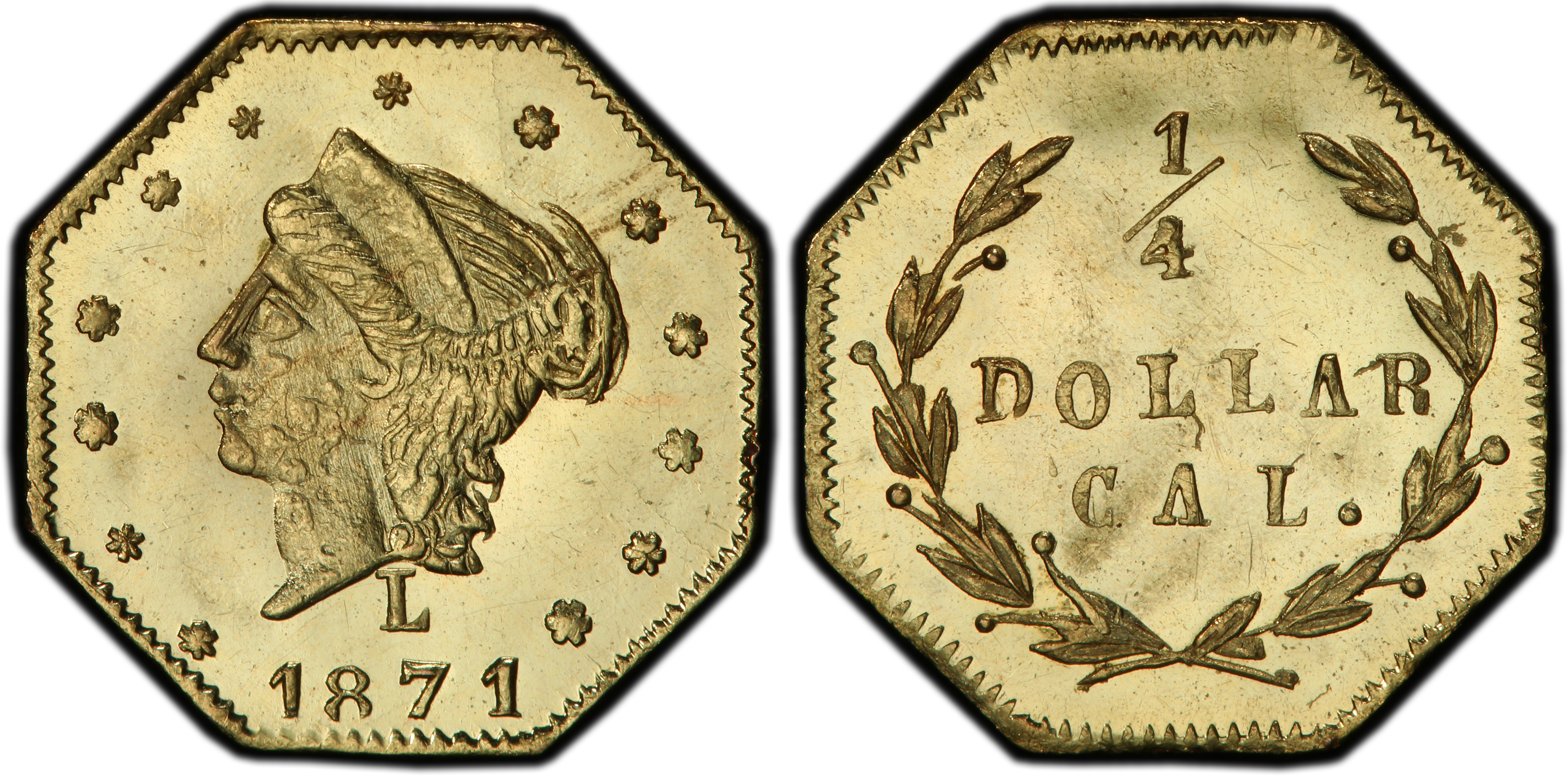
Obverse & Reverse
The 1871 Octagonal 25 Cents, cataloged as Breen-Gillio 770, is a product of the second period of California Fractional Gold production (1858-1882). Unlike the Period One issues (1852-1857) which were struck to alleviate a severe shortage of small change during the initial chaos of the Gold Rush, these later pieces were created primarily as souvenirs and keepsakes. By the 1870s, the United States Mint in San Francisco was in full operation, supplying ample federal coinage for the region's commerce. The necessity that birthed the original fractional gold was gone, but the romance of the Gold Rush and the allure of tiny gold coins persisted. Jewelers and private minters in San Francisco capitalized on this nostalgia, producing a wide variety of beautifully crafted, back-dated, and contemporary small-denomination gold pieces for tourists and locals alike. These items were not intended to, and largely did not, serve as circulating currency in the traditional sense. The Coinage Act of April 22, 1864, had made the private minting of coinage illegal, but the law was not strictly enforced by the Secret Service against these small souvenir pieces until 1883. This legal gray area allowed for their continued production. The BG-770, specifically, was manufactured by the Levison Brothers, prominent San Francisco jewelers who operated the California Jewelry Company. Their pieces are identifiable by the small 'L' stamped on the obverse, a feature of this variety. These coins represent a fascinating transition from utilitarian necessity to commercial nostalgia, capturing the enduring legacy of the California Gold Rush in miniature form. Their survival in high grades, often with prooflike surfaces, attests to their status as cherished mementos rather than workhorse coins of daily trade.
Associated EventPost-Gold Rush California Commerce
Reason For MintingPrimarily struck as souvenirs for the tourist trade and local collectors, not for general circulation, during a period when the novelty of the Gold Rush was still a strong cultural force.
Minter HistoryThe Levison Brothers, Herman and Louis, were prominent jewelers and watchmakers who founded their firm in San Francisco in 1859. By 1871, they had moved into a large, well-equipped building at 134 Sutter Street, operating as the California Jewelry Company. They were manufacturers and importers of fine jewelry, watches, diamonds, and silverware. Their production of fractional gold pieces in 1871, marked with an 'L', was a natural extension of their jewelry business, catering to the significant market for Gold Rush souvenirs.
Historical SignificanceThis coin is significant as an artifact of 'Period Two' of California's private gold coining era, illustrating the shift from creating coinage of necessity to producing souvenir tokens that capitalized on the romantic image of the Gold Rush, well after the initial need for such items had passed.
N/A
DenominationG25C
Minting Period1871
Assayer/MinterLevison Brothers
Geographic OriginSan Francisco, California
Obverse DescriptionA Liberty Head facing left, her hair tied in a bun, surrounded by 13 six-pointed stars. The date '1871' is below the bust, and a small but distinct 'L' (for Levison) is positioned above the date, between the truncation of the neck and the final star on the right.
Obverse Inscription1871 L
Reverse DescriptionThe denomination '1/4' is centered within a wreath composed of two olive branches. The legend 'CALIFORNIA GOLD' encircles the wreath, separated at the bottom by a small ornament. The denomination is sometimes stated as '25 CENTS' on other varieties, but this one features the fraction.
Reverse InscriptionCALIFORNIA GOLD 1/4
CompositionGold
Stated Fineness Actual FinenessVaries, but generally lower than federal coinage, consistent with jewelry-grade gold of the era.
Weight0.25 grams
Diameter10.00 mm
EdgePlain
Unknown
Survival Estimate76-100
Rarity ScaleHigh R-4
The BG-770 is sought after for its specific attribution to a known, high-quality San Francisco jeweler (Levison Brothers), its octagonal shape which is emblematic of the series, and its status as a representative 'Period Two' issue. The presence of the 'L' mintmark provides a direct link to its manufacturer, adding historical and numismatic interest. Prooflike examples are particularly desirable.
Key VarietiesThe primary variety is the regular business strike, which often comes with prooflike (PL) surfaces due to the minting process and its preservation as a souvenir. There are no known major sub-varieties, patterns, or official restrikes for the BG-770 specifically. The key distinction for collectors is the quality of the strike and the degree of prooflike reflectivity.
Authentication TipsGenuine pieces will have the word 'GOLD' and a denomination (e.g., '1/4'). Replicas often have a bear on the reverse, which is a certain sign of a non-genuine piece. The strike on genuine fractionals can sometimes appear weak or uneven due to the thinness of the planchets, a characteristic often absent in modern fakes. The 'L' mintmark should be carefully examined and compared to known genuine examples, as its style and placement are key diagnostic points. Any piece that seems too perfect or has mushy details should be treated with suspicion and authenticated by a reputable third-party grading service.
Shopping ConsiderationsA premium quality example of BG-770 will exhibit a sharp, well-defined strike, particularly on the stars, Liberty's hair, and the details of the wreath. Look for examples with deep prooflike or DMPL surfaces, as these command a significant premium. Original, uncleaned surfaces with a hint of reddish-gold toning are highly prized. Common problems include cleaning, which will manifest as hairlines under magnification, and minor planchet flaws or laminations, which are sometimes seen. Check for any evidence of having been mounted in jewelry, such as rim damage or solder marks, although this is less common for pieces that have been graded.
A coin's grade is its condition, rated on a 1-70 scale. For rare coins, this is the most critical factor in determining value, as a tiny difference in preservation can mean a huge difference in price.
Relevant Grade TypesOriginal period issues were business strikes intended as souvenirs, not for circulation. They are found in both Circulated (AU-58 and below) and, more commonly, Mint State (MS, 60-70) grades. The 'PL' (Prooflike) designation is frequently assigned to this issue and is a key value driver. There were no true Proofs struck during the original period of issue, and there are no known later-date collector restrikes for this specific BG number.
Mint State CharacteristicsUncirculated examples of BG-770 are defined by their luster, which is typically very flashy and reflective (prooflike). The quality of the strike can vary; centrally struck examples with full details on Liberty's hair and the wreath are scarce and desirable. Due to the manufacturing process, small, innate planchet flaws or striations are not uncommon and should be noted. Contact marks are the primary factor separating lower MS grades from higher ones; these are often seen in the open fields.
Circulated Wear PatternsAlthough most examples are uncirculated, wear on a circulated piece would first appear on the highest points: Liberty's cheekbone and the hair above her ear. On the reverse, the high points of the wreath's leaves and the fraction would be the first areas to show friction and lose detail.
Key Factors For ValueThe most significant value driver for BG-770 is the surface quality, specifically the depth and clarity of its prooflike fields. A coin designated 'DMPL' (Deep Mirror Prooflike) will command a substantial premium over a standard MS example. Sharpness of strike is also critical. Eye appeal is paramount; coins with clean, reflective surfaces and attractive original color are sought after. A CAC sticker for this issue indicates premium quality for the grade and will add a significant premium to its value.
PCGS Price Guide
| Grade | Price | Population |
|---|---|---|
| 62 | N/A | N/A |
| 64 | $1,250.00 | 2 |
| 64+ | $1,550.00 | N/A |
| 65 | $2,250.00 | 1 |