1871 G50C BG-911 (Regular Strike)
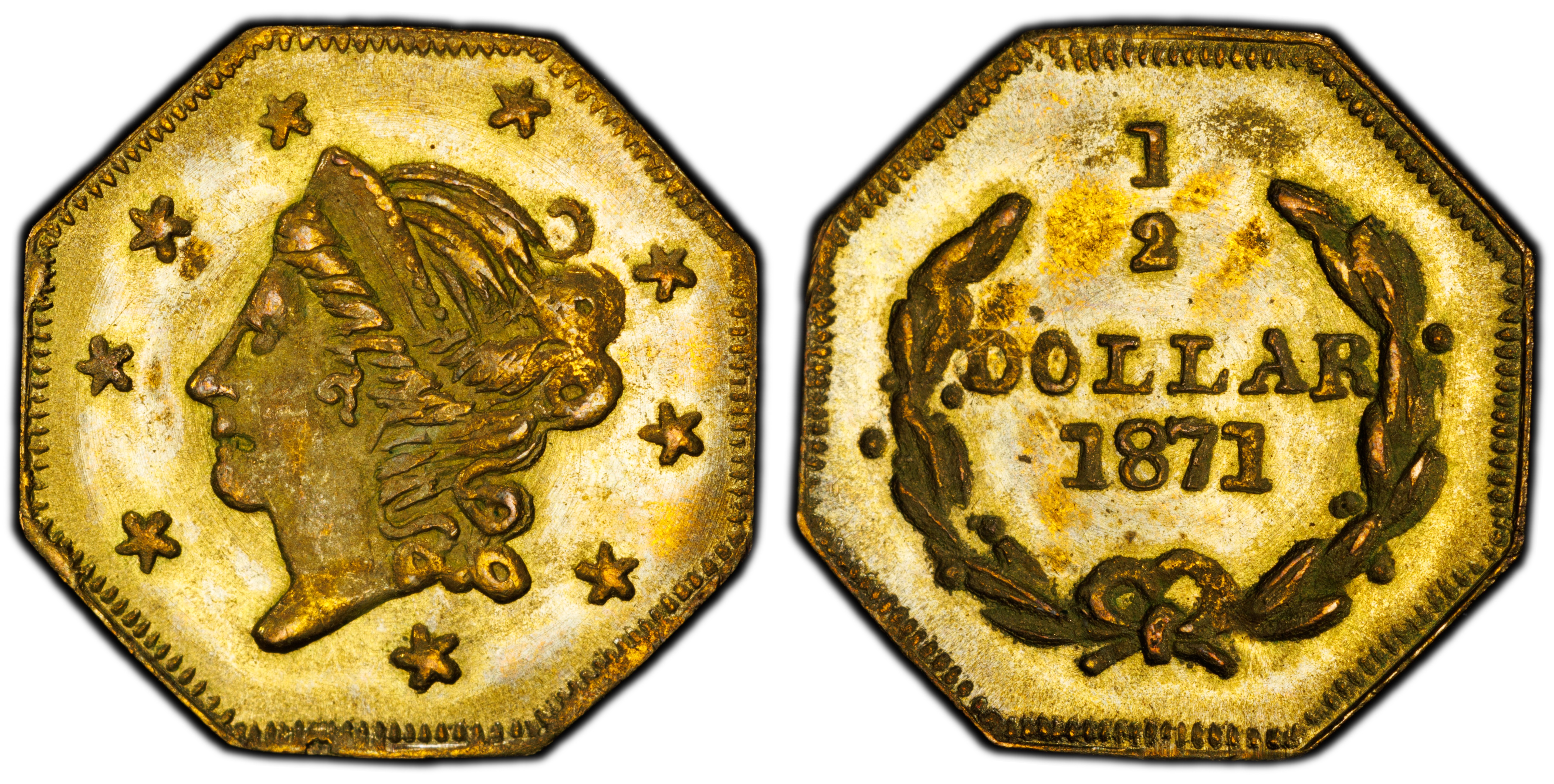
Obverse & Reverse
The 1871 G50C BG-911 is a product of a fascinating and often misunderstood era of American numismatics, the period of California Fractional Gold. Following the initial frenzy of the Gold Rush, California's economy boomed, but it was plagued by a chronic shortage of small-denomination coinage. The smallest official U.S. coin west of the Rocky Mountains was often the silver dime, making everyday transactions for items less than ten cents incredibly difficult. This created a vacuum that private minters eagerly filled, beginning in 1852. These miniature gold tokens, denominated from 25 cents to one dollar, served as a practical, albeit unofficial, form of currency. The production of these pieces waxed and waned with federal legislation. The Act of April 22, 1864, made the private issuance of gold coins illegal, but jewelers and souvenir makers soon found a loophole. By removing the word 'DOLLAR' or 'CENTS' (or abbreviating them to 'DOL.' or 'CTS.'), they could argue the items were mere tokens or charms, not currency, thus circumventing the law. The Period Two pieces, struck from 1859 to 1882, are characterized by this creative compliance. The 1871 BG-911 variety falls squarely in this later period. It was not intended to be a robust circulating coin in the same vein as federal issues, but rather a small-change facilitator and a popular souvenir for locals and tourists alike, a tangible piece of the California gold phenomenon. These pieces were often carried as pocket pieces or incorporated into jewelry, which accounts for the high number of cleaned, damaged, or impaired survivors. Their diminutive size made them easy to lose, contributing to their present-day rarity.
Associated EventPost-California Gold Rush Economic Expansion
Reason For MintingTo alleviate a severe shortage of small-denomination coinage for everyday commerce in California.
Minter HistoryThe specific minter of the BG-911 variety, like many California Fractional Gold pieces, is not definitively known. However, based on die characteristics and diagnostics, numismatic scholarship, primarily the work of Robert D. Leonard Jr. and the Breen-Gill catalog, attributes the piece to the workshop of either Herman J. Brand or Robert B. Gray & Co. Both were prominent San Francisco jewelers and engravers who are known to have produced a significant quantity and variety of these small gold tokens during this period. They operated in the gray area of the law, producing these items as both quasi-currency and souvenir jewelry.
Historical SignificanceCalifornia Fractional Gold coins are a direct physical legacy of the economic conditions in the American West after the Gold Rush. They represent a local, private-enterprise solution to a government failure in providing adequate coinage. The BG-911 is a classic example of the Period Two issues, showcasing the design motifs and legal workarounds that jewelers used to continue production after the federal crackdown of 1864, making it a tangible link to a unique chapter in U.S. monetary history.
N/A
Denomination50 Cents (Half Dollar)
Minting Period1871
Assayer/MinterAttributed to Herman J. Brand or Robert B. Gray & Co.
Geographic OriginSan Francisco, California
Obverse DescriptionA female head, often referred to as an Indian Head or Liberty Head, faces left. The portrait is adorned with a feathered headdress. The field is surrounded by 13 six-pointed stars, representing the original colonies.
Obverse InscriptionNo textual inscription; design consists of the head and 13 stars.
Reverse DescriptionThe denomination '1/2' is centrally located within a wreath composed of two laurel branches tied with a bow at the bottom. Below the bow is the date '1871'. The legend 'GOLD' is inscribed above the wreath, and the abbreviation 'CAL.' appears below it.
Reverse InscriptionGOLD / 1/2 / CAL. / 1871
CompositionGold
Stated FinenessNot explicitly stated on the coin.
Actual FinenessTypically ranges from .500 to .800 fine, often inconsistent.
Weight0.25 grams
Diameter9.90 mm
EdgePlain
Unknown, but likely several thousand.
Survival Estimate200-300
Rarity ScaleR-5
The BG-911 is popular due to its classic 'Indian Head' design, affordability relative to earlier issues, and its status as a representative example of Period Two California Fractional Gold. Its historical connection to the post-Gold Rush era and the Wild West adds significant allure.
Key VarietiesThe primary variety is the Regular Strike intended for circulation and souvenir sales. No known special collector issues, such as proofs or patterns, were made during the period of issue for this specific BG number. Modern copies and replicas exist, but there are no known contemporary restrikes or special strikings associated with the original dies.
Authentication TipsGenuine BG-911 examples exhibit sharp, well-defined details for the grade. The stars on the obverse should be distinct. On the reverse, the numerals and letters should be clear and properly formed. Counterfeits often have a mushy or soapy appearance, incorrect weight, or a brassy color. The 'CAL.' on genuine pieces is well-formed. Diagnostics for this die pairing include the specific positioning of the date relative to the bow and the unique shapes of the wreath's leaves. Use of a high-magnification loupe is essential to spot casting bubbles or tooling marks often found on fakes.
Shopping ConsiderationsA premium quality example for its grade will possess a sharp strike, particularly on the feathers of the headdress and the details of the wreath. Look for pieces with smooth, lustrous surfaces and minimal distracting contact marks; these are challenging to find as the coins are small and soft. Many surviving examples have been harshly cleaned or used in jewelry, exhibiting scratches, rim dings, or evidence of solder. A coin with original, unmolested surfaces, often showing a lovely reddish-gold patina, commands a significant premium. Avoid examples with planchet flaws, porosity, or signs of tooling in the fields.
A coin's grade is its condition, rated on a 1-70 scale. For rare coins, this is the most critical factor in determining value, as a tiny difference in preservation can mean a huge difference in price.
Relevant Grade TypesAll original 1871 BG-911 pieces were struck as business strikes, intended for circulation or sale as souvenirs. They are found in Circulated grades (AG-3 to AU-58) and Mint State grades (MS-60 to MS-70). No Proof (PR/PF) examples were struck during the original period of issue, and no later-date Proof restrikes from the original dies are known to exist. Any piece described as a 'Proof' is likely a modern copy or has been misattributed.
Mint State CharacteristicsUncirculated examples of BG-911 often display a soft, satiny luster rather than a hard, frosty one. The strike can be variable; a well-struck piece will show full detail in the feathers and the central knot of the bow on the reverse. Due to the softness of the low-karat gold and the small size, even high-grade Mint State examples will typically show some minor contact marks or 'tick' marks from handling and storage over the past 150+ years. The fields should be clean and free of the granularity associated with counterfeits.
Circulated Wear PatternsWear first appears on the highest points of the design. On the obverse, this includes the cheek, the ear, and the upper feathers of the headdress. On the reverse, the high points of the wreath leaves and the bow will show the first evidence of friction. In lower grades (VG and below), the stars on the obverse will begin to merge with the fields, and the date and legends on the reverse will become faint.
Key Factors For ValueThe primary value driver is surface preservation. An example with original, lustrous 'skin' is far more valuable than a cleaned, brighter-looking piece of the same grade. Strike quality is second; a sharply struck coin with full details is always preferred. Eye appeal is crucial; coins with a pleasing, even color and minimal distracting marks will always sell for a premium. For this series, a sticker from CAC (Certified Acceptance Corporation) indicating a premium quality coin for the grade can add a significant percentage to its value, as it confirms the originality of the surfaces.
PCGS Price Guide
| Grade | Price | Population |
|---|---|---|
| 53 | $220.00 | 1 |
| 53+ | $225.00 | N/A |
| 55 | $230.00 | 3 |
| 55+ | $235.00 | N/A |
| 58 | $240.00 | 3 |
| 58+ | $250.00 | N/A |
| 60 | $275.00 | 1 |
| 61 | $300.00 | N/A |
| 62 | $325.00 | 8 |
| 62+ | $345.00 | N/A |
| 63 | $400.00 | 22 |
| 63+ | $425.00 | N/A |
| 64 | $460.00 | 19 |
| 64+ | $550.00 | 1 |
| 65 | $750.00 | 13 |
| 65+ | $900.00 | N/A |
| 66 | $1,150.00 | 5 |
| 66+ | $1,675.00 | 2 |
| 67 | $2,250.00 | N/A |